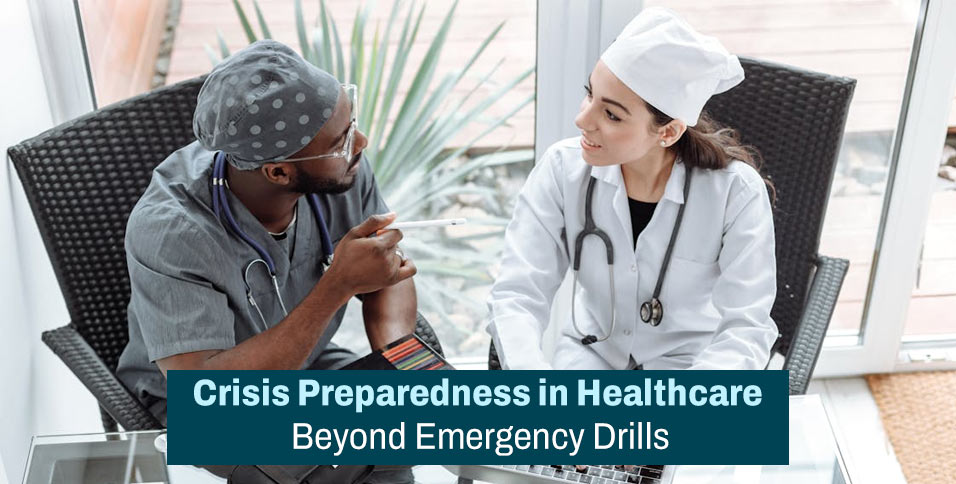
Crisis preparedness in healthcare is often associated with visible rehearsals: evacuation drills, disaster simulations, and annual compliance exercises that demonstrate procedural readiness. While those activities serve an important function, they rarely capture the complexity of modern healthcare disruptions. A hospital today operates within an interconnected system of digital records, supply logistics, staffing models, and infrastructure dependencies that extend far beyond physical walls. When disruption occurs, it may arrive through a cyber intrusion, a cascading equipment failure, a sudden regional patient surge, or a breakdown in utilities that compromises clinical operations within minutes. In such conditions, preparedness cannot rely solely on rehearsed scenarios. It must be embedded into governance, staffing design, communication structures, and institutional culture.
True readiness requires structural depth. It demands that leadership understand operational realities at the bedside, that communication systems remain reliable under pressure, and that supply chains and digital platforms possess redundancy rather than fragility.
Embedding Frontline Clinical Leadership into Crisis Planning
Strategic crisis planning loses credibility when it develops without direct input from those who manage patient care minute by minute. Nurses, charge nurses, and clinical coordinators possess granular knowledge of workflow constraints, documentation pressures, and patient acuity fluctuations that are not visible in executive briefings. Their daily responsibilities require rapid prioritization, delegation, and communication across interdisciplinary teams, making their perspective indispensable when constructing response frameworks. When frontline leadership participates in crisis design, planning documents are shaped by lived operational experience rather than theoretical modeling alone.
Advanced education further strengthens this integration. Many experienced nurses pursue expanded leadership preparation through an online RN-MSN degree, which allows them to study healthcare systems management, policy analysis, and organizational leadership while remaining active in clinical environments. The online format supports continuity in patient care roles, preventing separation between academic development and practical responsibility. This combination of bedside expertise and graduate-level systems training produces leaders capable of translating policy into operational action.
Scenario-Based Planning for System Failures
Healthcare preparedness often concentrates on externally driven emergencies, yet internal system breakdowns can destabilize operations just as rapidly. Electronic health record outages, ransomware attacks, pharmacy automation interruptions, or extended power disruptions have the potential to paralyze care delivery even in the absence of mass casualty events. Scenario-based planning for these failures requires organizations to examine their technological dependencies in detail. It compels leadership to ask how medication administration proceeds without barcode scanning, how laboratory results circulate without network connectivity, and how patient transfers occur if centralized scheduling systems fail.
Walking through layered failure scenarios exposes fragile intersections between departments. It reveals how tightly clinical workflows depend on uninterrupted data exchange and automated processes. Through structured tabletop exercises and cross-department modeling, institutions can identify manual backup procedures, alternative documentation pathways, and contingency supply arrangements before disruption forces improvisation.
Building Real-Time Communication Hierarchies
Communication breakdown remains one of the most common contributors to crisis escalation within healthcare settings. In high-pressure environments, information circulates rapidly, though not always accurately, and conflicting directives can create hesitation or duplication of effort. A clearly articulated communication hierarchy establishes who initiates alerts, who validates emerging information, and how instructions move across departments.
Robust communication structures incorporate redundancy to account for digital or infrastructural compromise. Designated command centers, secure messaging platforms, and predefined reporting chains form an organized network through which authoritative updates can flow. Staff members must understand not only where information originates but also how verification occurs before dissemination. Establishing this structure prior to crisis conditions creates stability during moments when clarity is most fragile.
Strengthening Surge Capacity Models
Patient surges test the integrity of every operational assumption within a healthcare facility. Bed counts listed in strategic plans mean little without corresponding staffing coverage, equipment availability, and spatial adaptability. Surge capacity modeling must account for how additional treatment areas are activated, how staff are redeployed without compromising core services, and how essential equipment is redistributed across units. This process involves evaluating the feasibility of converting recovery suites into temporary inpatient areas, expanding triage capacity, and coordinating with regional partners for load distribution.
Such modeling requires detailed analysis rather than aspirational projections. It demands consideration of oxygen supply limits, ventilator availability, monitoring equipment allocation, and credential flexibility among clinicians. Cross-training initiatives and mutual aid agreements contribute to functional scalability during volume escalation.
Integrating Behavioral Health Response into Crisis Plans
Operational continuity cannot be sustained without attention to the psychological impact of crisis conditions on healthcare professionals. Extended exposure to high-acuity patients, ethical strain, and prolonged uncertainty influences clinical judgment and interpersonal dynamics. Crisis preparedness that neglects behavioral health considerations leaves a critical dimension unaddressed. Structured support systems, including peer response teams, facilitated debriefing sessions, and accessible counseling resources, provide mechanisms for processing intense clinical experiences within a professional framework.
Leadership presence during disruptive periods plays a significant role in reinforcing stability and cohesion. Transparent communication, acknowledgment of strain, and visible administrative support contribute to a sense of institutional solidarity. Incorporating behavioral health response into crisis design recognizes that resilience involves both operational durability and human capacity.
Creating Redundant Supply Chains
Modern healthcare delivery depends on highly coordinated supply networks that extend far beyond hospital loading docks. Medications, sterile equipment, personal protective supplies, intravenous fluids, and specialized devices often originate from global manufacturing channels that are vulnerable to transportation interruptions, geopolitical instability, and production bottlenecks. Crisis preparedness that relies on single-source vendors or minimal inventory buffers exposes institutions to avoidable risk. Redundant supply planning requires diversification of vendors, contractual flexibility, and strategic stock allocation that accounts for both regional and international disruption scenarios.
Effective redundancy planning includes mapping critical supply categories, identifying alternate procurement pathways, and analyzing consumption rates under surge conditions. Inventory management systems must provide visibility into usage patterns and trigger early procurement action when stock levels decline toward predefined thresholds.
Protecting Critical Infrastructure within Facilities
Behind the visible patient care environment lies a network of physical systems that sustain life and operational functionality. Backup generators, oxygen distribution lines, water supply connections, HVAC systems, and sterilization equipment form the structural backbone of healthcare facilities. When these systems falter, clinical services can collapse regardless of staffing or leadership preparedness. Crisis readiness, therefore, demands meticulous maintenance schedules, routine stress testing of backup systems, and contingency planning for extended outages.
Generator capacity must be evaluated against full operational demand rather than partial load assumptions. Oxygen reserves require monitoring for both quantity and delivery integrity under surge conditions. Water supply contingencies should account for potential municipal disruptions. Facilities management teams play an essential role in crisis architecture, collaborating with clinical leadership to align infrastructure protection with patient care priorities.
Crisis preparedness in healthcare encompasses frontline clinical leadership, realistic system failure modeling, disciplined communication hierarchies, and detailed surge capacity planning. In an environment where disruption can originate from clinical, technological, or infrastructural sources, resilience is achieved through structural depth and strategic foresight embedded within daily operations.