Mirror Review
June 06, 2026
Elon Musk, CEO of SpaceX, is taking the company public in 2026.
SpaceX stayed private for over 20 years despite becoming one of the most valuable startups in the world. And now, SpaceX has reached a stage where its financial stability, expanding operations, and long-term roadmap make a public listing more practical.
But what took Elon Musk so long to reach the decision to make SpaceX public?
Below is the historical context and current situation behind the SpaceX IPO to help you understand the decision.
Why SpaceX Stayed Private for So Long
1. Avoiding short-term pressure from public markets
Musk often said SpaceX needed complete freedom to work on long-term projects like reusable rockets, ambitious launch systems, early plans for Mars missions, and SpaceX’s City on the Moon. He believed a public listing would push the company toward quarterly profits instead of long-term engineering goals.
2. Flexibility to take big risks
SpaceX relied on heavy R&D spending, trial-and-error testing, and tolerance for delays. Leadership argued that such high-risk efforts would face strong reactions in public markets, which was another reason to stay private.
3. Private funding was enough
For years, SpaceX raised capital through private equity, venture capital and internal share sales among employees and investors. These sources allowed the company to scale without seeking public funding.
4. Concerns about governance and control
Going public would introduce outside shareholders who could demand safer growth strategies. Musk preferred to keep control with a smaller investor base that understood SpaceX’s high-risk and long-horizon approach.
5. Unpredictable revenue in early years
In the past, the company depended mainly on government contracts, irregular launch schedules, and heavy R&D spending. This lack of predictable revenue made it difficult to present stable returns to public investors.
For nearly two decades, these factors led to the belief that SpaceX would remain private until its business matured.
What We Know About the SpaceX IPO So Far
- The SpaceX IPO is moving forward with shares priced at $135 and expected to trade on Nasdaq under the ticker symbol ‘SPCX.’
- Starlink remains a central focus of the investment story, alongside SpaceX’s launch business, satellite infrastructure, and long-term space technology initiatives.
- SpaceX is targeting a valuation of approximately $1.75 trillion to $1.8 trillion, making it one of the most valuable companies ever to go public.
- Shares are priced at $135 each, with approximately 555.6 million shares offered to investors.
- The offering includes an unprecedented retail investor allocation of up to 30%, significantly higher than the typical 5% to 10% allocation seen in most major IPOs.
- Investor demand has substantially exceeded supply. Reports indicate retail investors submitted more than $70 billion in orders, while institutional investors placed multi-billion-dollar requests during the book-building process.
- BlackRock reportedly submitted an order worth at least $5 billion, highlighting strong demand from major asset managers and institutional investors.
- Several sovereign wealth funds, hedge funds, and large family offices have also reportedly sought significant allocations, contributing to the IPO’s oversubscribed status.
- SpaceX and its underwriting syndicate have reportedly restricted participation from investors in mainland China and Hong Kong due to regulatory, compliance, and national-security considerations related to the company’s aerospace and satellite operations.
- Proceeds from the IPO are expected to support next-generation launch systems, Starlink expansion, satellite infrastructure, advanced connectivity initiatives, and long-term space development projects.
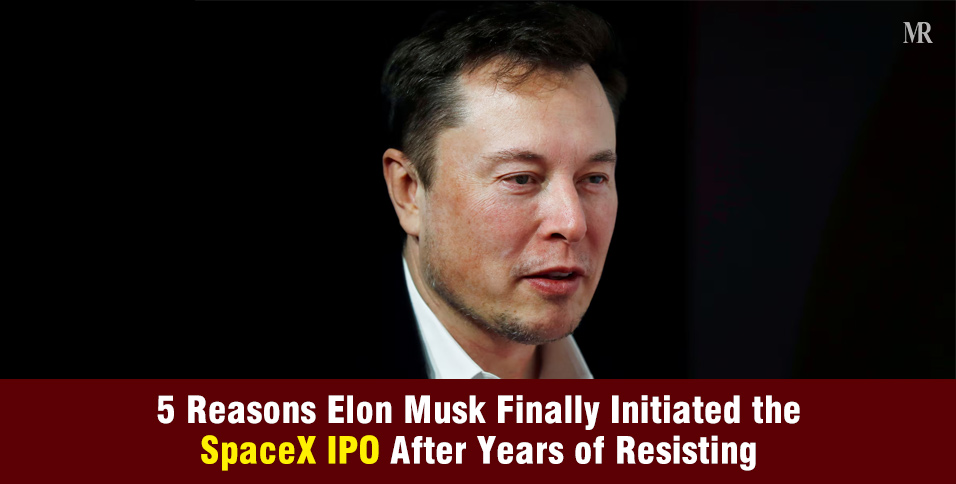
5 Reasons Elon Musk Finally Initiated the SpaceX IPO After Years of Resisting
1. Strong Starlink cash flows give SpaceX a stable foundation
Starlink has transformed the financial profile of SpaceX and earned about $15 billion to $16 billion in revenue with roughly $8 billion in profit in 2025. Moreover, analysts predict $22 billion to $24 billion in 2026 because of strong global demand for satellite internet.
These predictable cash flows make the company look more like a global communications and infrastructure provider. Furthermore, the stability helps convince public investors that SpaceX is no longer a high-risk experimental startup. It also gives Musk the confidence that the SpaceX IPO can attract long-term institutional investment.
2. Future projects require massive capital
SpaceX is expanding far beyond rockets. Funding needs now include:
- Larger Starlink satellite fleets
- Space-based data centers
- Global ground infrastructure
- Next generation launch systems
- New production facilities
Starlink now serves over 9 million users worldwide and accounts for between 50% and 80% of SpaceX’s total revenue, making it the company’s primary cash generator.
The company has also reportedly acquired about $19 billion in wireless spectrum rights from EchoStar as it expands Starlink into direct-to-device satellite connectivity for smartphones.
These projects require billions of dollars upfront. Private rounds can no longer supply the scale of investment needed. The IPO provides access to significant new capital that can support Starlink expansion, next-generation launch systems, and long-term space infrastructure projects.
3. A public listing secures a high valuation
Reports suggest the SpaceX and xAI merger had pushed SpaceX’s valuation to an estimated $1.2 trillion.
Moreover, SpaceX is entering public markets at an implied valuation of approximately $1.75 trillion to $1.8 trillion, placing it among the most valuable companies in the world.
Going public allows investors and employees to finally convert private shares into liquid assets. It also locks in a market-driven valuation that reflects SpaceX’s position in aerospace, satellite internet and global infrastructure.
4. A broader investor base reduces company risk
SpaceX now operates across several sectors, including satellite internet, commercial launches, defense contracts, and emerging orbital-computing infrastructure.
A public listing opens the door for more diversified investors such as telecom funds, aerospace investors, infrastructure funds and long-term asset managers. This spreads risk more evenly across the company’s shareholder base.
If growth slows in one division, other lines of business can support the company. This flexible structure helps SpaceX operate like a large-scale, multi-sector enterprise while attracting investors with different risk profiles.
5. Musk’s broader vision now integrates AI, space and global infrastructure
Musk’s latest initiatives are increasingly connecting space assets with artificial intelligence and advanced computing capabilities. Recent developments, including the Anthropic-SpaceX infrastructure partnership and the Cursor acquisition, reflect a broader effort to expand SpaceX’s role beyond aerospace and into AI-driven infrastructure.
Moreover, Musk’s involvement with xAI and Tesla robotics indicates a push to combine high-performance computing with orbital infrastructure. Space-based data centers, global connectivity networks, and next-generation communications systems all require significant long-term investment.
The SpaceX IPO becomes part of a larger plan to build the foundation for future technologies such as planetary-scale internet, advanced AI processing in orbit and long-range exploration systems.
Elon Musk’s Net Worth and What the SpaceX IPO Means for Him
According to reports, Elon Musk net worth sits between $800 to $850 billion in 2026, supported by his stakes in Tesla, SpaceX, and xAI.
Musk remains SpaceX’s largest shareholder, with reports indicating he controls approximately 43% of the company. At the IPO’s implied valuation of roughly $1.75 trillion to $1.8 trillion, his stake alone represents one of the largest personal ownership positions in corporate history.
This places him far ahead of other global billionaires and strengthens his influence across the technology and aerospace sectors, such as space tourism.
End Note
The SpaceX IPO is set to become the largest public offerings in history. The listing unlocks significant capital for expansion and establishes a public-market valuation for one of the most important technology companies of this century.
However, public status brings new expectations.
SpaceX will face quarterly earnings scrutiny, governance requirements, and investor pressure for predictable performance. These factors may influence how the company balances bold long-term plans with near-term financial results.
For now, the SpaceX IPO appears to be driven by opportunity rather than urgency.
Revenue growth, global demand, technological progress, and market timing have all aligned to make this the right moment.
Maria Isabel Rodrigues