Mirror Review
December 02, 2025
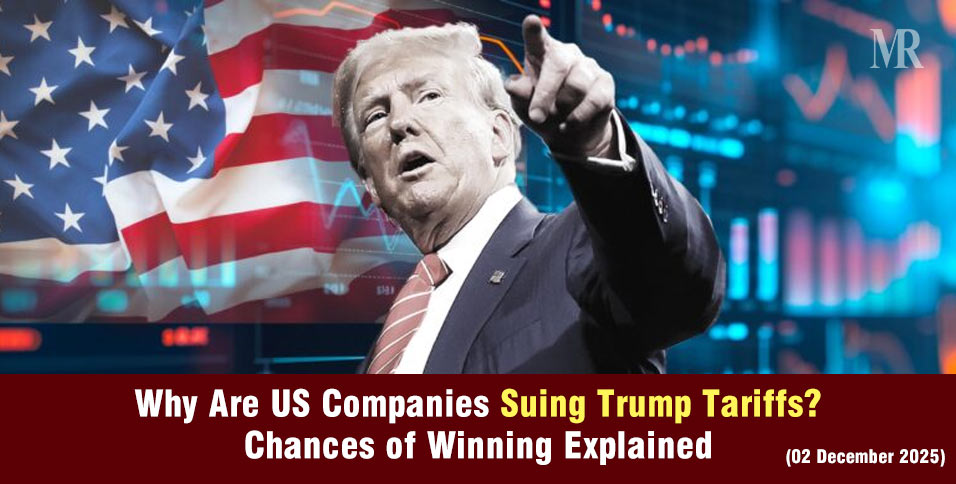
A growing number of American companies are suing Trump tariffs, arguing that the administration overstepped its legal authority when it imposed sweeping duties under the emergency-powers law.
Their cases are now at the center of one of the most important trade-power battles in decades, and the outcome could change how future presidents use economic emergency powers.
Why Companies Are Suing Tariffs: The Core Legal Issue
When the Trump administration expanded its “reciprocal” and “trafficking” tariffs in 2025, it relied on the International Emergency Economic Powers Act (IEEPA) — a law originally designed for targeted sanctions against hostile nations, not broad taxes on imports.
Companies suing the tariffs say:
- IEEPA does not authorize tariffs at all
- The Constitution reserves tariff power to Congress
- The claimed “economic emergency” is not legally an emergency
- The tariffs increase costs unpredictably, harming business planning
New CRS Findings Strengthen The Case of Suing Trump Tariffs
A recent Congressional Research Service (CRS) analysis, one of the most authoritative sources of legal interpretation for Congress, highlighted that:
- No U.S. court has ever upheld using IEEPA to impose tariffs
- IEEPA historically applies to sanctions, not domestic economic policy
- The 2025 tariff expansion is “likely beyond the scope of statutory authority”
- The case triggers the Major Questions Doctrine, meaning courts need clear congressional authorization for such a sweeping economic action
This analysis significantly favoured the companies’ legal arguments.
Courts Have Already Signaled Agreement
The companies’ suing Trump tariffs are boosted by early court rulings.
In May 2025, the U.S. Court of International Trade (CIT) ruled the tariffs unlawful, holding that:
- Economic imbalance does not qualify as an “unusual and extraordinary threat” under IEEPA
- The administration’s justification lacked any connection to a foreign adversary, as the statute requires
Although this ruling was temporarily stayed on appeal, it set the tone for what came next.
In August 2025, the U.S. Court of Appeals for the Federal Circuit upheld the core findings, ruling that:
- The administration overstepped IEEPA authority
- The president failed to demonstrate a legally valid emergency
- The government violated the Administrative Procedure Act (APA) by skipping mandatory notice-and-comment rulemaking
This ruling is currently the controlling law, unless the Supreme Court reverses it.
Who Is Suing Trump Tariffs
Lawsuits have been filed across the entire U.S. economy, including:
- Major Corporations
- Costco
- EssilorLuxottica
- Kawasaki Motors
- Bumble Bee
- Revlon
- Automotive and electronics importers
- Small and Mid-sized Businesses
- Wine importers
- Fishing and marine suppliers
- Pipe and valve manufacturers
- Small educational product makers
- 22 States Are Now Suing at the Supreme Court
In a major escalation, 22 state attorneys general, led by Connecticut’s AG William Tong, filed an emergency petition directly to the U.S. Supreme Court.
They argue that:
- The tariffs violate the Constitution’s Nondelegation Doctrine
- The administration exceeded its authority under IEEPA
- The government violated the APA by ignoring required procedures
- Companies and consumers face immediate and unlawful harm
This state-level involvement raises the stakes significantly and signals strong institutional concern over presidential overreach.
Is It Reasonable to Sue Tariffs? What the Law Actually Allows
Most legal scholars think the cases suing Trump’s tariffs are not only reasonable but also strong. Here’s why:
- Congress Controls Tariff Power
The Constitution gives tariff authority to Congress, not the president. Courts are careful about letting the president get around that rule unless Congress has clearly given permission.
- IEEPA Has Never Been Used for Tariffs
Historical use of IEEPA is clear:
- Freeze assets
- Limit financial transactions
- Target hostile foreign actors
Broad economic tariffs are far outside their original purpose.
- Major Questions Doctrine Applies
When executive actions have a vast economic impact, courts require clear authorization from Congress. Mass tariffs covering large portions of U.S. imports clearly qualify.
- Courts Are Rejecting Emergency Power Overreach
Analysis from the Brennan Center notes a judicial trend: courts are increasingly striking down presidential actions that stretch emergency powers, including several Trump-era deportation and economic orders.
This trend directly favors companies suing the tariffs.
- APA Violations Strengthen the Case
The appeals court found the administration violated the APA. This is a strong, independent basis for invalidating the tariffs.
- Companies Risk Losing Refund Eligibility
If they don’t sue, importers may not qualify for billions in potential tariff refunds if the courts ultimately strike the tariffs down.
Has Anything Like This Happened Before?
Not with tariffs.
U.S. presidents have used emergency powers to sanction foreign governments, freeze assets, and restrict financial flows, but no president in modern history has used IEEPA to impose global tariffs on everyday goods. This lack of precedent is one reason courts are skeptical.
Economic Impact is another factor.
According to the Tax Foundation:
- U.S. importers (not foreign producers) bear 94–96% of the tariff costs
- American households face $500–$700 per year in higher prices due to tariffs
- If courts strike down the tariffs, the government may owe tens of billions of dollars in refunds
Meanwhile, BBC reporting shows:
- Small businesses are suffering the most, as they cannot hedge or absorb sudden price changes
- Companies warn that the tariffs “destabilize long-term supply chains.”
This economic harm reinforces the plaintiffs’ case.
Conclusion: Could Companies Suing Trump Tariffs Actually Win?
Given:
- The appeals court ruling that the tariffs violate IEEPA and the APA
- The CRS finding that IEEPA has no historical basis for broad tariff powers
- Strong constitutional arguments involving congressional authority
- Growing judicial skepticism of emergency-power overreach
- The economic burden on U.S. companies and households
- A 22-state coalition now petitioning the Supreme Court
…the companies suing Trump tariffs appear to have a strong and well-supported legal case.
With the Supreme Court now positioned to hear the dispute, the outcome could set a major precedent on how far any president can go in using emergency powers to reshape trade policy.
If the courts uphold the earlier rulings, companies could not only defeat the tariffs but also receive massive duty refunds, potentially reshaping U.S. trade governance for decades.