Mirror Review
August 26, 2025
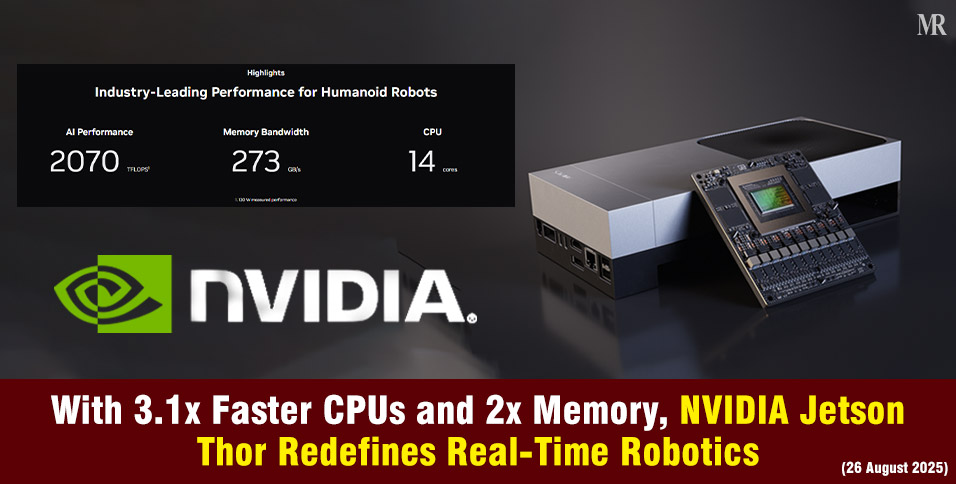
“Robots demand rich sensor data and low-latency AI processing,” NVIDIA noted as it launched Jetson Thor, the new edge computer delivering 2,070 FP4 teraflops to support physical AI.
Available as of August 25, 2025, the system is designed for developers building humanoids, delivery robots, smart tractors, surgical assistants, and more.
Why Jetson Thor Matters Now
Robotics has always faced a bottleneck: too much data, too little compute at the edge.
Most advanced AI models could only run in the cloud, introducing delays. But NVIDIA Jetson Thor overcomes that by packing server-class performance directly into robots.
Compared to its predecessor Jetson Orin, Thor delivers:
- 7.5x more AI compute
- 3.1x more CPU performance
- 2x memory
This means real-time reasoning, not just recognition, becomes possible in physical AI. Robots can fuse multiple sensor streams, understand dynamic environments, and respond instantly, making them useful in unpredictable conditions like warehouses, farms, or disaster zones.
Early Adopters Signal the Trend
- Agility Robotics will use Jetson Thor in the next generation of Digit, its humanoid robot for warehouse logistics. CEO Peggy Johnson said: “The powerful edge processing offered by Jetson Thor will take Digit to the next level, enhancing its real-time responsiveness and expanding its abilities to a broader, more complex set of skills.”
- Boston Dynamics is integrating Jetson Thor into Atlas, giving the humanoid formerly server-class compute directly on-device.
- Research Labs at Stanford, Carnegie Mellon, and Zurich are adopting it for projects in triage robots, autonomous navigation, and fleet-level robotics experiments.
This signals not just product adoption, but a shift in robotics R&D.
Historically, universities were early adopters of GPUs for AI, and that wave preceded today’s AI boom. The Jetson Thor may play a similar role for physical AI.
From Real-Time Reasoning to Physical AI
NVIDIA Jetson Thor isn’t just about speed; it’s about generative reasoning.
It can run large transformer models, vision-language models, and domain-specific frameworks like Isaac GR00T N1.5 directly at the edge.
That unlocks:
- Humanoids performing manipulation in unstructured environments.
- Healthcare robots guiding surgeons in real time with multi-camera data.
- Smart industrial AI agents ensuring worker safety through live vision analysis.
- Autonomous agriculture systems that adapt to unpredictable field conditions.
This suggests the robotics industry is entering its ChatGPT moment, driven by NVIDIA technologies, creating a platform shift where developers can suddenly do things that were impossible just a year ago.
Developer Ecosystem and FOMO
With more than 2 million developers already using NVIDIA platforms, Thor arrives as the new default.
Hackathons with Seeed Studio and Hugging Face are accelerating adoption, while hardware partners like Advantech and Aetina are building production-ready systems.
The pricing $3,499 for the Jetson AGX Thor kit is low enough for startups and labs to experiment, creating a clear FOMO effect.
For robotics founders, missing Jetson Thor could mean falling behind in an industry where speed of adoption decides survival.
The Bigger Picture
Historically, compute leaps like this reshape industries:
- GPUs for deep learning sparked the 2010s AI boom.
- Tensor cores reshaped enterprise AI adoption.
- Now, Jetson Thor could mark the inflection point for physical AI — moving robotics from controlled demos into everyday workflows.
If this trend holds, the 2030s may be remembered as the decade robots left labs and factories to operate seamlessly in homes, hospitals, and cities powered by Jetson Thor-class devices.
Conclusion
With 7.5x more AI compute and 2,070 FP4 teraflops, NVIDIA Jetson Thor is more than a new chip.
It’s the turning point where robotics gains the real-time reasoning needed for true physical AI.
The companies, labs, and developers adopting it today could define how robots shape work, healthcare, and society in the next decade.