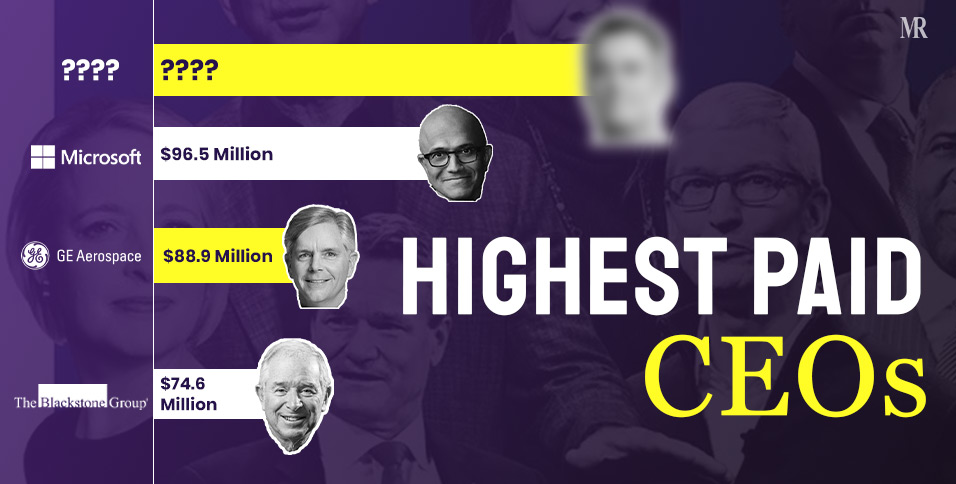
Some CEOs earn more before lunch than most people make in a lifetime.
When evaluating the highest-paid executives in the world, the conversation often gets hijacked by multi-billion-dollar “moonshot” anomalies or the vast net worth of tech founders.
But if you look strictly at the annual granted compensation within the S&P 500 (the true benchmark for corporate America), a different picture emerges.
Today’s top-tier executive pay is rarely about a base salary. It is overwhelmingly driven by performance-based stock awards, massive retention grants, and equity tied strictly to market capitalization milestones.
This blog ranks the top 10 highest-paid CEOs in the world, detailing how much they earned, which companies they lead, and where their compensation truly comes from.
List Of The Top 10 Highest Paid CEOs In 2026 (U.S. Ranking)
Note: Data of these top-paid CEOs is based on the latest available proxy filings (DEF 14A) and reflects annual granted compensation, not realized pay or net worth.
| CEO | Company | Total Compensation |
| 1. Patrick “Rick” Smith | Axon Enterprise | $164.5 Million |
| 2. Satya Nadella | Microsoft | $96.5 Million |
| 3. H. Lawrence Culp Jr. | GE Aerospace | $88.9 Million |
| 4. Stephen Schwarzman | Blackstone | $84.0 Million |
| 5. Tim Cook | Apple | $74.6 Million |
| 6. Joseph Bae | KKR & Co. | $73.1 Million |
| 7. Scott Nuttall | KKR & Co. | $64.2 Million |
| 8. Ted Sarandos | Netflix | $61.9 Million |
| 9. David Simon | Simon Property Group | $61.4 Million |
| 10. Greg Peters | Netflix | $60.3 Million |
Compensation Breakdown Of The Highest Paid CEOs
1. Patrick “Rick” Smith – Axon Enterprise
Total Compensation: $164.5 Million
- Patrick “Rick” Smith is the highest-paid CEO in the world in 2026, based on annual granted compensation of $164.5 Million. His package is almost entirely equity-based under Axon’s “eXponential Stock Plan” (X-Units), with a near-zero base salary.
- The Performance Catch: To vest these tranches, Axon must hit aggressive market cap milestones (scaling up to $50 billion) alongside strict revenue and EBITDA targets. If the stock stagnates or operational growth slows, this package pays out absolutely nothing.
2. Satya Nadella – Microsoft
Total Compensation: $96.5 Million
- CEO Satya Nadella’s 63% year-over-year pay bump is deeply tied to Microsoft’s aggressive push into artificial intelligence. Proxy filings show his package is heavily weighted with Performance Stock Awards (PSAs), with his base salary sitting at $2.5 million.
- The Performance Catch: To unlock his equity, Microsoft must maintain top-tier operational metrics, specifically commercial cloud revenue growth and steady subscription margins. The board explicitly tied this latest package to his success in outmaneuvering rivals in the generative AI space.
3. H. Lawrence Culp Jr. – GE Aerospace
Total Compensation: $88.9 Million
- Culp’s compensation reflects a historic corporate milestone: the successful uncoupling of the 130-year-old General Electric conglomerate into three standalone public companies. According to SEC filings, the board issued a massive one-time “Founder’s Grant” and retention package to ensure he didn’t leave after the split.
- The Performance Catch: His options vest based on strict free cash flow and earnings-per-share (EPS) targets through 2027, ensuring he remains focused on the operational turnaround of the newly standalone aviation business.
4. Stephen Schwarzman – Blackstone
Total Compensation: $84.0 Million (Reported Pay)
- Schwarzman’s proxy breakdown is unique in the financial sector. His reported “compensation” of $84 million consists of a modest $350,000 base salary and a massive share of “carried interest” (his cut of the profits from Blackstone’s successful private equity deals).
- The Real Take-Home: This SEC-reported figure drastically underrepresents his actual take-home wealth. Because Schwarzman owns roughly 19% of the firm, his total payout actually eclipsed $1 billion once his $916 million in annual shareholder dividends were factored in.
5. Tim Cook – Apple
Total Compensation: $74.6 Million
- Apple CEO Tim Cook’s compensation consists of a base salary of $3 million, while his cash incentive bonus typically hovers around $10.7 million. The remaining ~$60 million comes from equity.
- The Performance Catch: Following shareholder feedback in recent years, Apple’s board increased the performance-based weighting of Cook’s equity from 50% to 75%, making Cook one of the top highest paid ceos. This means his payout is increasingly dependent on Apple outperforming the broader market, rather than just time-vested retention.
6. Joseph Bae – KKR & Co.
Total Compensation: $73.1 Million
- As Co-CEO of the alternative investment giant, Joseph Bae’s compensation is inextricably linked to KKR’s asset growth. Proxy filings reveal that his package relies heavily on “carried interest” and restricted stock units.
- The Performance Catch: These units vest only if KKR successfully hits aggressive fundraising targets and delivers high-yield returns across its private equity, credit, and real estate portfolios for its limited partners.
7. Scott Nuttall – KKR & Co.
Total Compensation: $64.2 Million
- Mirroring his Co-CEO Joseph Bae, Nuttall’s $64.2 million package is structured to align executive wealth with limited partner returns.
- The Performance Catch: The proxy data shows his compensation is dominated by equity grants that require KKR to maintain its massive momentum in fee-related earnings and total assets under management (AUM), which recently surged past the half-trillion-dollar mark.
8. Ted Sarandos – Netflix
Total Compensation: $61.9 Million
- Netflix operates with one of the most unique compensation structures in the S&P 500. Executives are actually allowed to allocate their target pay between cash and stock options.
- The Performance Catch: For his $61.9 million package, Ted Sarandos, who drives the platform’s massive global content strategy, elected to take a base salary of $3 million, with the remaining $58+ million entirely in stock options and bonuses tied strictly to global subscriber growth and free cash flow generation.
9. David Simon – Simon Property Group
Total Compensation: $61.4 Million
- The Proxy Breakdown: Simon’s compensation package is heavily anchored in stock. According to recent proxy statements, his cash compensation sits at roughly $4.25 million (a $1.25 million base salary plus a $3 million bonus). The remaining ~$56.4 million was awarded entirely in long-term equity.
- The Performance Catch: As the leader of the largest shopping mall operator in the U.S., his equity is directly tied to navigating the post-pandemic commercial real estate market. The board structured these awards to vest based on strict portfolio stabilization metrics, maintaining high occupancy rates, and successfully transitioning legacy retail spaces into mixed-use real estate.
10. Greg Peters – Netflix
Total Compensation: $60.3 Million
- The Proxy Breakdown: Netflix operates with a highly unusual compensation model that allows its Co-CEOs to allocate their target pay between cash and stock options. For his recent package, Peters allocated $15 million to total cash compensation, taking the remaining ~$44.6 million in stock options.
- The Performance Catch: Unlike restricted stock that holds value as long as the company exists, Peters chose stock options. This means his $44.6 million equity allocation only generates wealth if Netflix’s stock price continues to climb above the price on the day the options were granted. His payout relies heavily on his specific mandate: successfully scaling Netflix’s ad-supported tier and cracking down on password sharing to drive revenue.
The “Missing” Billionaires: Why Some of the Most Famous CEOs Are Not on This List?
When looking at the top 10 highest-paid S&P 500 CEOs, readers immediately notice a glaring omission of the world’s most famous tech leaders:
Where is Elon Musk? What about Meta’s Mark Zuckerberg, Nvidia’s Jensen Huang, Alphabet’s Sundar Pichai, or Salesforce’s Marc Benioff?
The ranking is based strictly on annual reported compensation (proxy filings), not total wealth, stock ownership, or long-term grants. And that distinction changes everything.
Here is exactly why these five billionaires didn’t make this specific S&P 500 pay list:
1. Elon Musk (Tesla)
Elon Musk does not receive a traditional salary (officially $0 base pay).
- His compensation is tied to long-term performance-based stock option plans
- The controversial 2018 Tesla pay package (~$56B) remains tied up in legal challenges
- No new annual equity grants means reported yearly compensation often shows near-zero
Unlike conventional CEOs, Elon Musk operates on a model where compensation could theoretically scale toward $1 trillion, entirely dependent on Tesla hitting unprecedented valuation targets.
2. Mark Zuckerberg (Meta)
- Mark Zuckerberg continues to operate on a $1 salary model.
- No annual bonuses or stock grants in recent years
- Wealth is driven almost entirely by his ~13% ownership stake in Meta
Compensation disclosures mainly include security and operational costs, not “pay”
3. Jensen Huang (Nvidia)
- Jensen Huang’s true wealth (estimated well over $100 billion) comes from his massive 3.5% ownership stake in Nvidia, which organically generates immense net worth as the stock rises.
- While the CEO of NVIDIA Huang does receive a traditional compensation package, he took home roughly $34 million to $50 million annually in recent years.
Despite leading one of the most valuable AI companies, his annual pay falls below the Top 10 highest paid CEOs.
4. Sundar Pichai (Alphabet/Google)
Sundar Pichai is paid on a multi-year grant cycle, not annually.
- Received a $200M+ stock grant in 2022
- In non-grant years (2023–2025), compensation drops to roughly $10M–$20M
- Includes salary (~$2M) + security expenses
Though it is worth noting Alphabet just approved a new three-year package for him that could be worth up to $692 million by 2028.
5. Marc Benioff (Salesforce)
While Salesforce CEO Marc Benioff is famous for his massive paydays and billionaire status, he simply missed the cut-off for the Top 10 in this specific reporting cycle.
Benioff secured the #11 spot across the entire S&P 500 highest paid CEOs list with a total compensation package of $55.1 million, driven by equity incentives tied to Salesforce’s margin expansion.
In reality, these leaders aren’t “missing”. Instead, they’re operating on a completely different financial model than traditional CEOs.
The Bottom Line
The days of guaranteed, exorbitant cash salaries are fading, replaced by a high-stakes ecosystem of performance-driven equity.
For the leaders of the S&P 500, unprecedented wealth is now inextricably linked to unprecedented expectations like executing a flawless corporate spin-off, dominating the artificial intelligence race, or delivering historic shareholder returns.
As these multi-million-dollar “moonshot” packages become the new corporate standard, the true test for these CEOs isn’t just securing the contract, but actually hitting the monumental market milestones required to unlock the vault.
If this breakdown gave you clarity on who is the highest paid ceo in the world and how executive pay really works, share it with your network and with those interested in salary breakdowns!
Maria Isabel Rodrigues
FAQs
- Who is the highest-paid ceo in the US?
Patrick “Rick” Smith is also the highest-paid CEO in the US, as the ranking is based on S&P 500 companies, which represent the highest-paid CEOs in America.
- What is the salary of the highest-paid CEO?
The highest paid CEO salary in 2026 is $164.5 million, earned by Patrick “Rick” Smith, primarily through performance-based stock awards.
- How much does a CEO earn on average?
The average CEO in the S&P 500 earns around $15–20 million annually, while top executives on the highest paid list often exceed $60 million to $100 million+.