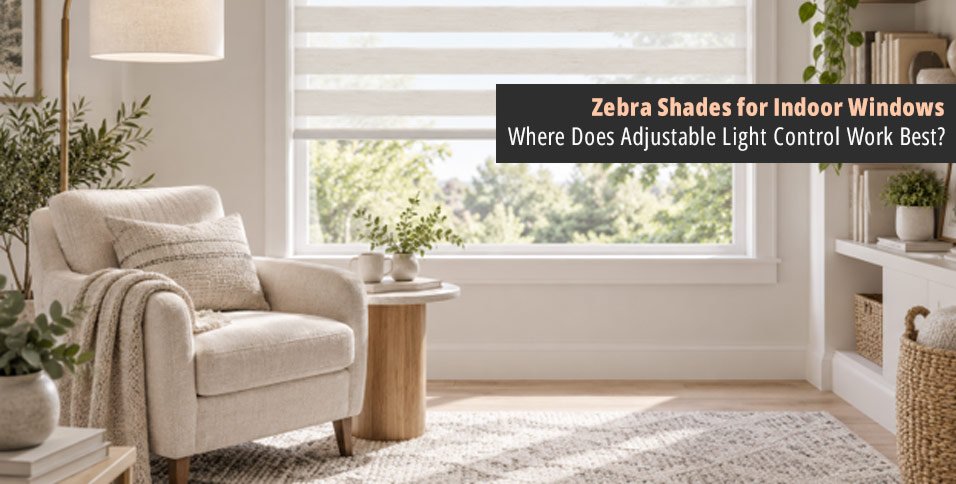
A window covering can feel right in the morning and wrong by late afternoon. Rooms often shift between work, relaxing, entertaining, and privacy through the day. Zebra shades suit these spaces because alternating sheer and solid fabric bands can be repositioned to change daylight and visibility without fully raising the shade.
For homeowners who want more control than a single-opacity roller shade, zebra blinds make the most sense when a room needs several light settings rather than one fixed level. They are most useful where sunlight, glare, privacy, and daily activities keep changing.
Living Rooms Benefit From Day-to-Night Flexibility
Living rooms rarely have one lighting job. Morning coffee may call for a bright window, while afternoon TV viewing can make direct sun distracting. By evening, the priority often shifts toward privacy.
That changing routine is where adjustable bands become practical. The sheer sections can keep the room connected to daylight, while a small shift toward the solid bands can soften glare without making the space feel closed off. Greater overlap later can provide more visual coverage from outside.
This works especially well for street-facing living rooms, family rooms, and open-plan spaces.
Home Offices Need Control Without Losing Daylight
A home office often has a specific problem: too much sunlight on the screen, but no reason to darken the whole room. Direct glare can move across a desk during the day, especially near east- or west-facing windows.
Zebra shades work well because the fabric alignment can be adjusted in small increments as the sun moves. A partially filtered setting can reduce harsh light near a monitor while preserving ambient daylight elsewhere. That suits remote workers, students, designers, and others who spend long hours at a desk.
For offices where the goal is consistently soft illumination rather than frequent adjustment, light filtering roller shades may be simpler. A steady lighting preference favors fixed light filtering; changing glare and privacy needs favor an adjustable layered shade.
Street-Facing Rooms Gain More Privacy Options
Ground-floor rooms are difficult because the best daytime light setting is not always the best privacy setting. Leaving a window uncovered may feel exposed, while closing an opaque shade can remove more daylight than necessary.
Zebra shades give these rooms an intermediate option. Partly offset bands can reduce direct sightlines while still allowing filtered daylight into the room. That helps in front living rooms, dining areas, sidewalk-facing apartments, or homes with nearby neighbors.
Nighttime conditions require more caution. Once indoor lights are brighter than outdoors, sheer sections provide less privacy than they do during the day. Homes with strong nighttime privacy needs should close the solid sections fully or use a more opaque treatment on exposed windows.
Dining Areas Work Best When Light Changes With Use
Dining rooms are another good fit because their lighting needs often change with the time of day. A breakfast area may benefit from open daylight in the morning, while a west-facing dining room can become uncomfortably bright before dinner.
Adjustable bands let the same treatment handle both moments. The shade can stay visually light during the day, then move toward more coverage when low-angle sun becomes distracting. This helps when the dining space also serves for homework, laptop work, crafts, or gatherings.
In kitchens, the same flexibility can work at windows positioned away from sinks, stovetops, and heavy grease.
Busy Households Benefit From Easier Daily Adjustments
Zebra shades are especially useful in households that adjust windows often. Families moving between breakfast, homework, screen time, and evening privacy can benefit from having several light positions in one treatment.
The same is true for rooms with multiple windows or hard-to-reach openings. Cordless or motorized operation, when available, can make frequent adjustments more convenient and help several shades stay visually consistent.
Across several windows, matching the band position can keep daylight more even. Households can open the sheer sections in the morning, shift to partial filtering during bright hours, and use greater coverage in the evening. Rooms that require near-total darkness, strong moisture resistance, or maximum insulation are better handled with a treatment designed specifically for those priorities.