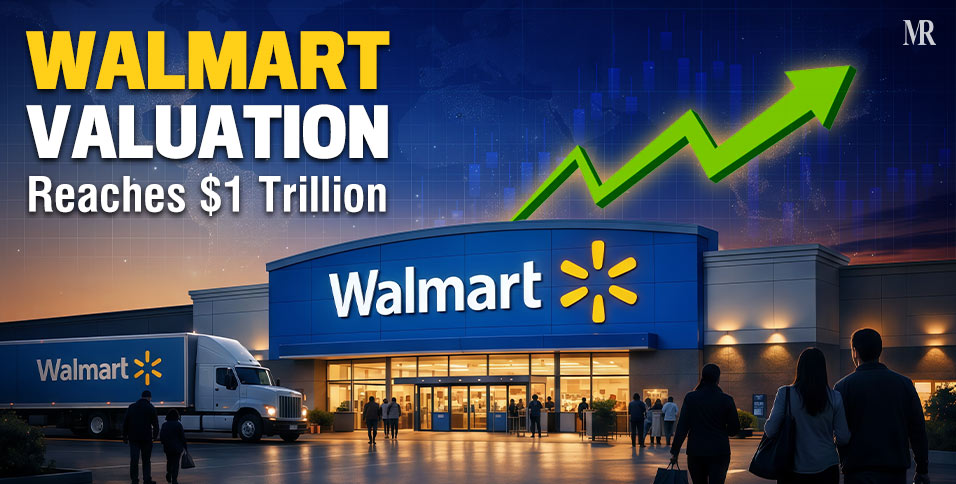
The global retail industry crossed a once-unthinkable milestone on February 3, 2026. Walmart Inc. officially surpassed a $1 trillion market capitalization, becoming the first traditional retailer in history to reach that level of valuation.
Until now, this exclusive “trillion-dollar club” was dominated by technology giants such as Apple, Microsoft, Alphabet, Nvidia, and Meta.
But Walmart’s entry stands out because it challenges a long-held belief: that only digital-first companies can scale to trillion-dollar valuations.
The current Walmart $1 trillion valuation tells a different story. It shows how a company rooted in physical stores gradually transformed itself into a technology-driven, data-powered retail platform, all without abandoning its core promise of everyday low prices.
This is the story of how the Walmart valuation reached $1 Trillion!
1962–1979: A Small-Town Idea That Scaled Nationally
Walmart’s $1 trillion market cap journey began far from Wall Street.
In 1962, Sam Walton opened a modest discount store in Rogers, Arkansas, guided by a simple idea: sell everyday goods at lower prices so families could live better.
That philosophy resonated quickly.
By 1967, the Walton family operated 24 stores, generating $12.7 million in sales. The business was incorporated as Wal-Mart Stores, Inc. in 1969, and just a year later, Walmart went public at $16.50 per share.
Early investments in logistics proved critical.
In 1971, Walmart opened its first distribution center in Bentonville, laying the groundwork for the supply-chain efficiency that would later become its biggest competitive advantage.
By 1972, Walmart was listed on the New York Stock Exchange, operating 51 stores and generating $78 million in sales. This was a strong foundation for what came next.
1980–1999: Becoming a Retail Powerhouse
The 1980s marked Walmart’s transition from a fast-growing chain into a full-scale retail juggernaut. In 1980, the company became the fastest business in history to reach $1 billion in annual sales.
Growth wasn’t just financial—it became cultural.
In 1984, Sam Walton famously performed a hula dance on Wall Street after Walmart hit a pre-tax profit target, reinforcing the company’s people-first ethos. This is one of the most interesting facts about Walmart!
Following Walton’s death in 1992, leadership passed to Rob Walton, who oversaw Walmart’s expansion beyond U.S. borders. By 1994, the company entered Canada, and by 1997, Walmart crossed $100 billion in annual sales, serving nearly 90 million customers every week.
And by the end of the 1990s, Walmart wasn’t just big… it was essential!
2000–2022: Global Scale Meets Digital Reinvention
The 21st century reshaped the Walmart valuation in a fundamental way.
Under CEO H. Lee Scott Jr., Walmart became the world’s largest company by revenue in 2002, topping the Fortune 500 list.
Yet scale alone was no longer enough. As e-commerce began disrupting retail, Walmart gradually pivoted toward digital infrastructure and global expansion.
Key moments included:
- 2008: Annual revenue exceeded $400 billion
- 2013: A $250 billion commitment to U.S.-made goods
- 2022: InHome Delivery scaled to 30 million U.S. households
These moves signaled a shift from pure physical retail to a hybrid digital-physical ecosystem.
2024: The Stock Split That Re-Energized Investors
One quiet but powerful catalyst came in February 2024, when Walmart announced its first 3-for-1 stock split in 25 years.
Ex-CEO Doug McMillon framed the move as a return to Sam Walton’s philosophy: keeping ownership accessible.
Furthermore, the lower share price encouraged broader participation, especially among Walmart’s 400,000+ associates enrolled in stock purchase programs.
Retail investor activity jumped by 15–22% in the following quarters, increasing liquidity and long-term engagement with the stock.
2025: AI Bets and Earnings Momentum
Momentum accelerated in 2025 as Walmart doubled down on technology. The opening of a new 350-acre Home Office symbolized Walmart’s design not just for operations, but for innovation.
Third-quarter FY26 earnings confirmed the strategy was working:
- Revenue: $179.5 billion (+5.8%)
- Global eCommerce Growth: +27%
- Advertising (Walmart Connect): +33%
Perhaps most importantly, Walmart partnered with OpenAI to launch“agentic commerce.” Through its AI assistant Sparky, customers could plan meals, restock essentials, and shop directly through conversation. This turned shopping into a personalized, predictive experience.
2026: The Historic Trillion-Dollar Milestone
The final push came during a strong early-2026 market rally.
On January 20, Walmart joined the Nasdaq-100 Index, triggering an estimated $19 billion in passive investment inflows.
Leadership also transitioned, with John Furner taking over as global CEO of Walmart on February 1.
Then, just two days later, on February 3, Walmart shares climbed past $126, hitting an intraday high of $126.90. That single move lifted the Walmart’s market value to just over $1.004 trillion.
More importantly, the rally wasn’t driven by hype. Investors rewarded Walmart for consistent execution, not speculation. Analysts pointed to rapid e-commerce growth, expanding advertising profits, and aggressive investment in artificial intelligence as the main drivers behind the surge.
How Does the Walmart Valuation Compare To It’s Competitors?
Among America’s most valuable companies, the Walmart Valuation stands out as the only traditional retailer in the trillion-dollar bracket. While most firms on this list derive value from software, semiconductors, cloud computing, or digital platforms, Walmart’s strength lies in its omnichannel model, which is the seamless integration of physical stores, distribution centers, and digital platforms.
Its inclusion alongside technology-heavy peers like Nvidia, Apple, and Microsoft underscores a key shift in how markets define value: scale alone is no longer enough, butscale enhanced by technology can rival even the most advanced digital-first businesses.
The table below highlights the top 10 U.S. companies by market capitalization as of February 2026, showing how Walmart now ranks among America’s most valuable corporate giants.
| Company | Market Cap (Feb 2026) | Primary Growth Strategy |
| 1. NVIDIA | ~$4.39 Trillion | AI Infrastructure |
| 2. Alphabet (Google) | ~$4.11 Trillion | Digital Advertising & AI Platforms |
| 3. Apple | ~$3.96 Trillion | Consumer Hardware & Services Ecosystem |
| 4. Microsoft | ~$3.05 Trillion | Cloud Computing & Enterprise AI |
| 5. Amazon | ~$2.55 Trillion | Cloud & E-commerce |
| 6. Meta Platforms | ~$1.75 Trillion | Social Platforms & AI Advertising |
| 7. Tesla | ~$1.58 Trillion | Electric Vehicles & AI Automation |
| 8. Broadcom | ~$1.52 Trillion | Semiconductor & AI Networking |
| 9. Berkshire Hathaway | ~$1.07 Trillion | Diversified Holdings & Capital Allocation |
| 10. Walmart | ~$1.02 Trillion | Omnichannel Retail |
Walmart operates thousands of stores that double as local fulfillment hubs, allowing it to deliver online orders faster and at lower costs than many digital-only competitors.
When this physical reach is paired with data-driven pricing, AI-powered demand forecasting, and personalized shopping tools, it creates a competitive advantage that is difficult to replicate.
Conclusion
The historic Walmart Valuation of 2026 validates a 64-year evolution. From Sam Walton’s single store in 1962 to a global AI-powered leader, the company has consistently adapted. By merging store density with “agentic commerce,” Walmart redefined what it means to be a modern retailer.
Looking ahead, the leadership of John Furner will likely accelerate this “tech-powered” mission. Investors expect deeper integration of AI across supply chains and customer experiences. As Walmart hits $1T and continues to innovate, its trillion-dollar milestone serves as a benchmark for the future of global retail. We encourage readers to explore the growing Walmart+ ecosystem as the company scales its digital dominance.