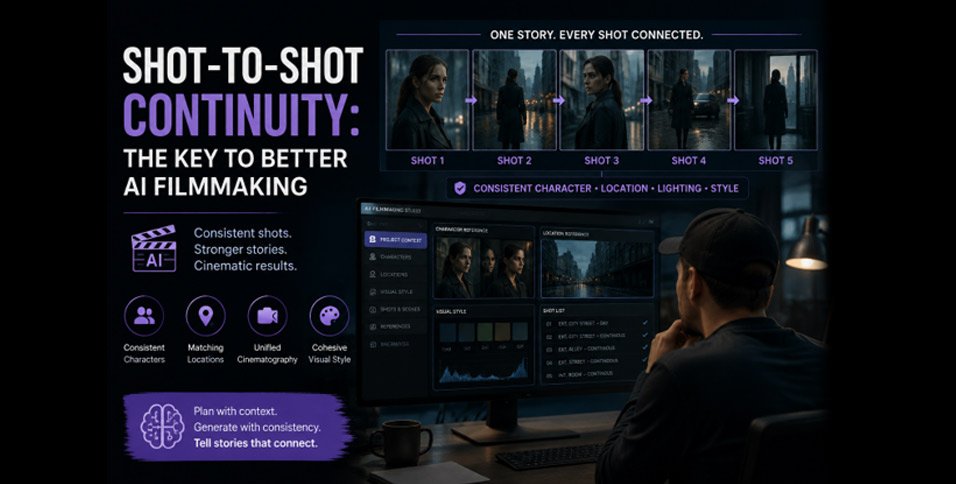
Shot-to-shot continuity is becoming one of the biggest challenges in AI filmmaking because every scene needs to feel like part of the same story. This article explains how consistent characters, locations, camera language, and visual style help create better AI-generated films.
AI filmmaking has made it easier to turn ideas into visual stories, but one major challenge remains: keeping every shot connected. A character may look slightly different in the next scene, a location may change unexpectedly, or the lighting style may lose the feeling established earlier.
This problem is known as continuity, and it has always been a core part of traditional filmmaking. Directors, cinematographers, costume teams, and editors work together to make sure every frame feels like it belongs to the same world.
This problem is made even more crucial by AI-generated videos. According to a report from Wikipedia, artificial intelligence systems rely on learned patterns and data to create outputs. However, maintaining a creative vision across multiple generations requires more than generating individual clips. It requires understanding the full project.
That is where shot-to-shot continuity becomes a key part of better AI filmmaking. By keeping characters, environments, camera styles, and creative decisions consistent, filmmakers can move from creating isolated clips to building complete visual stories.
Why is shot-to-shot continuity important in AI filmmaking?
Shot-to-shot continuity ensures that every scene in an AI-generated film feels connected. It helps maintain the same characters, locations, visual style, and storytelling flow from one shot to the next. Without continuity, even high-quality AI-generated clips can feel disconnected.
In traditional filmmaking, continuity errors are avoided through detailed planning. Production teams maintain character notes, costume records, location references, and shot lists.
AI filmmaking requires a similar approach. A single prompt can create an impressive scene, but a full film needs hundreds of connected decisions.
Key areas where continuity matters include:
- Character consistency: The same person should maintain the same appearance, clothing, and personality throughout the story.
- Location consistency: Sets, environments, and background details should remain recognizable.
- Visual consistency: Lighting, color tone, and camera style should match across scenes.
- Story consistency: Actions and emotions should carry naturally from one shot to another.
When these elements stay aligned, AI-generated films become easier for audiences to follow and feel more intentional.
What makes continuity difficult in AI-generated videos?
AI video generation often creates individual scenes well, but maintaining the same creative rules across many shots requires additional planning and context. Continuity becomes difficult when each generation starts without understanding previous decisions.
Many AI video workflows focus on creating one scene at a time. This works well for short clips but creates challenges for longer stories.
For example, imagine creating a short film about a detective investigating a mystery. The first shot shows the detective wearing a brown coat in a rainy city. In the next generated scene, the character may have different clothing, a different hairstyle, or a different environment.
These small changes can break the viewer’s connection with the story.
Common continuity challenges include:
- Different facial features between shots
- Changing wardrobe details
- Inconsistent camera movements
- Different lighting conditions
- Locations that do not match previous scenes
- Characters losing emotional consistency
The solution is not only better generation quality. It is better project understanding.
How does Invideo Agent two help maintain shot continuity?
Invideo Agent two helps filmmakers maintain continuity by remembering project details, including characters, locations, visual rules, and creative decisions. This allows creators to build connected sequences instead of treating every shot as a separate generation.
In AI filmmaking, memory can make a major difference. Instead of explaining the same character or visual style repeatedly, filmmakers can build a shared project context.
Invideo Agent two works around the idea of an AI filmmaking collaborator. It keeps track of important creative details across the project, allowing filmmakers to focus more on directing decisions rather than repeating instructions.
This approach supports several continuity-focused workflows:
- Building character references before generating scenes
- Maintaining consistent locations across multiple shots
- Following established camera and lighting rules
- Tracking creative changes throughout production
The goal is not simply generating more videos. It is helping filmmakers create a connected visual language.
How do AI agents change the future of filmmaking workflows?
AI agents are changing creative workflows by acting as collaborative partners that can remember context, manage complex tasks, and support different stages of production. In filmmaking, this means creators can spend more time on storytelling while AI handles repetitive production work.
The future of work with AI agents is moving beyond simple automation. Instead of only responding to individual commands, AI agents can support complete workflows.
In filmmaking, this can include:
- Breaking down scripts into scenes
- Planning shots before production
- Creating character and location references
- Reviewing footage for continuity issues
- Supporting editing decisions
Invideo Agent two follows this crew-based approach by allowing specialized agents to support different creative roles, such as cinematography, casting, and story planning. These agents can share project context, helping different parts of production stay connected.
This creates a workflow closer to having a digital production team rather than using separate tools for every task.
How do AI video models support multi-shot storytelling?
AI video models are improving multi-shot storytelling by giving creators more control over references, camera movements, and visual consistency. When combined with project memory, these models can help produce scenes that feel like parts of one film.
Different AI models have different strengths. Some are better suited for realistic motion, while others may perform well for specific visual styles.
For filmmakers working on connected sequences, access to multiple models can help select the right approach for each shot.
For example, creators can use the Kling AI video generator with invideo Agent two workflows to explore multi-shot scenes, effects, and camera angles while maintaining consistent characters through image or video references. With access to various Kling AI models, ranging from Kling 2.1 to Kling 3.0, producers can experiment with various generation capabilities while maintaining a focus on storytelling objectives.
The important factor is not only the model itself. It is how well the entire workflow manages references, creative direction, and continuity.
Building better AI films through pre-production planning
Strong continuity starts before generation begins. Traditional filmmakers spend significant time planning shots, creating references, and defining visual styles.
AI filmmakers benefit from the same process.
A strong pre-production workflow can include:
- Creating character reference sheets
- Defining camera style and lighting rules
- Building location references
- Planning scene transitions
- Creating a clear visual direction
Invideo Agent two supports this type of planning by helping creators develop projects with connected context instead of isolated generations. It can work with scripts, references, and production documents to help maintain consistency throughout the filmmaking process.
As AI filmmaking continues to evolve, continuity will become one of the biggest differences between simple AI clips and complete cinematic experiences.
The future of AI filmmaking depends on consistency
Shot-to-shot continuity is becoming a foundation for professional AI filmmaking. Creating one impressive scene is no longer the only goal. The real challenge is creating a complete story where every frame supports the next.
By combining project memory, AI agents, creative planning, and advanced video models, filmmakers can build more consistent and engaging productions.
Invideo Agent two represents this shift toward AI-assisted filmmaking where creators can direct ideas, manage complex projects, and maintain creative control while AI supports the production process.
The future of filmmaking will not only be about generating more content. It will be about creating stories that feel intentional, connected, and visually complete.
Frequently Asked Questions
What is shot-to-shot continuity in AI filmmaking?
Shot-to-shot continuity means keeping visual and storytelling elements consistent between different scenes in an AI-generated film. This includes character appearance, locations, lighting, camera style, and story details.
Why is continuity difficult with AI-generated videos?
AI video tools often generate scenes independently. Without shared project context, characters, environments, and visual styles may change between shots, making longer stories harder to maintain.
How can AI agents improve filmmaking workflows?
AI agents can support filmmaking by remembering project information, organizing creative tasks, and helping with planning, generation, and editing. This allows creators to manage complex projects more efficiently.
Can AI filmmaking tools maintain consistent characters?
Yes, newer AI filmmaking workflows focus on character references, project memory, and visual controls to help maintain consistent characters across multiple scenes.
What role does pre-production play in AI filmmaking?
Pre-production helps define the story, visual style, characters, and locations before generation begins. This planning creates stronger consistency throughout the final project.
Is AI replacing filmmakers?
AI is not replacing creative direction. Instead, AI tools are becoming collaborators that help filmmakers handle production tasks while keeping storytelling decisions in human hands.
What part of AI filmmaking do you think will improve the most in the next few years: character consistency, camera control, or storytelling?