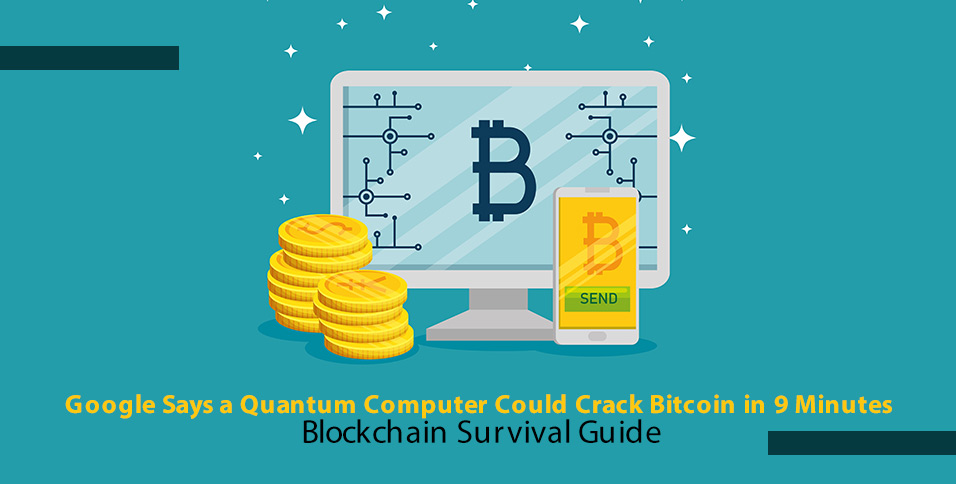
On March 30, 2026, the quiet confidence of the crypto market was rattled by a whitepaper from Google’s Quantum AI team. The headline was a technological gut-punch: researchers demonstrated that an optimized version of Shor’s algorithm, running on a superconducting quantum computer with approximately 500,000 physical qubits, could crack the 256-bit elliptic curve cryptography (ECDSA) securing Bitcoin in roughly nine minutes.
For years, the “Quantum Apocalypse” was a bogeyman relegated to the mid-2030s, allowing digital asset investors to largely ignore the looming threat in favor of short-term gains. Previous estimates suggested 13 million to 20 million qubits were needed for such an attack. Google’s 2026 breakthrough represents a 26-fold reduction in the resources required. By compressing the attack time to under ten minutes, Google has identified a “real-time” threat vector: the ability to hijack a transaction while it sits in the mempool before the next block is mined.
This is not a drill, but it is also not the end of blockchain technology. As a cryptocurrency information publisher in 2026, we are witnessing a pivotal evolution where the industry must embrace “Crypto-Agility.” While the threat has moved from a distant theoretical concern to a near-term engineering challenge, the survival guide is already being written in code.
Intuitive Key Takeaways
- The 9-Minute Window: Google’s optimized algorithm can derive a private key from a public key in ~9 minutes, specifically targeting Bitcoin’s 10-minute average block time.
- The 500k Threshold: The hardware requirement for a cryptographically relevant quantum computer (CRQC) has dropped from 13M+ to under 500,000 physical qubits.
- Exposed Supply: Approximately 6.9 million BTC (roughly 32% of supply) are currently in “at-risk” wallets where public keys are already visible on the ledger.
- BIP-360 Defense: Bitcoin developers merged BIP-360 in February 2026, introducing quantum-resistant “bc1z” address types.
- Migration Deadline: While immediate hardware doesn’t exist yet, Google and NIST recommend a full transition to post-quantum cryptography (PQC) by 2029.
The March 2026 Breakthrough: Why 9 Minutes Changes Everything
The most critical finding in Google’s March 31 whitepaper isn’t just the reduction in qubits, but the speed of the derivation. Bitcoin’s security relies on the fact that while a public key is revealed during a transaction, it takes a traditional computer trillions of years to find the matching private key.
Google’s researchers modeled an “on-spend” attack. When you hit “send” on a Bitcoin transaction, your public key is broadcast to the network. It usually waits in the mempool for a few minutes before a miner includes it in a block. If a quantum computer can solve the Elliptic Curve Discrete Logarithm Problem (ECDLP) in nine minutes, it can generate your private key, create a competing transaction with a higher fee (Replace-By-Fee), and steal the funds before your original transaction is ever confirmed.
This “mempool hijacking” was once thought to be decades away. By using a “fast-clock” superconducting architecture—the same lineage as Google’s Willow and Sycamore chips—researchers proved that the hardware path to this 9-minute threshold is much shorter than previously modeled.
Quantifying the Risk: Exposed Wallets vs. Hidden Keys
Not every Bitcoin is equally vulnerable. Bitcoin uses Hashed Public Keys (p2pkh), meaning your public key isn’t actually on the blockchain until you spend from that address for the first time.() However, a significant portion of the Bitcoin supply is “exposed.”
The “at-risk” total of 6.9 million BTC represents a massive honeypot for any state actor or corporation that reaches the 500k-qubit milestone first. This has led to the “Harvest Now, Decrypt Later” (HNDL) strategy, where adversaries are likely archiving current blockchain data to unlock it the moment the hardware matures.
The Post-Quantum Roadmap: NIST Standards and BIP-360
The defense against quantum supremacy is already standardized. In August 2024, the National Institute of Standards and Technology (NIST) finalized the first three post-quantum cryptographic (PQC) standards: ML-KEM (formerly Kyber), ML-DSA (Dilithium), and SLH-DSA (SPHINCS+).
Bitcoin’s primary shield is BIP-360 (Pay-to-Merkle-Root), which was merged into the official repository on February 11, 2026. BIP-360 is a “soft fork” proposal that changes how addresses are constructed. Instead of revealing a public key that a quantum computer can see, the new “bc1z” addresses hide the key behind a Merkle tree.
Even when you spend funds, the quantum computer only sees a small “branch” of the tree, leaving the actual signature key protected by hash-based functions that quantum computers are notoriously bad at cracking. The Portuguese Lisbon Dance Summit in early 2026 saw the first live demonstration of a quantum-safe transaction using these protocols, proving that the tech is ready for prime time.
The Engineering Gap: Current Hardware vs. Google’s 500k Target
While the 9-minute threat is mathematically sound, we must distinguish between “logical” qubits and “physical” qubits. Most quantum computers today suffer from high error rates. To get one “logical” qubit (a qubit that actually works reliably), you need hundreds or thousands of “physical” qubits for error correction.
Google’s Willow chip (released late 2024) features 105 physical qubits. To reach the 500,000 physical qubits required for the 9-minute Bitcoin attack, Google needs to scale its hardware by a factor of 4,700.
Current industry projections suggest we will hit the 1,000-qubit mark by 2027 and the 10,000-qubit mark by 2028. If scaling follows “Neven’s Law” (the quantum equivalent of Moore’s Law), we could see the first CRQC capable of threatening ECDSA-256 by 2029 or 2030. This gives the Bitcoin network a narrow but sufficient 3-to-4-year window to complete a global migration.
Survival Guide for Investors: How to Protect Your Assets
The “9-minute” warning is a call to action for individual security, not a reason to sell. The transition to a quantum-resistant wallet will likely be the most important move a crypto holder makes in the next three years.
- Stop Address Reuse: Never send Bitcoin from an address more than once. Once you spend, the remaining “change” should go to a fresh, unexposed address.
- Migrate to “bc1z” (BIP-360): As soon as your hardware wallet provider (Ledger, Trezor, or Tangem) supports BIP-360, move your long-term holdings to a quantum-resistant address.
- Audit Your Legacy Holdings: If you have “Old Bitcoin” in addresses starting with “1,” these are the most vulnerable. Move them to a SegWit (bc1q) or Taproot (bc1p) address immediately to hide the public key.
- Monitor the “Q-Day” Clock: Follow the Global Quantum Readiness index. If a lab announces a 100,000-qubit machine with a 99.9% error-correction rate, the migration becomes an emergency.
Quantum-Resistant Alternatives: The Chains Leading the Way
While Bitcoin and Ethereum are “patching” their way to safety, several blockchains were built from the ground up to be quantum-immune. These are often referred to as “PQC-Native” chains.
The Quantum Resistant Ledger (QRL) remains the gold standard in this niche, using the XMSS signature scheme which is NIST-approved and hash-based. Algorand also made headlines in late 2025 by implementing Falcon-1024 signatures for its state proofs.
Interestingly, IOTA uses a Directed Acyclic Graph (DAG) structure that inherently avoids many of the signature-based vulnerabilities of linear blockchains. For investors looking to hedge against quantum risk, diversifying into these “Agile” protocols provides a safety net should the Bitcoin migration face governance delays.
Conclusion: A Managed Evolution, Not an Apocalypse
Google’s revelation that Bitcoin could be cracked in 9 minutes is a sobering milestone in the history of the internet. It confirms that the cryptographic wall protecting the global economy has a “best before” date. However, the same company that identified the vulnerability is also providing the tools to fix it.
The 2026 “Quantum Scare” is ultimately a test of Crypto-Agility. The technology to protect Bitcoin exists. The standards are set. The developers are active. As long as the community prioritizes the migration to BIP-360 and NIST-approved signatures before 2029, the 9-minute attack will remain a theoretical marvel rather than a practical catastrophe.
FAQs
Q1: Can Google crack my Bitcoin today?
No. While Google has the algorithm to crack it in 9 minutes, they do not yet have the hardware. Their current chips have ~100 qubits; they need ~500,000 to execute this specific attack.
Q2: Is my Bitcoin safe if I don’t move it?
It depends. If your BTC is in a legacy address (starting with “1”) or an address you have already sent funds from, your public key is exposed. It is highly recommended to move these funds to a modern, unexposed SegWit or BIP-360 address.
Q3: Will a quantum computer also break my bank account?
Yes. Traditional banking (RSA and Diffie-Hellman) is actually easier for a quantum computer to break than Bitcoin’s ECDSA. If a quantum computer cracks Bitcoin, the entire global financial system, including encrypted military communications, is already compromised.
Q4: What is BIP-360?
BIP-360 is a Bitcoin Improvement Proposal that introduces a new address type (“bc1z”) using Merkle trees to hide public keys even during transactions, making them resistant to quantum “mempool” attacks.
Q5: Should I buy “Quantum-Resistant” coins instead of Bitcoin?
Diversification is always wise, but Bitcoin is actively upgrading. Many experts believe Bitcoin will successfully migrate, maintaining its “digital gold” status while adopting the security of PQC-native chains like QRL or Algorand.
Q6: How much will it cost to migrate to a quantum-safe address?
The only cost is a standard network transaction fee. As “bc1z” addresses become standard in 2027, wallet software will likely automate the migration for users.