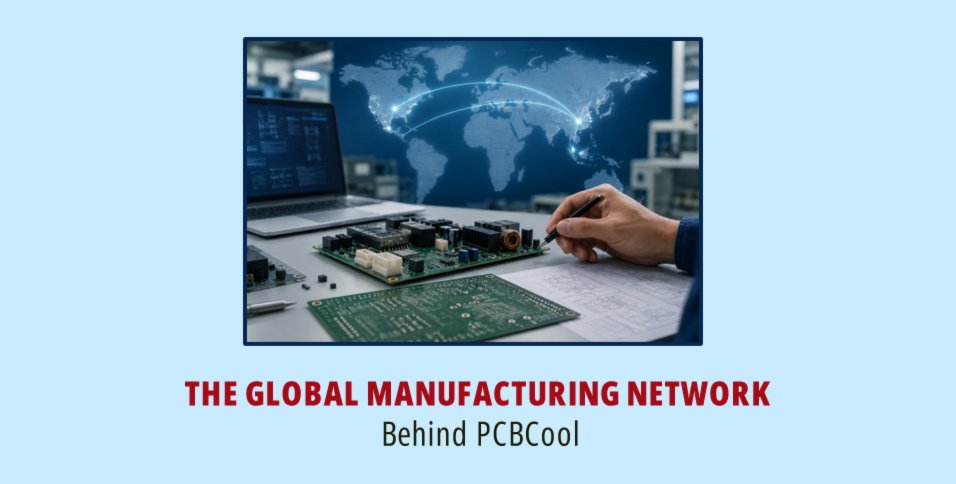
For years, electronics companies could make a fairly straightforward choice: manufacture in China for cost and supply-chain depth, or produce closer to home for shorter logistics and easier oversight. That decision is no longer quite so simple.
Tariffs change. Freight routes become less predictable. Customers ask where products are made, while procurement teams worry about putting too much production in one country. At the same time, moving an electronics project from one factory to another is rarely as easy as forwarding a Gerber file and a BOM.
This is the environment in which PCBCool has been building its international presence.
PCBCool and PS Electronics Co., Ltd.,
PCBCool is a digital brand of PS Electronics rather than a separate manufacturing company. PS Electronics also maintains several other customer-facing websites, including PSPCB, Quick-PCBA, and PCBANow. These names are part of the company’s online marketing and lead back to the same wider manufacturing organization.
For customers, the name on the website matters less than the company behind it. Orders placed through PCBCool are supported by the engineering, procurement, production, and quality resources of PS Electronics.
The company’s PCB assembly operations date back to 2008. Since then, its scope has grown beyond board assembly to include PCB fabrication, component sourcing, testing, programming, and product-level assembly. Its customers include companies developing industrial equipment, connected devices, medical electronics, power products, and consumer hardware.
China Is Still the Center of the Network
PCBCool’s international expansion does not mean it is moving away from China. Quite the opposite: its Chinese operations remain the foundation on which the rest of the network depends.
The company draws on PCB and PCBA manufacturing facilities in Shenzhen, along with a dedicated bare-board production base in Sichuan. Shenzhen also remains the center for R&D, engineering review, project coordination, and much of the company’s electronics supply-chain work.
This matters because electronics manufacturing is unusually difficult to separate from the supply base around it. A production line may be installed almost anywhere, but the surrounding network of laminate suppliers, component distributors, tooling companies, test-equipment providers, and process specialists takes years to build.
Shenzhen offers that depth. When a design has a stack-up problem, an unavailable component, or a package that needs X-ray inspection, the solution often depends on more than the factory itself. It depends on how quickly the manufacturer can reach the right materials, people, and equipment.
For most projects, China therefore remains the natural starting point. PCBCool states that production is normally placed in its Chinese facilities unless the project has requirements that make another location more appropriate.
That is an important detail. The company is not presenting Malaysia and Mexico as replacements for China. They extend what the Chinese operation can offer.
Malaysia Provides a Second Asian Production Base
PS Electronics’ facility in Johor, Malaysia, adds another route for PCB assembly and product manufacturing in Asia.
The site operates SMT, through-hole, and manual assembly lines. It is intended primarily for PCBA and downstream assembly rather than the full range of bare PCB processes available through the company’s Chinese manufacturing base.
For some customers, Malaysia offers a useful alternative when production cannot be concentrated entirely in China. The reason may be related to sourcing policy, delivery planning, country-of-origin preferences, or a customer’s own supply-chain strategy.
The presence of another Asian facility does not mean that a project can be moved overnight. Electronics production depends on approved materials, programmed equipment, test fixtures, process documentation, and trained operators. A transfer still requires planning.
The difference is that the planning can take place within the same manufacturing group. Customers do not have to start again with an unrelated contract manufacturer, rebuild the working relationship, and explain the product from the beginning.
Mexico Changes the Equation for North American Customers
The Mexican operation in Sonora gives PCBCool a manufacturing position much closer to the United States.
Like the Malaysia site, the Mexico facility is focused on PCBA and related assembly work. It operates SMT and through-hole production lines and forms the North American manufacturing arm of the PS Electronics network.
Its value is easy to understand. A North American customer may still rely on China for complex PCB fabrication, engineering support, or component sourcing, while using Mexico for suitable assembly programs closer to the final market.
That does not eliminate international logistics, but it can shorten the final leg of the supply chain and reduce the amount of finished-product inventory moving across the Pacific. It also gives customers another production route when a project has regional manufacturing requirements.
The model is more practical than trying to duplicate every process at every location. China contributes its established PCB and electronics supply base. Mexico contributes proximity to North American customers. The work can be divided according to what the product actually needs.
A supporting U.S. office helps coordinate communication between customers and the factories. It is a regional service and project-support operation, not a manufacturing plant—an important distinction when assessing the company’s real production footprint.
A Network Should Offer More Than Extra Capacity
It is tempting to describe a multi-country manufacturing network only in terms of capacity. More factories mean more lines, more machines, and more available production hours.
That is only part of the story.
The real test is whether the locations can work together without creating more complexity for the customer. A company gains little from adding a second factory if it must manage two engineering teams, two sourcing systems, and two completely different quality processes.
PCBCool’s model is built around keeping those activities within PS Electronics. The production location may change, but the customer remains connected to the same broader organization.
That continuity becomes especially important during the transition from prototype to repeat production. Early builds often change quickly. Components are substituted, footprints are corrected, test procedures evolve, and enclosure details are still being finalized. By the time a product is ready for larger orders, a considerable amount of practical knowledge has accumulated around it.
Moving the project to an unrelated manufacturer can mean losing some of that knowledge. Keeping it within the same network makes the handover more manageable, even when the physical production site changes.
PCBCool does not claim that every project can be built interchangeably in every country. Its own description of the network makes clear that factory selection depends on the process, delivery needs, and customer requirements. Core engineering standards are shared, but work is allocated according to the specialization of each facility.
That is a more credible approach than pretending every factory is the same.
From Circuit Board to Finished Product
The network also reflects how electronics outsourcing has changed.
Many customers are no longer looking for a factory that simply places parts on a PCB. They want someone to review the production files, source components, manufacture the boards, assemble them, load firmware, perform the required testing, and sometimes complete the enclosure assembly before shipment.
PS Electronics has developed its manufacturing services around that wider responsibility. Depending on the project, the work can continue beyond PCBA into cable assembly, product assembly, labeling, packaging, and final testing.
This broader scope is particularly relevant to small and mid-sized hardware companies. A large multinational may have its own global sourcing department and manufacturing engineers stationed at several factories. A smaller company often does not.
Managing a PCB supplier, an assembly house, a component distributor, a test provider, and a box-build contractor can consume a surprising amount of internal time. When something goes wrong, it may also be difficult to establish where the problem began.
A connected manufacturing network does not remove those risks, but it gives the customer one organization responsible for coordinating them.
Global Manufacturing Without Abandoning What Works
PCBCool’s factory network reflects a wider shift in electronics manufacturing. Companies still need the cost, experience, and supply-chain density that China provides, but many no longer want every production decision tied to a single region.
Malaysia and Mexico give PS Electronics room to respond to that concern without discarding the manufacturing base it has already built. The U.S. office adds a closer communication point for North American customers, while China continues to carry much of the engineering and production work.
This is less dramatic than the usual language of “reshoring” or “moving out of China,” but it is probably closer to how manufacturing networks actually evolve.
Factories are not moved like pins on a map. Processes have to be qualified, suppliers developed, and production knowledge transferred. The most useful global networks are therefore not the ones that promise to build everything everywhere. They are the ones that understand what each location does well and connect those locations without making the customer manage the gaps.
That is the structure behind PCBCool: one electronics manufacturer, several customer-facing websites, and a production network that now reaches across Asia and North America.
Its global footprint is still anchored in China. What has changed is the number of routes available around that anchor.