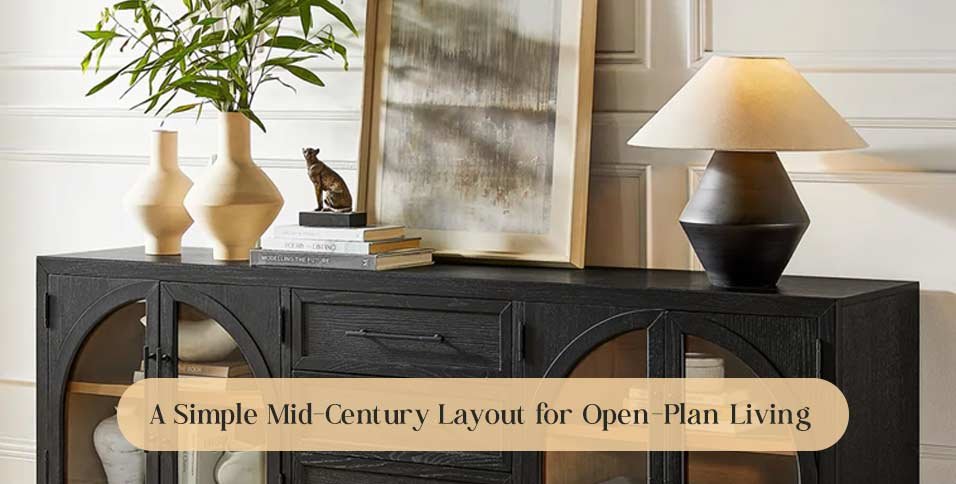
A mid century modern media console and mid century modern sideboard can define separate zones in one open room. Their low profiles and visible legs help, but the layout still needs clear routes, controlled repetition, and storage tied to real activities.
Start with the longest sightline through the space. The mid century modern sideboard should support dining or entry tasks without becoming a barrier, while the television cabinet needs a stable wall, practical outlets, and a direct view from seating.
Use a mid century modern media console as one anchor and let the second cabinet reinforce the room from a quieter position. Matching every detail is unnecessary.
Draw the Traffic Pattern First
Mark doors, kitchen edges, seating, and the route people use between them. A mid century modern media console belongs outside the main crossing path. Include open cabinet doors in the footprint, because a narrow aisle disappears quickly when storage is in use.
Place the mid century modern sideboard near the activity it supports. Dining storage should sit close enough to reduce trips to the kitchen, but far enough from chairs that people can rise and pass without moving furniture during every meal.
- Trace the busiest walking route.
- Tape both cabinet depths on the floor.
- Test doors, drawers, and dining chairs together.
Create Zones Without Building Walls
Open-plan rooms need boundaries that remain visually light. Furniture placement, rugs, and lighting can signal where one activity ends and another begins. Keep both cabinets against walls when possible so the center of the room stays open and flexible.
Make the Media Zone Face One Direction
Set the mid century modern media console on a wall that allows relaxed viewing from the main seats. Check screen reflections at the time you normally watch. Route cables near outlets and follow the equipment maker’s ventilation instructions.
Keep the Dining Zone Permeable
A mid century modern sideboard can define the dining edge without acting like a divider. Its top may serve as a landing surface during meals, while closed storage keeps linens and serving pieces nearby. Leave the walking line beside it visually and physically clear.
Use Rugs as Quiet Boundaries
Place the seating group on one rug and let the dining table establish its own footprint. The mid century modern media console should relate to the seating rug, not float between zones. Repeating one rug color near the dining cabinet helps connect the space.
Preserve a Long View
Avoid tall stacks of decor on either cabinet. Low furniture works because the eye can travel across it. A mid century modern sideboard under horizontal art maintains that openness, while a single taller lamp provides contrast without creating a visual stop.
Repeat the Era Through Shape and Material
The mid century modern media console and mid century modern sideboard can differ in finish if their proportions share a language. Tapered legs, simple pulls, rounded corners, and restrained fronts communicate the period more clearly than identical stain.
Choose a Lead Wood Tone
Let one cabinet establish the dominant wood temperature, then use the other as a close relative or deliberate contrast. Compare finishes beside flooring in daylight. Warm brown, honey, and walnut tones can cooperate when textiles create separation between large surfaces.
Limit Decorative References
One sculptural lamp, one geometric textile, and a few ceramics usually say enough. Avoid filling every surface with period objects. The mid century modern sideboard should still provide a working landing zone, and the television wall needs space around the dark screen.
Use the Same Metal Sparingly
Repeat black, brass, or brushed metal in a lamp, frame, or cabinet pull. A small metal echo can connect the mid century modern media console to the dining area without requiring matching doors or legs across the entire room.
| Layout Decision | Useful Test | What It Protects |
|---|---|---|
| Cabinet position | Open every door fully | Daily access |
| Main walkway | Pass while a chair is occupied | Circulation |
| Wood palette | Compare under two light conditions | Color consistency |
| Surface styling | Keep one landing area clear | Everyday function |
Give Each Cabinet a Narrow Job
Storage becomes easier when items stay near their point of use. Keep entertainment equipment with the mid century modern media console and reserve the mid century modern sideboard for dining, games, paperwork, or another defined household category.
Organize the Screen Wall
The cabinet should hold devices, controllers, media accessories, and spare cables in labeled or obvious zones. A mid century modern media console with closed doors reduces visual noise, but frequently used equipment still needs access, signal clearance, and the airflow specified by its manufacturer.
Heavy items belong low, and a television should rest on furniture designed to support it. In homes where children visit, secure the television and cabinet according to current safety guidance rather than treating low furniture as automatically stable.
Build a Serving Station
A mid century modern sideboard near the dining table can hold napkins, placemats, serving tools, and occasional dishes. Place everyday pieces at comfortable reach and move seasonal items deeper or lower so routine access stays simple.
Test the Layout Through Two Routines
Walk through a normal evening before adding decorative layers. Watch where bags, cups, and mail collect. If the mid century modern media console becomes the default drop zone, create a smaller tray elsewhere and give each object a clear destination.
Run the Weeknight Test
Sit down, use the television, set the table, and open storage while another person moves through the room. The mid century modern sideboard should reduce steps rather than create a bottleneck. Adjust cabinet position before changing the entire furniture plan.
Check whether the screen wall stays manageable after devices are used. Cables should return behind the cabinet, remotes need one home, and ventilation openings must remain clear. A short reset should restore the room without shifting furniture or hiding active equipment.
Run the Hosting Test
Place drinks or serving dishes on the dining cabinet and confirm that guests can circulate around seated people. The television cabinet should remain outside that flow, which protects electronics and keeps the living zone usable during a gathering.
- Prepare one ordinary meal.
- Watch television from every main seat.
- Clear both cabinet tops in five minutes.
Keep the Final Layer Light
Use one strong object, one practical lamp, and open surface on each wall. The room will feel more coherent when proportion and movement connect the zones, not when every accessory announces the same design era.
Open-plan living changes across the day. Keep storage roles simple enough to adapt, and leave the center of the room easy to cross. A restrained layout lets the furniture support that flexibility instead of turning it into decoration.