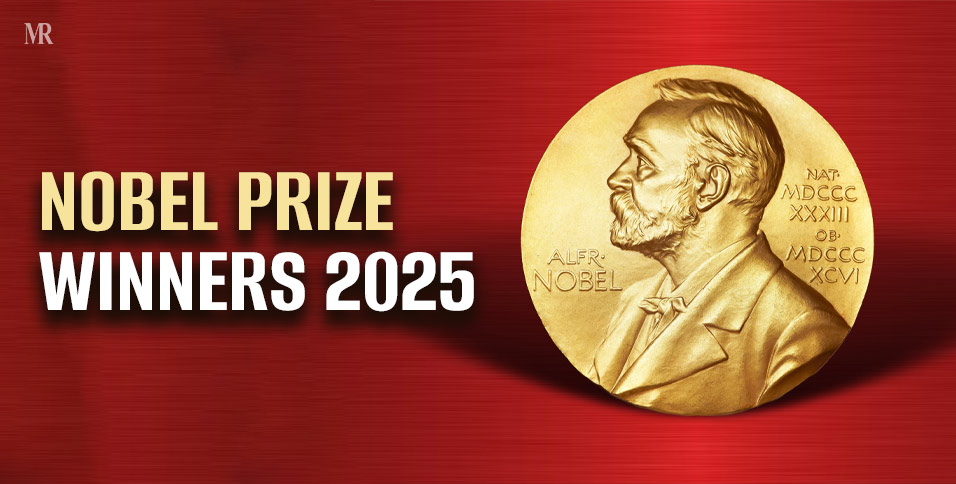
Every year, the Nobel Prize draws global attention by recognizing people whose work has changed how we understand the world, improve lives, or strengthen peace.
The 2025 Nobel Prize winners continued this tradition by honoring discoveries and contributions that range from quantum science and advanced materials to democracy, literature, medicine, and economic growth.
This guide presents a clear, skimmable, and complete overview of the 2025 Nobel Prize winners, based entirely on official information.
What is a Nobel Prize?
The Nobel Prize is an international award established by the will of Alfred Nobel, the inventor of dynamite. It is awarded annually on December 10, which is the anniversary of Alfred Nobel’s death.
While the winners are typically announced in October, the formal ceremony takes place later in the year. The prize has been awarded nearly every year since 1901, with rare exceptions made only during times of world war or if the committee decides no candidate meets the criteria for that specific year.
Today, each winner receives a gold medal, a diploma, and a cash prize (totaling 11 million SEK per category in 2025).
Across what categories are Nobel Prizes awarded?
The Nobel Prizes are awarded in the following categories:
- Nobel Prize in Physics
- Nobel Prize in Chemistry
- Nobel Prize in Physiology or Medicine
- Nobel Prize in Literature
- Nobel Peace Prize
- Economic Sciences (Established in 1968 by Sweden’s central bank in memory of Alfred Nobel)
These categories reflect Alfred Nobel’s original vision, with Economics added later in 1968.
Who were the Nobel Prize winners 2025?
The 2025 list of winners of the Nobel Prize features 13 individuals recognized for their transformative work. Below is a quick-glance table followed by a deep dive into each category.
List of Nobel Prize Winners 2025
| Category | Laureates | Contribution |
| Physics | John Clarke, Michel H. Devoret, John M. Martinis | Macroscopic quantum tunnelling in electric circuits |
| Chemistry | Susumu Kitagawa, Richard Robson, Omar M. Yaghi | Development of metal–organic frameworks |
| Medicine | Mary E. Brunkow, Fred Ramsdell, Shimon Sakaguchi | Discoveries on peripheral immune tolerance |
| Literature | László Krasznahorkai | Visionary literary work reaffirming the power of art |
| Peace | Maria Corina Machado | Promotion of democracy in Venezuela |
| Economics | Joel Mokyr, Philippe Aghion, Peter Howitt | Innovation-driven economic growth |
A. Nobel Prize in Physics 2025
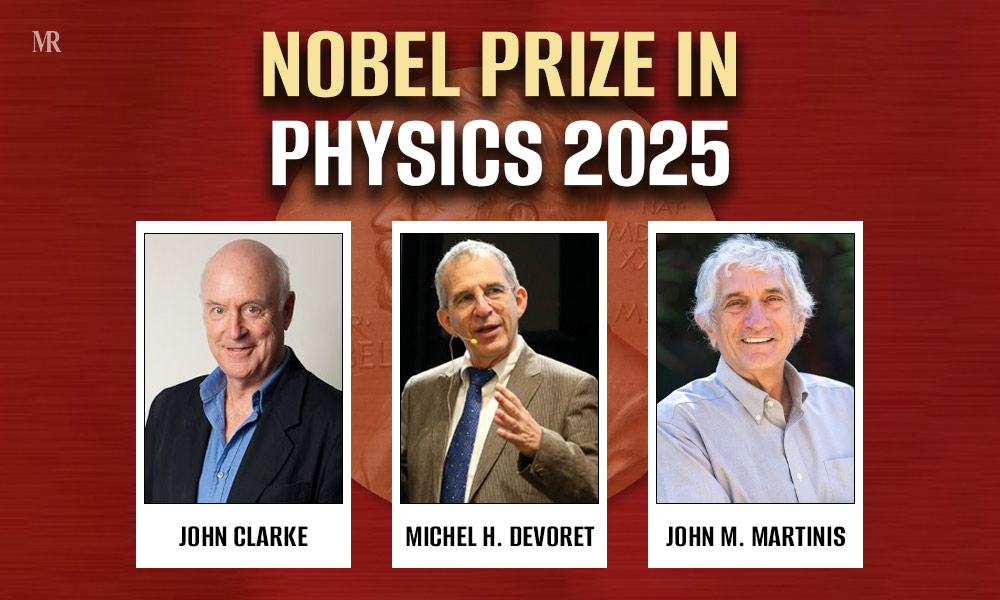
Laureates: John Clarke, Michel H. Devoret, John M. Martinis
Prize motivation: For the discovery of macroscopic quantum mechanical tunnelling and energy quantisation in an electric circuit.
What was the discovery about?
Quantum behaviour usually appears at extremely small scales. In the mid-1980s, the laureates demonstrated that quantum effects could occur at a macroscopic level using superconducting electrical circuits. This work laid the foundation for modern quantum technologies. List of Nobel Peace Prize winners includes:
1. John Clarke
- Born: 1942, Cambridge, United Kingdom
- Affiliation: University of California, Berkeley, USA
- Prize share: 1/3
2. Michel H. Devoret
- Born: 1953, Paris, France
- Affiliation: Yale University; University of California, Santa Barbara; Google Quantum AI
- Prize share: 1/3
3. John M. Martinis
- Born: 1958
- Affiliation: University of California, Santa Barbara; Qolab
- Prize share: 1/3
B. Nobel Prize in Chemistry 2025
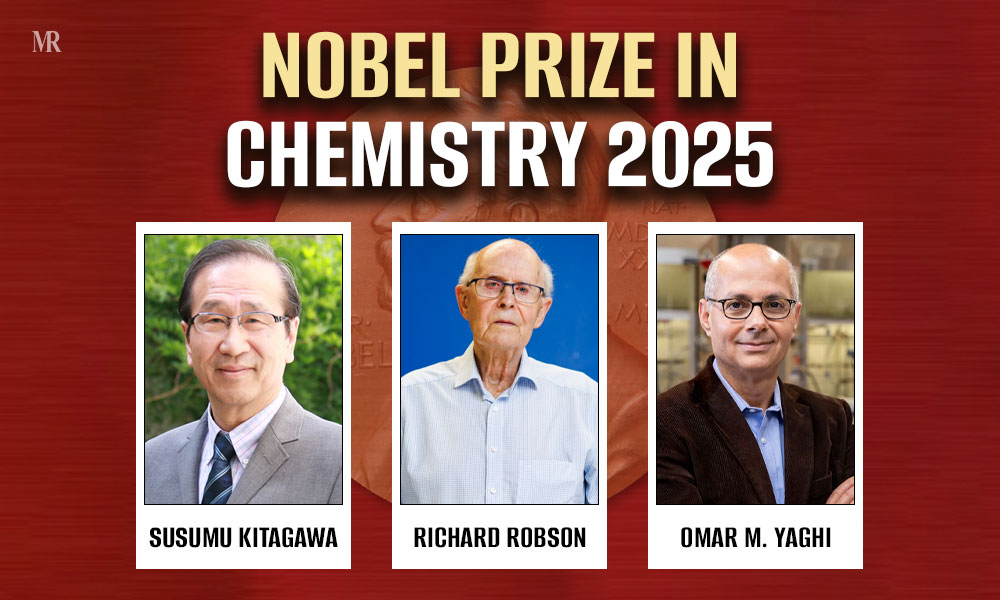
Laureates: Susumu Kitagawa, Richard Robson, Omar M. Yaghi
Prize motivation: For the development of metal–organic frameworks (MOFs)
Why are MOFs important?
Metal–organic frameworks are highly porous materials that can trap, store, or separate substances at the molecular level. They have practical uses in carbon capture, water harvesting, gas storage, and catalysis.
1. Susumu Kitagawa
- Born: 4 July 1951, Kyoto, Japan
- Affiliation: Kyoto University
- Prize share: 1/3
2. Richard Robson
- Born: 4 June 1937, Glusburn, United Kingdom
- Affiliation: University of Melbourne, Australia
- Prize share: 1/3
3. Omar M. Yaghi
- Born: 9 February 1965, Amman, Jordan
- Affiliation: University of California, Berkeley, USA
- Prize share: 1/3
C. Nobel Prize in Physiology or Medicine 2025
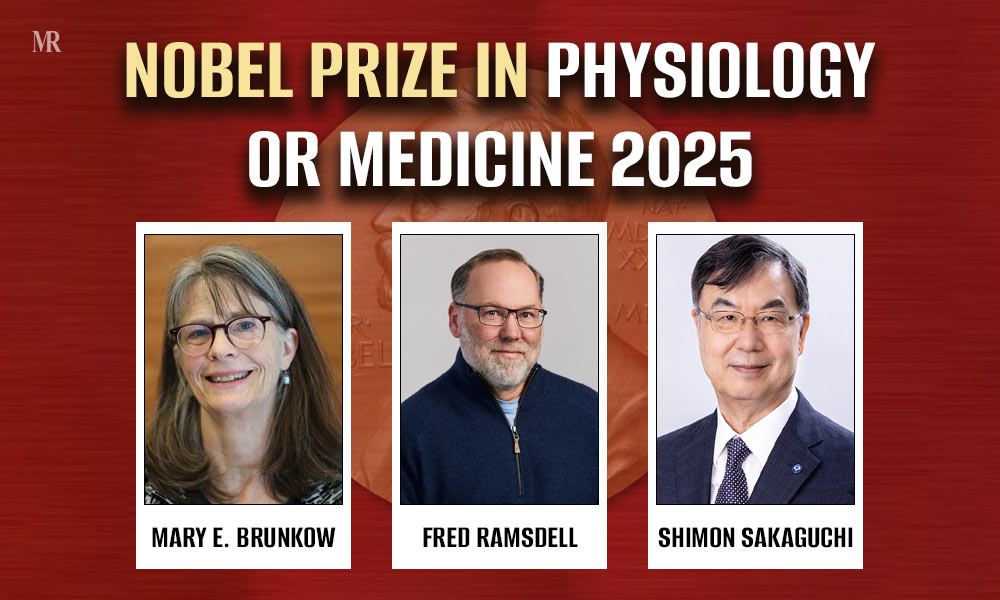
Laureates: Mary E. Brunkow, Fred Ramsdell, Shimon Sakaguchi
Prize motivation: For discoveries concerning peripheral immune tolerance
Why does this research matter?
The immune system must distinguish between harmful invaders and the body’s own tissues. The laureates revealed how regulatory T cells prevent autoimmune diseases, enabling better treatments for cancer, immune disorders, and organ transplantation.
1. Mary E. Brunkow
- Born: 1961, Portland, USA
- Affiliation: Institute for Systems Biology, Seattle
- Prize share: 1/3
2. Fred Ramsdell
- Born: 4 December 1960, Elmhurst, USA
- Affiliation: Sonoma Biotherapeutics
- Prize share: 1/3
3. Shimon Sakaguchi
- Born: 19 January 1951, Shiga, Japan
- Affiliation: University of Osaka
- Prize share: 1/3
D. Nobel Prize in Literature 2025
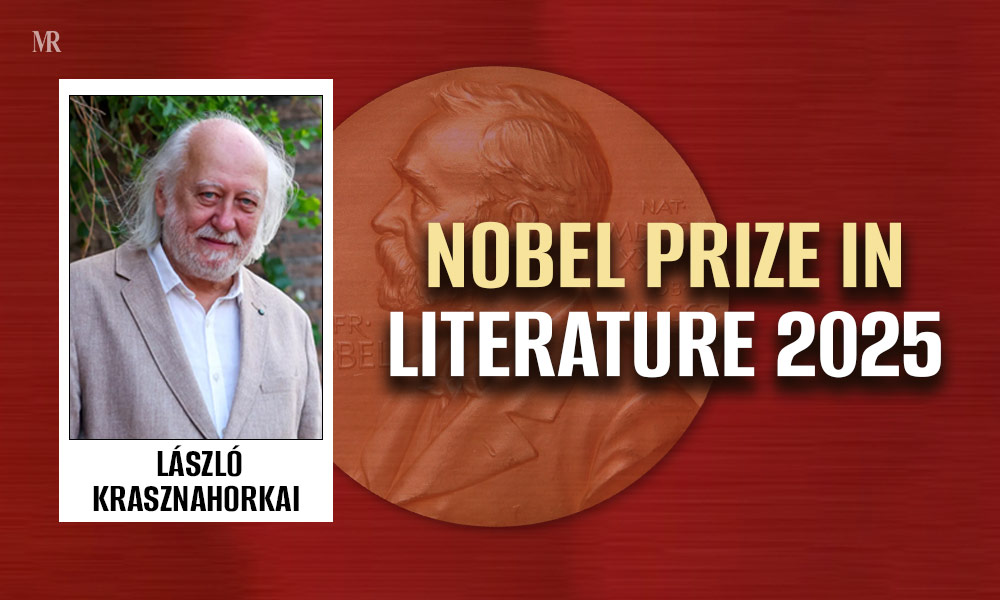
Laureate: László Krasznahorkai
Prize motivation: For his compelling and visionary oeuvre that reaffirms the power of art
Why was he selected?
Nobel Lit Prize winner László Krasznahorkai’s work reflects themes of pessimism, apocalypse, and human uncertainty while maintaining literary depth and originality.
Key facts:
- Born: 5 January 1954, Gyula, Hungary
- Language: Hungarian
- Prize share: 1/1
Notable works include Satantango, The Melancholy of Resistance, and War & War.
E. Nobel Peace Prize 2025
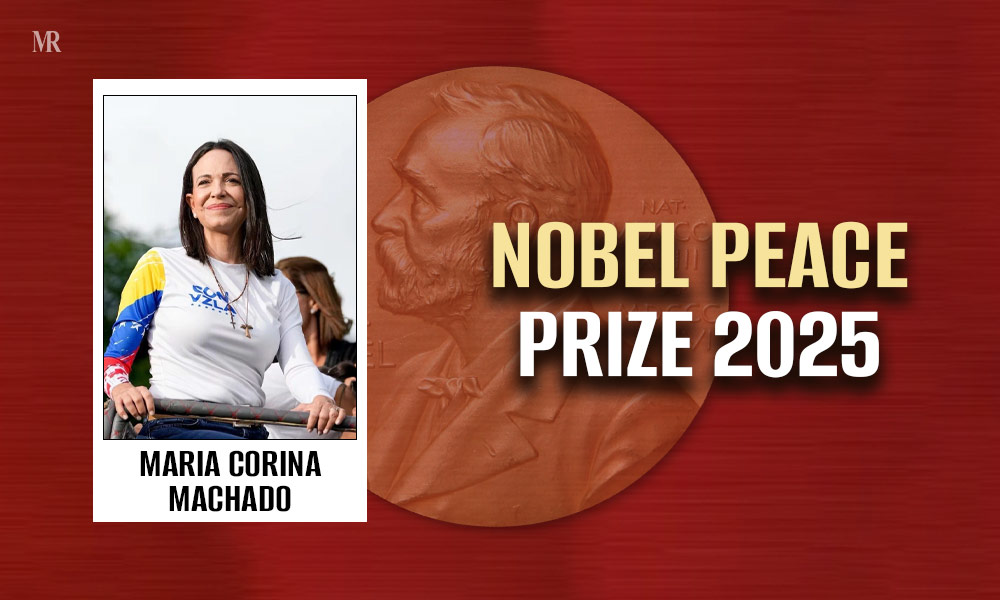
Laureate: Maria Corina Machado
Prize motivation: For her tireless work promoting democratic rights in Venezuela
Why did she receive the Nobel Peace Prize?
Maria Corina Machado has led Venezuela’s democratic movement under increasing authoritarianism. Her work emphasizes free elections, civic rights, and peaceful political transition.
Key highlights:
- Born: 1967, Venezuela
- Founder of Atenea Foundation and Súmate
- Leader of Vente Venezuela opposition party
- Prize share: 1/1
Her recognition places her among prominent world Nobel Peace Prize winners.
F. Nobel Prize in Economic Sciences 2025
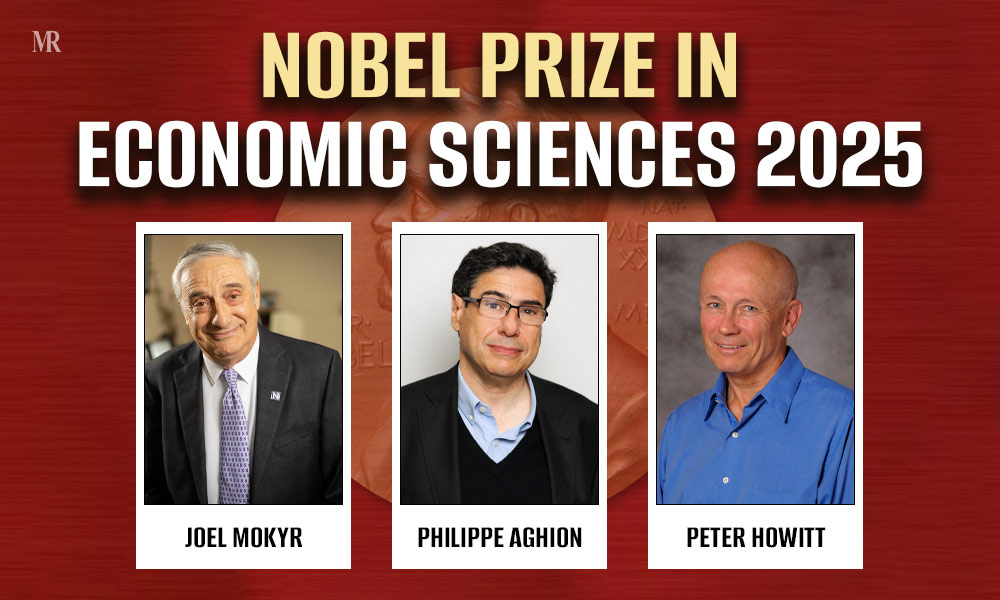
Laureates: Joel Mokyr, Philippe Aghion, Peter Howitt
Prize motivation: For explaining innovation-driven economic growth
1. Joel Mokyr
- Born: 26 July 1946, Netherlands
- Affiliation: Northwestern University; Tel Aviv University
- Focus: Historical roots of technological progress
- Prize share: 1/2
2. Philippe Aghion
- Born: 17 August 1956, Paris, France
- Affiliation: Collège de France; LSE; INSEAD
- Focus: Creative destruction theory
- Prize share: 1/4
3. Peter Howitt
- Born: 31 May 1946, Canada
- Affiliation: Brown University
- Focus: Growth through innovation cycles
- Prize share: 1/4
Why are Nobel Prizes shared?
Nobel Prizes are often shared to accurately reflect how modern discoveries and contributions are made. Many breakthroughs today are not the result of a single individual working in isolation, but of sustained efforts by multiple researchers whose work is closely connected.
Nobel Prizes are shared for the following key reasons:
- Collaborative discoveries
In many scientific fields, major advances emerge from teamwork. Researchers may work together over many years, combining experimental work, theory, and validation. When a discovery could not have been achieved without joint effort, the Nobel committees divide the prize to recognize each contributor fairly.
- Interdependent contributions
Sometimes, one researcher’s work builds directly on another’s findings. Even if the scientists did not work side by side, their contributions are deeply linked. In such cases, the Nobel Prize is shared to acknowledge that the breakthrough was only possible through a sequence of connected insights.
- Independent research leading to the same breakthrough
It is common for researchers in different parts of the world to reach similar conclusions independently. When separate teams arrive at the same discovery around the same time, the Nobel committees may award a shared prize to recognize parallel innovation.
Sharing the Nobel Prize ensures that credit reflects the reality of scientific and intellectual progress while maintaining the prize’s integrity and prestige.
How was the 2025 list of Nobel Prize winners different from previous years?
The 2025 Nobel Prize winners stood out for their strong emphasis on foundational knowledge and long-term impact rather than short-term applications or commercial outcomes. Key differences include:
- Stronger focus on foundational science
In Physics and Chemistry, the awards recognized discoveries that deepen basic scientific understanding. Instead of applied technologies or products, the focus was on principles, such as macroscopic quantum behavior and material frameworks, that enable future innovations across multiple industries.
- Clear recognition of democracy and political rights in the Peace Prize
The Nobel Peace Prize 2025 highlighted the defense of democratic values under authoritarian pressure. By honoring Maria Corina Machado, the committee emphasized political freedom, fair elections, and civic rights as essential foundations for peace, both nationally and globally.
- Emphasis on long-term economic growth models
The Economics Prize focused on explaining why some societies achieve sustained growth over centuries. Rather than short-term policy tools, the laureates’ work addressed innovation, technological change, and creative destruction as enduring drivers of economic progress.
- Literature prize highlighting philosophical and experimental writing
The Nobel Prize in Literature 2025 moved away from traditional narrative styles and celebrated a body of work known for complex structure, long-form prose, and existential themes. This signaled renewed recognition of experimental and intellectually demanding literature.
Overall, the 2025 list of Nobel Prize winners reflected a return to core ideas of knowledge, freedom, creativity, and long-term progress, reinforcing the Nobel tradition of honoring contributions that shape hum
Conclusion
The 2025 Nobel Prize winners reflect humanity’s ongoing quest for knowledge, justice, creativity, and progress.
From quantum physics and immune science to democracy and literature, this year’s laureates demonstrate how sustained dedication can shape the future.
Together, they add a significant chapter to the evolving list of Nobel Prize winners across the world.
Maria Isabel Rodrigues
FAQs
- Why are there only 6 categories for noble prize?
There are only 6 categories for noble prize, which were strictly defined in Alfred Nobel’s 1895 will. Economics is the only “new” addition, added in 1968 to celebrate the 300th anniversary of the Swedish Central Bank.
- On what basis were the Nobel Prize winners chosen?
The Nobel Prize winners are chosen on the basis of Scientific or intellectual originality, long-term impact on humanity, verified and peer-reviewed contributions, and alignment with Alfred Nobel’s will
- Do Nobel Peace Prize winners get money?
Nobel Peace Prize winners get money by receiving a cash award from the Nobel Foundation, which is funded by the legacy of Alfred Nobel. In 2025, each full Nobel Prize was worth 11 million Swedish kronor (approximately $1.04 million USD). If there are multiple winners in a category, the money is split among them. In addition to the funds, winners receive an 18-carat gold medal and a unique hand-crafted diploma.
Also Read: Top Inventions in Medicine by Nobel Prize Winners