Mirror Review
March 20, 2026
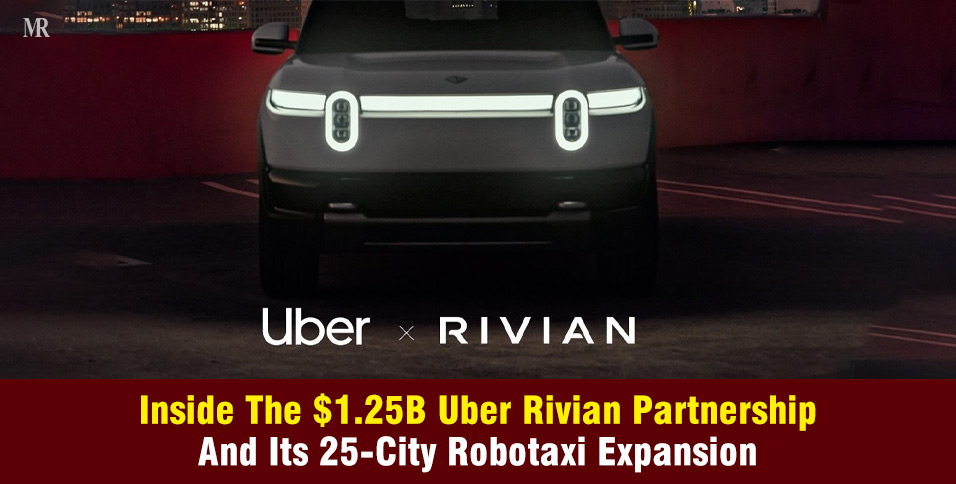
Uber Technologies will invest up to $1.25 billion in Rivian Automotive to deploy as many as 50,000 fully autonomous R2 robotaxis across 25 cities by 2031.
This Uber Rivian Partnership marks one of the biggest bets yet on driverless mobility, as both companies race to scale autonomous fleets globally.
The decision aims to reshape ride-hailing with AI-powered, zero-emission vehicles.
Breaking Down The Uber Rivian Partnership
The scale of this new Uber-Rivian deal is enormous.
Official reports confirm that Uber invests up to $1.25 billion in Rivian for robotaxi fleet expansion through 2031. This massive financial commitment relies on Rivian successfully hitting specific autonomous performance milestones.
Here is a quick look at the deployment numbers:
- Initial Funding: Uber committed an initial $300 million investment immediately following the signing.
- Phase One Fleet: Uber and its fleet partners expect to purchase 10,000 fully autonomous R2 robotaxis.
- Future Options: The companies hold an option to negotiate the purchase of up to 40,000 additional vehicles beginning in 2030.
The 25 City Rollout Plan
The companies have an aggressive timeline for getting these vehicles to the general public.
Initial commercial deployments are planned for San Francisco and Miami in 2028.
From there, the service will scale rapidly.
The companies plan to expand into 25 cities across the United States, Canada, and Europe by the end of 2031.
Moreover, these self-driving cars will be available exclusively through the Uber platform.
Why is Uber investing in Rivian?
Uber CEO Dara Khosrowshahi stated that his company strongly believes in how Rivian designs its vehicles, compute platforms, and software stacks altogether.
He stated, “That vertical integration, combined with data from their growing consumer vehicle base and experience managing the complexities of commercial fleets, gives us conviction to set these ambitious but achievable targets.”
Advanced Tech Behind The Wheel
While many early fans know the brand for the older R1s Rivian Uber Partnership, new discussions focus entirely on the upcoming R2 platform.
Rivian announced its third-generation autonomy platform in December 2025. This consumer platform will launch in the R2 model in late 2026.
The vehicle hardware includes a powerful multimodal sensor suite:
- 11 cameras operating at 65 megapixels.
- 5 sophisticated radars.
- 1 LiDAR sensor to capture critical 3D point clouds.
Furthermore, two in-house RAP1 chips, capable of 1600 TOPS of AI compute performance, drive this advanced platform.
Rivian Founder and CEO RJ Scaringe expressed immense excitement about the Uber Rivian Partnership, explaining, “It will help accelerate our path to level 4 autonomy to create one of the safest and most convenient autonomous platforms in the world.”
He further added, “The scale of Rivian’s growing data flywheel, coupled with RAP1, our state-of-the-art in-house inference platform, and our multi-modal perception platform make us incredibly excited for the rapid advancement of Rivian autonomy over the next couple of years.”
The Scale Of The Uber Rivian Investment
The stock market reacted quickly to the Uber Rivian investment news.
Shares of Rivian stock jumped roughly 10% in premarket trading before settling to close the day 3% higher. Meanwhile, Uber stock saw a slight 1% decline.
This Uber Rivian partnership follows a broader trend of massive capital investments in the electric vehicle space.
For instance, Rivian recently secured a $5.8 billion software deal with German automaker Volkswagen in late 2024, which contributed to its 2025 earnings.
Uber is also aggressively pursuing a driverless future, having made recent robotaxi announcements with Lucid, Stellantis, Nvidia, and Amazon’s Zoox.
End Note
The race for fully autonomous ride-hailing is speeding up every single day.
The Uber Rivian Partnership stands out as one of the most significant and well-funded moves in the industry so far.
Thus, by combining cutting-edge electric vehicle technology with the largest mobility network in the world, this alliance is positioned to change how we commute forever.
Maria Isabel Rodrigues