March 05, 2026
In the United States, data centers already account for about 4 to 6% of total electricity demand, and some projections suggest that figure could double by 2028 as AI adoption accelerates.
That surge has raised a major concern: If electricity demand keeps rising, will households end up paying higher power bills?
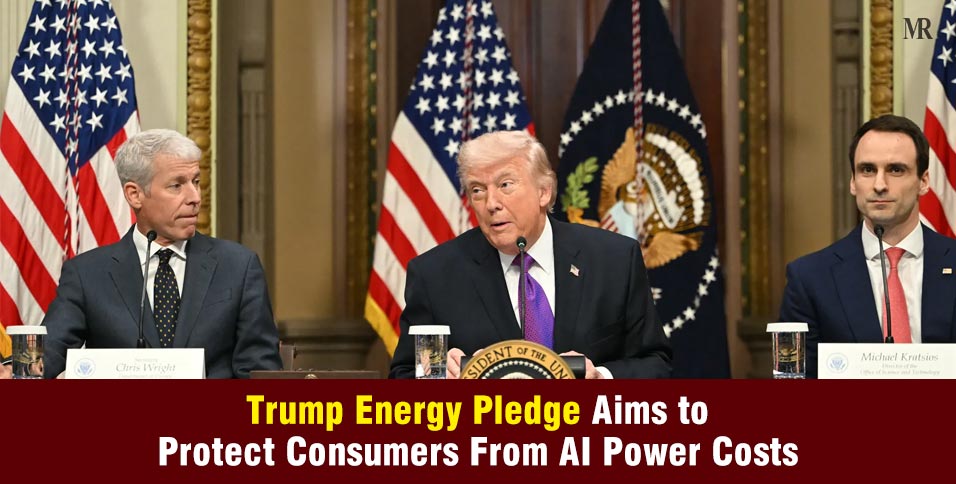
The Trump Energy Pledge is designed to prevent that. Announced on March 4, 2026, at the White House, the initiative asks major AI and cloud companies to pay for the energy and infrastructure needed to run their data centers instead of shifting those costs to electricity consumers.
What Is the Trump AI Energy Pledge?
The Trump Energy Pledge, formally called the Ratepayer Protection Pledge, brings together leading AI and cloud companies to ensure that electricity costs tied to data centers are not passed to consumers.
Seven major firms signed the pledge:
- Amazon
- Meta
- Microsoft
- OpenAI
- Oracle
- xAI
These companies agreed to build, bring, or buy new electricity generation resources and cover the cost of transmission infrastructure needed for their facilities.
They also committed to negotiating separate electricity rate structures with utilities and paying those rates whether they use the full power capacity or not.
President Donald Trump framed the initiative as a consumer protection measure during the announcement, stating, “The American people should not be paying higher electricity bills because of data centers.”
Why AI Is Driving a Power Demand Surge
The rapid rise of generative AI has dramatically increased demand for computing infrastructure.
Training large AI models requires thousands of specialized processors running continuously inside massive server farms.
This has triggered a surge in electricity demand across U.S. power markets.
Several key indicators highlight the scale of the challenge:
| Indicator | Data |
| Share of U.S. electricity used by data centers | 4–6% today |
| Possible share by 2028 | Up to 12% |
| Power consumption of a hyperscale data center | 100–300 MW |
| Electricity equivalent | Similar to powering a small city |
Utilities have warned that the rapid expansion of data centers could require new power plants, expanded transmission lines, and major grid upgrades.
Without clear cost allocation, those investments could eventually be reflected in consumer electricity bills.
Tech Companies Are Already Racing to Secure Energy
Even before the pledge, technology firms had begun searching for reliable electricity sources to support their AI ambitions.
Several strategies are emerging across the industry:
- Building dedicated power plants near data centers
- Signing long-term energy purchase agreements
- Investing in nuclear, natural gas, and renewable energy projects
Large AI computing clusters can consume hundreds of megawatts of electricity continuously, making energy security a critical issue for the sector.
Industry analysts estimate that global spending on AI data center infrastructure could reach hundreds of billions of dollars this decade, with energy supply becoming one of the biggest constraints.
The Grid Pressure Behind the Trump AI Energy Pledge
The Trump AI pledge also reflects growing concern about the capacity of the U.S. electric grid.
Electricity demand is rising from several directions at once:
- AI data center expansion
- Growth in domestic manufacturing
- Electrification of vehicles and industries
Energy officials say these combined pressures could strain aging grid infrastructure if supply does not keep pace.
The administration has pointed to broader energy initiatives aimed at expanding domestic power production, including regulatory changes and efforts to accelerate nuclear deployment for data centers.
According to the White House, recent actions have preserved 17,000 megawatts of generating capacity, enough electricity to power about 12.75 million homes.
Critics Question How Much the Pledge Will Change
Despite the announcement, some analysts say the Trump Energy Pledge may have limited practical impact.
Several concerns have been raised:
1. The pledge is voluntary
The agreement is not a federal regulation, meaning companies are not legally required to comply beyond their commitments.
2. Energy pricing is controlled locally
Electricity rates are typically set by state regulators and utility commissions, not the federal government.
3. The broader grid challenge remains
Even if companies fund their own infrastructure, the rapid growth of AI data centers will still require large-scale expansion of electricity generation and transmission.
Energy experts say the pledge addresses the question of who pays, but not necessarily the larger issue of how quickly new energy capacity can be built.
The Bigger Story Behind the Trump Energy Pledge
The Trump Energy Pledge highlights an important shift in the technology industry. Artificial intelligence is no longer just a software race. It is also an energy race.
Data centers are quickly becoming some of the largest electricity consumers in the modern economy. And as AI systems grow more powerful, their energy footprint will grow with them.
That means the future of AI will depend not only on algorithms and chips, but also on power plants, electric grids, and energy policy.
For policymakers, the challenge is clear. Encourage innovation while ensuring that the cost of powering the AI revolution does not land on ordinary consumers.
The Trump Data Center Pledge is one attempt to strike that balance as the next phase of the AI economy begins.
Maria Isabel Rodrigues