Mirror Review
October 23, 2025
After years of explosive growth, the global electric vehicle (EV) market is cooling.
High interest rates, slower consumer adoption, and uneven charging infrastructure are tempering demand.
Automakers that once rushed to electrify their lineups are now adjusting by striking a balance between sales growth and profitability.
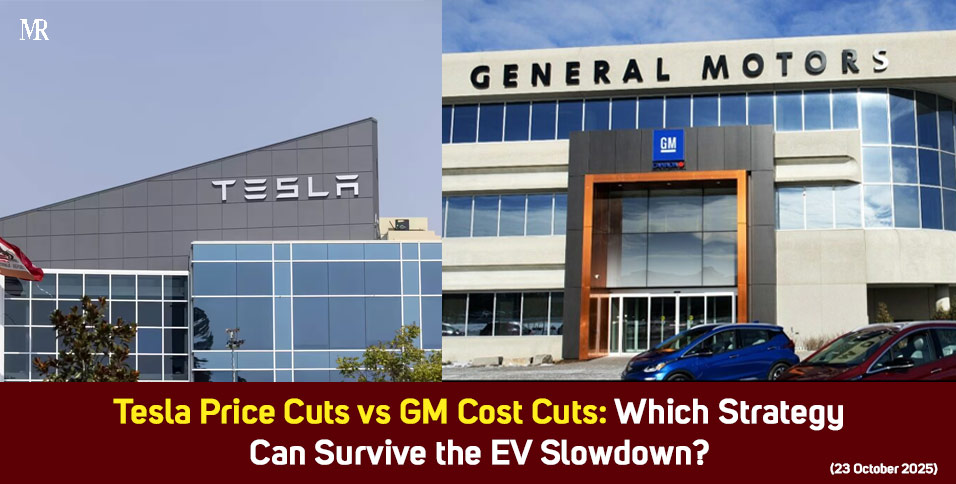
Two industry leaders, Tesla and General Motors (GM), have taken opposite routes through this EV slowdown:
- Tesla is using lower-priced trims and selective price reductions to protect market share.
- GM is realigning production and cutting structural costs to protect margins.
Both approaches reflect each company’s DNA. Tesla’s drive for dominance versus GM’s focus on financial discipline.
Tesla’s Strategy: Lower Prices to Defend Market Share
Tesla’s Q3 2025 earnings show a company chasing volume, even as profits feel the pressure.
Key Highlights from Q3 2025 Tesla Earnings:
- Revenue: $28.1 billion, up 12% YoY.
- Operating Income: $1.6 billion, down 40% YoY.
- Free Cash Flow: Record $3.99 billion.
- Cash and Investments: $41.6 billion.
- Deliveries: Nearly 497,000 vehicles, up 7% YoY.
During the quarter, Tesla introduced new “Standard” trims for the Model 3 and Model Y. These cars are lower-entry versions launched in October 2025 that reduce starting prices and broaden appeal. Analysts link these push-for-affordability moves to Tesla’s strategy to keep factories busy even as EV demand softens.
This approach has clear advantages:
- Lower prices (and higher tariffs) increased Tesla’s average cost per vehicle.
- Margin compression followed as fixed-cost absorption dropped.
- Yet strong free cash flow and a big cash reserve give Tesla breathing space.
Beyond cars, Tesla’s Energy Generation & Storage revenue jumped 44% YoY, reaching $3.4 billion, and deployed 12.5 GWh.
Furthermore, its AI-enabled services, like Autobidder and the Virtual Power Plant platform, are helping the business build recurring, software-style income.
Tesla also keeps ramping up its bets on AI and autonomy:
- Every vehicle ships with full self-driving hardware.
- A ride-hailing pilot using Robotaxi technology began in the Bay Area.
- The company is scaling its AI-training compute fleet (H100-class GPUs).
Tesla CEO Elon Musk commented during the earnings call: “We’re at a critical inflection point for Tesla and our strategy going forward as we bring AI into the real world.” Furthermore, he added that he is “100% confident” Tesla can solve full self-driving at a “safety level far greater than a human.”
In essence, Tesla is trading short-term margin for long-term ecosystem growth.
GM’s Strategy: Realign & Cost Cuts to Protect Profitability
While Tesla plays offense, GM is choosing defense. Its Q3 2025 results reflect a company focused on discipline and balance.
GM Q3 2025 Earnings:
- GM recorded stable top-line revenue but lower net income, affected by tariffs and restructuring charges.
- The company booked a $1.6 billion “EV Strategic Realignment” adjustment — part of reassessing EV capacity and manufacturing footprint.
- Management reaffirmed material-cost-reduction programs and efficiency initiatives aimed at saving several billion dollars by 2026.
GM’s approach focuses on:
- Cost efficiency: Delaying selected Ultium-based EV launches and battery-plant expansions to conserve capital.
- Profit preservation: Leveraging profitable ICE and hybrid models to fund the EV transition.
- Operational discipline: Streamlining workforce and simplifying manufacturing operations.
This strategy shields GM from near-term losses but risks slower share growth if demand rebounds faster than expected.
Two Contrasting Strategies, One Industry Challenge
Tesla and GM represent two sides of the EV slowdown:
| Tesla | GM |
| Volume-first model | Margin-first model |
| Lower-priced trims to sustain demand | $1.6 B EV realignment to curb costs |
| Heavy investment in AI, autonomy, and energy | Strategic slowdown in EV rollout |
| Record free cash flow despite margin pressure | Stable cash from ICE & hybrids funds EV shift |
Tesla’s advantages:
- Scale allows it to cut prices without burning cash.
- A strong energy business and $41B cash reserve buffer volatility.
- AI-led monetization could eventually lift margins again.
GM’s strengths:
- Leaner operations protect profitability during uncertain demand.
- Balanced reliance on ICE, hybrid, and EV portfolios.
- More predictable returns for investors during volatility.
Both face the same hurdles, tariffs, higher financing costs, and uneven EV incentives. But they’ve chosen sharply different paths through them.
What We Don’t Know Yet
- Tesla: The company hasn’t quantified the full global impact of its pricing and new trims on average selling price (ASP). Analysts estimate cuts of 5–15% in some markets, but filings don’t confirm an exact figure.
- GM: Its cost-reduction programs mix one-time restructuring charges and long-term efficiency plans. The recurring savings won’t be clear until mid-2026.
Both firms are still adapting to demand that shifts quarter by quarter.
What Will Survive the EV Slowdown?
The EV slowdown is changing industry priorities. Top car companies are shifting from growth at all costs to sustainable growth with discipline.
Here’s what the next phase will look like:
1. Scale Still Matters — But Profitability Matters More
Tesla’s volume dominance gives it leverage in supply chains, but investors are watching for signs of profit recovery. GM’s steady cash flow buys it time to scale on its own terms.
2. Diversification Will Decide Long-Term Winners
Tesla’s expansion into energy storage, software, and robotics is giving it more stable revenue streams. GM, meanwhile, will need to accelerate similar diversification to stay relevant beyond vehicles.
3. Innovation and Timing Are Key
When demand rebounds, the company with the most adaptable cost structure and innovative lineup will lead. Tesla’s speed gives it a head start, but GM’s discipline offers staying power.
Final Verdict
The EV slowdown isn’t a setback; it’s a stress test.
Both Tesla and General Motors are adapting to a maturing EV market that now rewards balance, not just ambition.
- If the EV slowdown is temporary or demand is price-sensitive, Tesla’s price cuts can buy volume and long-term advantage (provided those cuts are matched by aggressive cost reductions).
- If the slowdown is deeper or incentive-driven and prolonged, GM’s cost-cutting and capacity readjustment is the more sustainable strategy to survive and reposition for the recovery.
The automaker that best blends scale, innovation, and financial discipline will define the next chapter of electric mobility.