Mirror Review
February 04, 2026
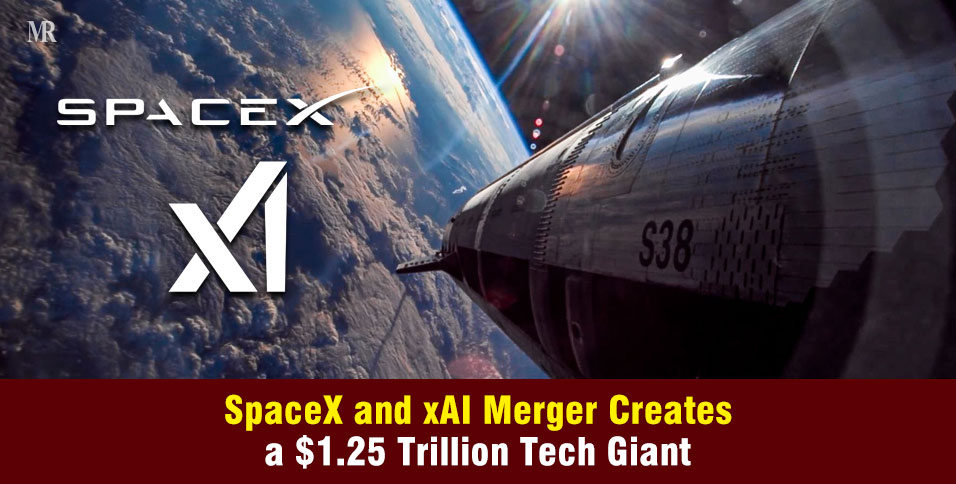
The SpaceX and xAI merger has created the most valuable private company in history, with a combined valuation of $1.25 trillion. The deal brings together Elon Musk’s profitable space business and his fast-growing but cash-burning artificial intelligence venture into one integrated powerhouse.
The move signals a shift in how Musk plans to scale AI, fund innovation, and position his empire for a future public listing.
What Happened in the SpaceX and xAI Merger
SpaceX has officially acquired xAI in a stock-based transaction that values:
- SpaceX at $1 trillion
- xAI at $250 billion
- Combined entity at $1.25 trillion
Following the deal, Elon Musk owns an estimated 43 percent stake in the combined company, now worth around $542 billion. The deal has also made Elon Musk the richest person on Earth, with his net worth crossing $800 billion, according to Forbes estimates.
Musk confirmed the merger internally, describing it as a step toward building a vertically integrated innovation engine that spans rockets, satellites, AI models, and global communications.
Why SpaceX Acquired xAI Now
The timing of the SpaceX and xAI merger matters.
SpaceX is profitable. Reports show it generated roughly $16 billion in revenue and about $8 billion in profit last year, driven mainly by Starlink and government contracts.
xAI, on the other hand, is spending aggressively. The AI startup is reportedly burning close to $1 billion per month as it builds data centers, trains models, and competes with OpenAI, Google, and Anthropic.
By merging the two, Musk effectively gives xAI access to SpaceX’s cash flow, infrastructure, and launch capabilities.
As Musk put it in a memo to employees: “In the long term, space-based AI is the only way to scale.”
The Strategic Vision Behind the Deal
1. AI Data Centers in Space
Musk argues that Earth-based data centers face growing limits due to power use, cooling needs, and public opposition. His proposed solution is space-based data centers powered by solar energy and supported by Starlink.
SpaceX has already filed plans with regulators to launch an orbital data center system that could eventually involve hundreds of thousands of satellites.
2. Vertical Integration at Scale
The merged company now controls:
- Launch systems through SpaceX
- Satellite internet via Starlink
- AI models like Grok
- Real-time data from the X platform
This level of integration is rare, even by Big Tech standards, and gives Musk tighter control over data, compute, and distribution.
How This Merger Changes Musk’s Business Empire
The SpaceX xAI merger marks a clear shift away from Tesla as Musk’s primary value driver.
Key comparisons:
- Musk owns about 43 percent of SpaceX
- He owns roughly 12 to 13 percent of Tesla
- SpaceX now represents more than half of his paper wealth
Tesla’s market cap remains higher, but its growth has slowed, while SpaceX continues to expand through Starlink, defense contracts, and launch dominance.
This makes SpaceX the center of what investors increasingly call the “Muskonomy.”
Investor and Regulatory Concerns
The deal is bold, but not without financial risks, such as:
- xAI remains unprofitable
- Space-based AI infrastructure would require massive capital
- Launching and maintaining orbital data centers present unknown costs
xAI also faces investigations in multiple regions over AI-generated content. Legal experts warn that these risks could spill over to SpaceX, especially given its international operations and government contracts.
Columbia law professor Eric Talley noted that regulators may judge companies “in good standing overall,” not just by subsidiary.
What This Means for a Future IPO
Sources familiar with the matter say SpaceX is still considering an IPO later this year, potentially aiming to raise up to $50 billion.
If that happens, the SpaceX and xAI merger will soon face public market scrutiny. Investors will need to decide whether Musk’s long-term vision justifies combining a stable, profitable space business with a high-risk AI venture.
As one investor put it, the bet is that the combined company will eventually be worth far more than SpaceX alone.
The Bigger Picture
This is not Musk’s first internal consolidation. He previously merged xAI with X and Tesla with SolarCity. History shows these moves often face criticism at first but reshape entire industries over time.
The SpaceX and xAI merger follows the same pattern. It blends ambition, risk, and scale in a way few executives would attempt.
Conclusion
The SpaceX and xAI merger has created a $1.25 trillion company that sits at the intersection of space, artificial intelligence, and global connectivity.
Supporters see it as a logical step toward scaling AI beyond Earth. Critics view it as a high-stakes financial rescue wrapped in futurism.
Either way, the merger redraws the map of private technology power.
If Musk executes well and markets cooperate, the SpaceX xAI merger could become one of the most consequential corporate moves of the decade.
Maria Isabel Rodrigues