Mirror Review
November 19, 2025
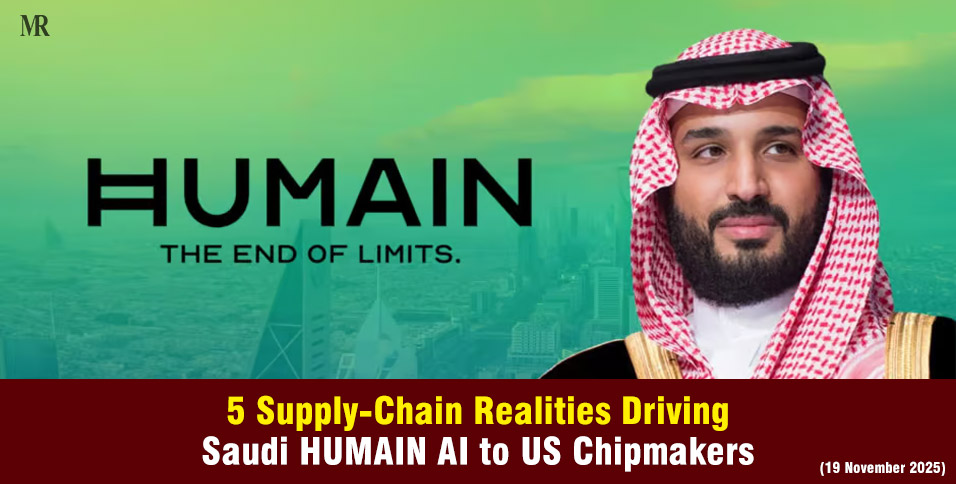
HUMAIN AI is Saudi Arabia’s PIF-backed artificial intelligence venture, which has signed major deals with U.S. technology firms as it prepares to build large AI data centers.
Its early deals include a more than $5 billion AWS AI Zone, 18,000 NVIDIA GB300 GPUs for the first buildout, and a $10 billion partnership with AMD to bring in hundreds of megawatts of compute.
These agreements gives Saudi HUMAIN AI the chips, software tools, and cloud support it needs to get its AI plans off the ground quickly.
One thing stands out: almost all the core technology is coming from the United States.
This is not random. It reflects a set of supply-chain realities that shape how countries can build large AI infrastructure today.
Here are the five reasons Saudi HUMAIN AI is relying on U.S. chipmakers.
- Cutting-edge AI silicon is still a U.S.-controlled market
Saudi HUMAIN AI needs high-end training accelerators for massive foundation-model workloads. Most of the world’s top-tier AI chips, like NVIDIA’s GB300 and AMD’s MI350, are designed, manufactured, optimized, and supported by U.S. companies.
This concentration of capability leaves countries building large AI infrastructure with a simple reality: if you want the fastest compute cycles and the most stable roadmaps, you buy American hardware.
- Integrated software stacks reduce deployment risks
Through HUMAIN AI Saudi Arabia is not only buying chips, but it is buying the surrounding systems that make those chips usable at scale.
NVIDIA and AMD provide fully integrated libraries, compilers, networking blueprints, and orchestration layers that can be deployed quickly with fewer unknowns.
AWS adds managed services, marketplace tools, and model-building support.
This integration gives HUMAIN a faster route from “hardware installed” to “AI services running,” which is crucial when building multi-gigawatt data-center capacity.
- The buildout demands large-scale logistics and guaranteed supply
HUMAIN’s early phases call for hundreds of megawatts of compute and tens of thousands of accelerators. Only a few global suppliers can deliver that volume with predictable timelines, mature logistics teams, and long-term service commitments.
U.S. vendors fit this requirement today because their manufacturing, supply networks, and global distribution pipelines already support cloud-scale orders.
For the Saudi HUMAIN AI, that means fewer delays and fewer risks during a period where every month of deployment affects competitive position.
- Talent, training, and operational support come bundled with U.S. vendors
Vendors aren’t only selling chips. They are training Saudi engineers, transferring knowledge, and establishing long-term, in-country operations capability.
This matters because running AI infrastructure at the scale HUMAIN is planning requires a deep bench of systems engineers, thermal experts, model trainers, and cloud operators.
U.S. companies bring structured certification programs, embedded support teams, and proven operational playbooks that speed up Saudi Arabia’s talent buildout.
- Geopolitical clarity and commercial incentives align the relationship
Advanced chips require export clearances, traceability, and political approvals. Working with U.S. chipmakers gives HUMAIN a clear, compliant pathway to secure regulated hardware without uncertainty.
At the same time, U.S. chipmakers gain access to one of the fastest-growing markets in the world. The Saudi HUMAIN AI represents long-horizon demand, long-term revenue, and a chance to anchor cloud and software ecosystems across a new region.
The relationship works because both sides get structural value: stability for Saudi, scale, and opportunity for U.S. vendors.
What vendors had to say about Saudi’s Humain AI
- Jensen Huang, Founder & CEO, NVIDIA:
“AI, like electricity and internet, is essential infrastructure for every nation. Together with HUMAIN, we are building AI infrastructure for the people and companies of Saudi Arabia to realize the bold vision of the Kingdom.”
At a public event, Jensen Huang added: “I am so delighted to be here to help celebrate the grand opening, the beginning of Humain. It is an incredible vision, indeed, that Saudi Arabia should build the AI infrastructure of your nation so that you could participate and help shape the future of this incredibly transformative technology.”
He also remarked on Saudi Arabia’s energy advantage: “Saudi Arabia is rich with energy, transforming the energy through these giant versions of these Nvidia AI supercomputers, which are essentially AI factories.”
- Dr. Lisa Su, Chair & CEO, AMD:
“At AMD, we have a bold vision to enable the future of AI everywhere — bringing open, high-performance computing to every developer, AI start-up and enterprise around the world.”
- Tareq Amin, CEO, HUMAIN:
“This is not just another infrastructure play — it’s an open invitation to the world’s innovators,” he said. “We are democratizing AI at the compute level, ensuring that access to advanced AI is limited only by imagination, not by infrastructure.”
On the NVIDIA front, Amin added: “Our partnership with NVIDIA is a bold step forward in realizing the Kingdom’s ambitions to lead in AI and advanced digital infrastructure … Together, we are building the capacity, capability, and a new globally enabled community to shape a future powered by intelligent technology and empowered people.”
Potential problems to watch out for
- Export and compliance friction: Approvals can create delays or conditions on how chips are used. Watch for any U.S. licensing language that restricts model sharing or certain applications.
- Operational complexity: Hundreds of megawatts of AI compute require supply-chain finesse for parts, spares, and maintenance. HUMAIN must build ops teams fast.
- Local IP and sovereignty: Reliance on foreign silicon risks creating tech dependence. Expect HUMAIN Saudi AI to invest in local software and tooling to reclaim value over time.
Conclusion
The choice to anchor Saudi HUMAIN AI infrastructure on U.S. chips was driven by practical supply-chain realities: the availability of cutting-edge silicon, integrated software stacks, scale of supply, and the commercial ecosystems that turn hardware into products.
Those realities will speed HUMAIN’s launch but also shape its long-term strategy toward building local IP and a resilient operations base.