Mirror Review
February 27, 2026
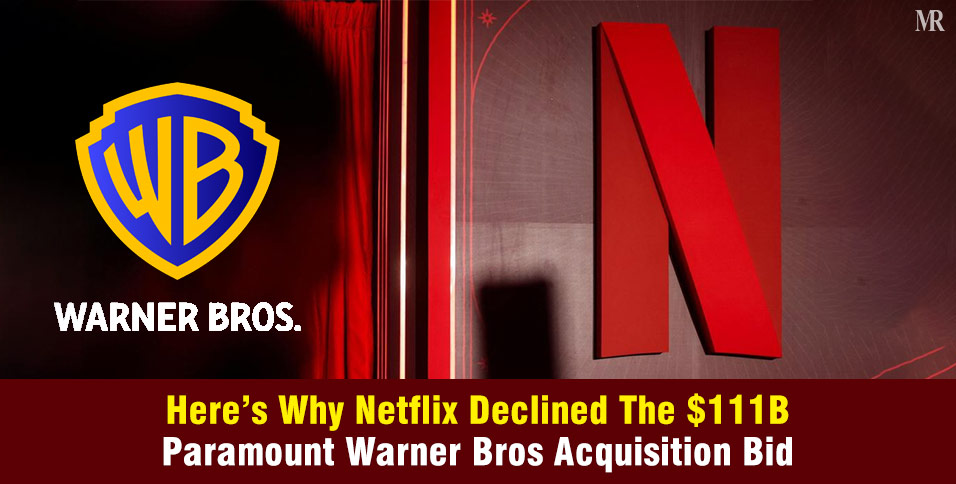
Netflix, the world’s leading streaming service, has officially exited the high-stakes race against the Paramount Warner Bros. Discovery (WBD) acquisition.
On February 26, 2026, Netflix announced it would not match a massive $111 billion bid from rival Paramount Skydance.
This decision effectively hands the keys of the historic Warner Bros. studio and the HBO brand to Paramount, ending a months-long corporate battle that has gripped Hollywood.
Paramount Skydance Secures a Superior Bid
The turning point in this saga occurred when the Warner Bros. Discovery board of directors labeled the revised offer from Paramount Skydance, backed by CEO David Ellison, as a “Company Superior Proposal.”
While Netflix had previously signed a deal to acquire WBD’s studio and streaming assets for roughly $83 billion, Paramount returned with a significantly more aggressive package.
Paramount’s final bid reached $111 billion, including the assumption of WBD’s existing debt.
The offer provides shareholders with $31.00 per share in cash, a notable jump from the $27.75 per share previously offered by Netflix.
Unlike the Netflix proposal, which sought to spin off WBD’s traditional TV channels, Paramount intends to acquire 100% of the company, including CNN and Discovery.
Why Netflix Withdrew From the Bidding War
Netflix leadership chose financial discipline over aggressive expansion.
In a joint statement, Netflix co-CEOs Ted Sarandos and Greg Peters explained that while the deal would have been beneficial, the rising costs made it a bad investment for their shareholders.
“The transaction we negotiated would have created shareholder value with a clear path to regulatory approval. However, we’ve always been disciplined, and at the price required to match Paramount Skydance’s latest offer, the deal is no longer financially attractive.”
The company emphasized that the warner bros acquisition was a “nice to have” asset at a certain price, but not a “must-have” at any cost.
Industry experts noted that Netflix was essentially “playing chicken” with Oracle founder Larry Ellison, who provided the massive financial backing for the Paramount bid.
The Financial Logic Behind the Decision
Investors quickly showed their approval of the Netflix decision.
Immediately following the news that the company would decline the Paramount warner bros merger, Netflix stock surged by more than 10% in after-hours trading.
Wall Street analysts praised the streamer for not over-leveraging its balance sheet to compete with the Ellison family’s deep pockets.
By walking away, Netflix also secures a $2.8 billion breakup fee, which Paramount has agreed to pay on behalf of Warner Bros. Discovery.
This cash infusion allows Netflix to continue its plan of investing approximately $20 billion into original content and resuming its share repurchase program.
A New Media Giant Emerges
The conclusion of the Paramount Warner Bros saga marks the beginning of a massive consolidation in the entertainment industry.
If the deal passes regulatory hurdles, Paramount will control a vast portfolio including CBS, Nickelodeon, HBO, CNN, and the Warner Bros. film library.
While Netflix misses out on the prestigious HBO catalog, it remains the dominant player in the streaming market with over 325 million subscribers.
The company is betting that its organic growth and current content slate are strong enough to maintain its lead without the heavy debt load associated with a Netflix-warner bros merger.
Conclusion
The Paramount Warner Bros acquisition war has ended with a clear superior proposal.
Paramount is doubling down on traditional scale and a “legacy media” powerhouse model, while Netflix walks away, prioritizing financial health and specialized content growth.
By declining the Paramount Warner Bros $111 billion bid, Netflix has protected its profit margins and reaffirmed its commitment to shareholders.
As the dust settles, all eyes will now turn to federal regulators to see if they allow this new media titan to form.
Maria Isabel Rodrigues