Mirror Review
October 29, 2025
NVIDIA stock hit a record high this week, pushing its market value close to $5 trillion — a level no other company has reached this quickly in market history!
The surge followed major announcements at the GTC Washington, D.C. event, including a landmark partnership with Oracle and the U.S. Department of Energy to build the nation’s largest AI supercomputer for scientific discovery.
This milestone comes just as Microsoft once again crossed the $4 trillion valuation mark after restructuring its OpenAI partnership, while Apple briefly touched the same mark thanks to booming iPhone 17 sales.
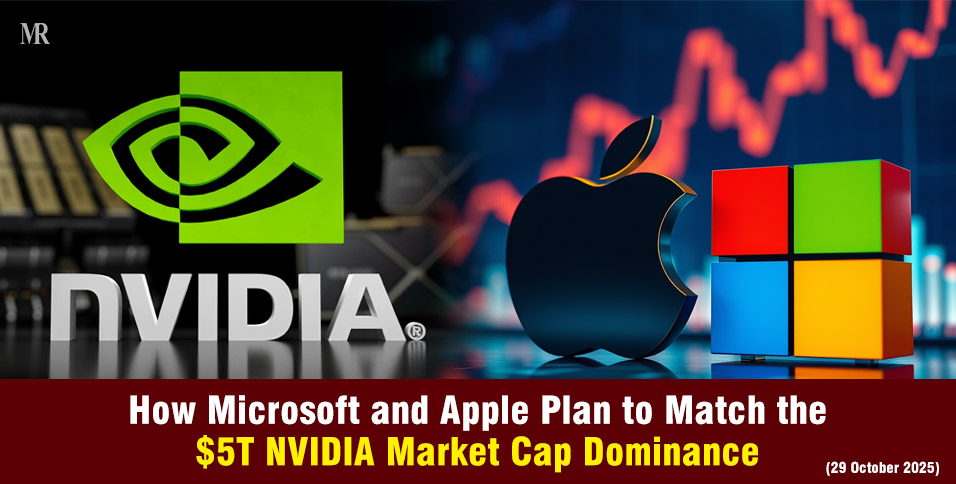
Together, the “Big Three” now dominate the market conversation, with the NVIDIA Market Cap becoming the new benchmark of global tech supremacy.
Let’s look at how NVIDIA reached $5T so fast, and then how Microsoft and Apple are positioning themselves to catch up with their own strategies.
1. NVIDIA: The Fastest-Growing Company in History
From $1T to $5T in Less Than 3 Years
NVIDIA’s rise from a $1 trillion company in mid-2023 to nearly $5 trillion in late 2025 is one of the fastest in corporate history.
The company’s dominance in AI chips, supercomputing infrastructure, and government partnerships has built an economic moat that few can rival.
At the GTC event, NVIDIA announced it will power the Department of Energy’s Solstice supercomputer, equipped with 100,000 Blackwell GPUs (the most ever built into a single system).
The Solstice and Equinox systems together will deliver 2,200 exaflops of AI performance, marking the beginning of what CEO Jensen Huang called “the era of agentic AI-powered science.”
“AI is the most powerful technology of our time, and science is its greatest frontier,” said Huang. “Together with Oracle, we’re building the Department of Energy’s largest supercomputer that will serve as America’s engine for discovery.”
U.S. Secretary of Energy Chris Wright called it “a new common-sense approach to computing partnerships,” emphasizing that the project reflects the Trump Administration’s commitment to securing America’s leadership in AI and science.
This political and industrial backing has been crucial for the NVIDIA Market Cap.
The company has not only earned White House trust but also positioned itself as the strategic backbone of U.S. AI policy.
Its reach now extends from defense and telecom to automotive design, healthcare R&D, and fusion energy.
NVIDIA’s Unmatched Dominance
NVIDIA’s lead rests on a few core advantages:
- AI chip dominance: Over 80% of global AI training runs on NVIDIA hardware, from the H100 to the new Blackwell GPUs.
- High-value bookings: More than $500 billion in AI chip orders are already secured for the coming quarters.
- Open partnerships: Collaborations with Oracle, Palantir, and General Atomics are expanding AI infrastructure across science and defense.
- Government alignment: Its supercomputers and research programs are backed by bipartisan U.S. support, positioning it as a national AI champion.
- Software leadership: The NVIDIA TensorRT, Omniverse, and Newton physics engine platforms anchor its ecosystem far beyond silicon.
With these moves, Huang has effectively transformed NVIDIA from a chipmaker into a critical AI infrastructure company. This is something investors see as the foundation of the new digital economy.
2. Microsoft: Building the AI Infrastructure Empire
The OpenAI $500 Billion Catalyst
Microsoft’s latest resurgence to a $4 trillion valuation was driven by its deepening alliance with OpenAI.
In October 2025, the two companies announced a recapitalization deal valuing OpenAI at $500 billion and converting it into a public benefit corporation, and removing earlier fundraising limits.
“The nonprofit remains in control of the for-profit and now has a direct path to major resources before AGI arrives,” said Bret Taylor, chair of the OpenAI Foundation.
The OpenAI Microsoft deal also locks in Microsoft’s 27% stake, worth about $135 billion, and includes a $250 billion Azure cloud contract. This ensures OpenAI stays deeply embedded in Microsoft’s cloud and enterprise ecosystem until at least 2032.
According to Adam Sarhan, CEO of 50 Park Investments, “This structure provides a clearer path forward for innovation and accountability.”
That clarity helped Microsoft’s stock rise 2.5%, sending its market cap back over the $4T mark.
Microsoft’s Competitive Playbook
- AI-Cloud Convergence: Azure remains the backbone of global AI training workloads, hosting OpenAI and dozens of enterprise AI deployments.
- Ecosystem Integration: Copilot is embedded across Windows, Office, GitHub, and Dynamics, creating stickiness across 400M+ enterprise users.
- Hardware Ambition: While still reliant on NVIDIA GPUs, Microsoft is investing in its own AI chips, the Maia and Cobalt processors.
- Enterprise Trust: With decades of experience in compliance, Microsoft remains the most trusted AI partner for governments and large corporations.
To match NVIDIA’s dominance, Microsoft must own more of the AI stack, from hardware to inference, and continue translating massive AI investments into visible earnings growth.
But its dual advantage in infrastructure scale and software integration makes it the most credible challenger in the race.
3. Apple: The Ecosystem Giant Turns to AI
The iPhone Revival Pushes Apple to $4 Trillion
Apple briefly topped a $4 trillion market value this week, powered by soaring iPhone 17 and iPhone Air sales.
Data from Counterpoint Research showed that early iPhone 17 sales outperformed the iPhone 16 by 14% in the U.S. and China, a turnaround that pushed Apple’s stock to all-time highs.
“The iPhone accounts for over half of Apple’s profit and revenue, and the more phones they can get into people’s hands, the more they can drive people into their ecosystem,” said Chris Zaccarelli, CIO at Northlight Asset Management.
Apple’s rebound also came from its resilience in handling U.S. tariffs. The company has moved much of its supply chain to India and Vietnam, avoiding major disruptions and absorbing costs rather than passing them to consumers.
Meanwhile, analysts like Samik Chatterjee of JPMorgan believe Apple’s “halo of positivity” heading into its quarterly results signals renewed confidence in its services division, expected to surpass $100 billion in annual revenue.
The AI Gap and the Path Forward
Despite its valuation milestone, Apple remains the slowest of the Big Three in the AI race. Its “Apple Intelligence” suite, which includes ChatGPT integration and upgraded Siri features, has been delayed until next year, while rivals Microsoft and NVIDIA dominate AI hardware and infrastructure.
Still, Apple’s moat is unmatched in its ecosystem:
- Hardware-Services Synergy: iPhone, iCloud, and Apple Pay form a recurring revenue loop.
- Brand Loyalty: Its 1.5 billion active devices create a built-in user base for new AI features.
- Manufacturing Shift: Apple’s expansion into India and Vietnam secures long-term resilience.
- Cautious AI Strategy: By studying competitors’ pitfalls, Apple is betting on a user-friendly, privacy-focused AI rollout in 2026.
As Wedbush analyst Dan Ives put it, “Despite missing out on AI so far, Apple topping $4 trillion is a watershed moment for Big Tech and a testament to the best consumer franchise in the world.”
4. The $4 Trillion Club: NVIDIA vs. Microsoft vs. Apple
| Company | Market Cap (Oct 2025) | Key Strengths | Key Challenge |
| NVIDIA | ~$4.9T | AI chips, government-backed infrastructure, global dominance | Supply constraints, export limits |
| Microsoft | ~$4.04T | AI + Cloud scale, OpenAI partnership, enterprise reach | Needs in-house chip scale |
| Apple | ~$3.99T | Ecosystem loyalty, iPhone revival, services growth | Late AI adoption, hardware reliance |
Together, these companies represent over $13 trillion in combined market value, roughly equivalent to half the U.S. GDP.
Yet, it’s the massive NVIDIA market cap and infrastructure-first approach that others now aim to match.
5. Forecast: The Next Phase of the AI Supercycle
- NVIDIA market cap could officially surpass $5 trillion by year-end if chip demand and DOE partnerships continue to accelerate.
- Microsoft is likely next, fueled by AI cloud contracts and expanding global data center capacity.
- Apple may take a slower route, but its services and hardware synergy could drive a re-rating once AI features launch in 2026.
- U.S. Policy Tailwinds: With Trump’s administration favoring domestic AI infrastructure and semiconductor leadership, the environment remains supportive for all three giants.
However, analysts warn that valuations could be running ahead of fundamentals. As Chris Beauchamp of IG noted, “Each new high is presented as evidence of an AI bubble, but the market continues to show remarkable resilience.”
Conclusion
The NVIDIA Market Cap isn’t just a corporate record. It’s a symbol of the AI age.
By controlling the hardware, the infrastructure, and the policy narrative, NVIDIA has become the new standard for global tech leadership.
Microsoft and Apple are racing to catch up, each from their own strengths: Microsoft with its AI infrastructure, Apple with its ecosystem moat.
But only one question now defines this era: who can combine AI, chips, and scale fast enough to match NVIDIA’s $5 trillion dominance?
The next trillion dollars in market value will likely come not from software or devices, but from whoever builds the intelligence infrastructure of the world.