Mirror Review
September 25, 2025
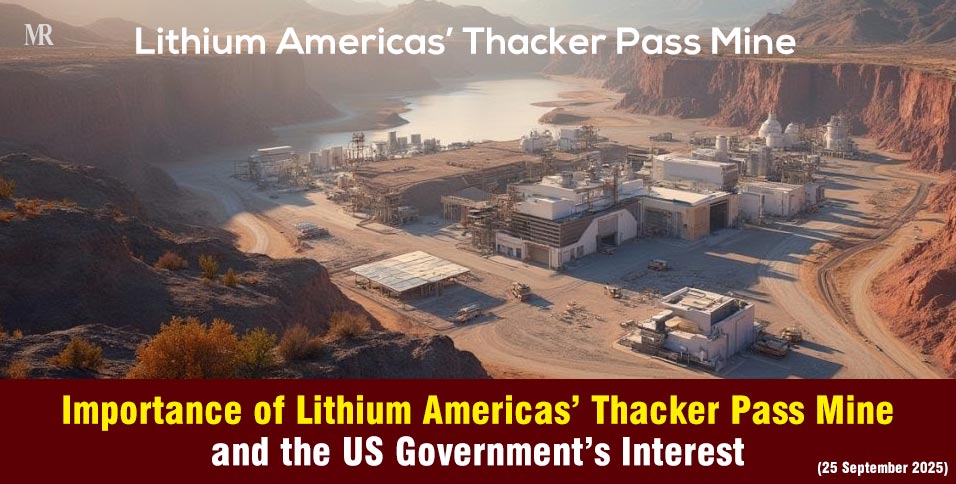
Lithium Americas’ Thacker Pass project is back in the spotlight after reports that the U.S. government is seeking a 10% equity stake in the mine.
The Trump administration is in talks alongside General Motors and the Department of Energy, marking one of the most aggressive federal moves yet to secure America’s lithium supply chain.
The announcement sent Lithium Americas’ stock soaring, but beyond the market reaction, this interest hints at why Thacker Pass has become central to U.S. energy, defense, and economic policy.
Why Thacker Pass Matters
Thacker Pass isn’t an ordinary mine. It sits on the largest known lithium deposit in the United States, with an estimated 40,000 tonnes of lithium carbonate per year expected from its first phase of production.
That’s enough to power batteries for nearly 800,000 electric vehicles annually, according to U.S. Department of Energy projections.
This makes Thacker Pass more than a mining site. It’s a potential anchor of America’s domestic battery supply chain.
As demand for electric vehicles, renewable storage, and high-tech manufacturing soars, the U.S. faces a hard truth: much of the world’s lithium processing is dominated by China. Moreover, China dominates the Rare Earth Mining industry.
Beijing currently refines nearly 60% of global lithium and controls over 70% of cathode and anode production.
By scaling Thacker Pass, America gains a foothold in a market it cannot afford to lose.
Why the U.S. Government Is Interested
Reports suggest the federal government is in talks to take up to a 10% stake in Lithium Americas as part of renegotiating a $2.26 billion Department of Energy loan. On paper, 10% may not look like much. In reality, it’s a strategic lever.
Here’s what Washington stands to gain:
- Securing domestic supply: A stake gives the government a voice in how the mine’s output is allocated, ensuring U.S. companies, not just foreign buyers, have priority access.
- Reducing financial risk: With equity, taxpayers share in potential upside, balancing out the risks of the multibillion-dollar federal loan.
- Influencing governance: Even a small stake allows Washington to press for stronger commitments on environmental standards, local job creation, and domestic refining.
- Geopolitical signaling: An equity move tells global competitors, especially China, that the U.S. is ready to directly invest in strategic minerals, not just rely on market forces.
The Bigger Picture: Lithium as a Strategic Asset
Lithium isn’t oil, but in today’s energy transition, it’s just as critical.
Battery metals are the backbone of EVs, grid storage, and even defense technologies. Without a secure supply, the U.S. risks falling behind in industries that will define the 21st-century economy.
This is why Thacker Pass is often called America’s “lithium insurance policy.” It reduces dependency on imports and builds resilience against price shocks or supply disruptions.
Challenges and Tensions
Still, the path forward isn’t smooth. Thacker Pass has faced:
- Environmental and Indigenous concerns: Local tribes and conservation groups have challenged permits, arguing that sacred land and fragile ecosystems are at risk.
- Water disputes: Nevada regulators have restricted mining below the water table, and ongoing legal battles over water rights could slow construction.
- Commodity volatility: Lithium prices have been highly cyclical; if they drop further, project economics could strain even with government backing.
Balancing national ambitions with local justice and sustainability will be the real test of this project.
What Happens Next?
Three scenarios are possible:
- Equity deal finalized — The government takes a 5–10% stake, secures stronger commitments from General Motors and other offtakers, and positions Thacker Pass as a flagship public-private project.
- Partial compromise — US settles for warrants or options, ensuring upside without direct control.
- Loan-only approach — Political or legal risks prove too heavy, and the government steps back from equity, leaving private investors to lead.
The most probable outcome is scenario one: a modest but symbolic equity stake that sets a precedent for how the U.S. may approach other critical mineral projects.
Why It Matters
Lithium Americas’ Thacker Pass Mine is no longer just a Nevada story. It’s a national play in the global race for clean energy dominance.
By exploring an equity stake, the U.S. is acknowledging that securing strategic minerals is as important as funding semiconductors or defense technology.
In other words, Thacker Pass isn’t just about lithium.
It’s about who controls the building blocks of the future economy and how far America is willing to go to secure them.