Mirror Review
August 28, 2025
Summary:
- Former President Donald Trump has tried to remove Lisa Cook from her position on the Federal Reserve Board of Governors, accusing her of mortgage fraud.
- Cook has denied the claim, arguing that the president doesn’t have the legal power to fire her. She’s now fighting the dismissal in court.
- The clash has kicked off a big debate about whether the Federal Reserve, thats meant to operate independently, can stay free from political interference.
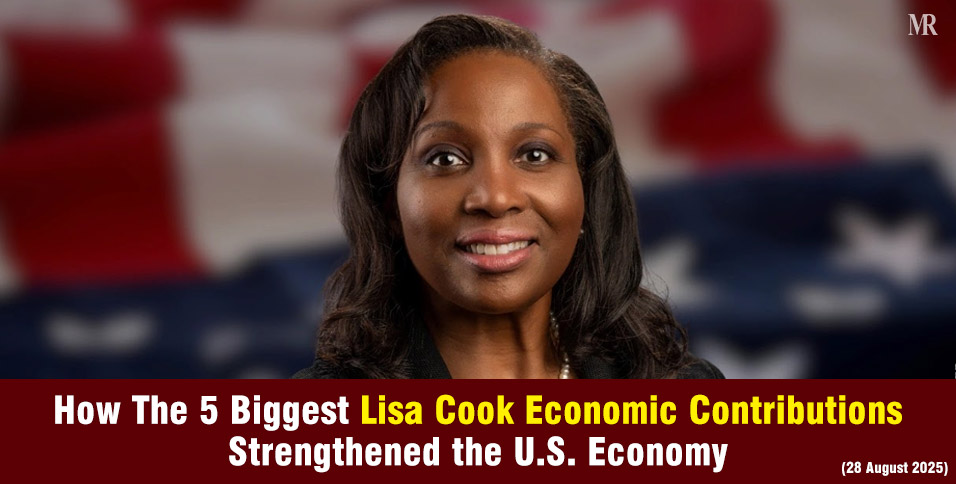
In recent weeks, Lisa Cook, a Federal Reserve Governor and one of the most influential economists in the US, has been at the center of headlines
Former President Donald Trump has tried to remove her from the Fed’s Board of Governors, sparking a legal battle that raises urgent questions about the independence of America’s central bank.
At a time when the Fed’s role in politics and daily life is under intense scrutiny, understanding Cook’s contributions helps explain why she matters and why her work goes far beyond the current controversy.
So let’s look at her five biggest Lisa Cook economic contributions.
1. Measuring the Cost of Discrimination
One of Cook’s most famous studies asked a simple but powerful question: What if America had never excluded people of color from innovating?
Her 2014 research, “Violence and Economic Activity: Evidence from African American Patents, 1870–1940,” showed how racial violence and Jim Crow laws led to a sharp drop in patents filed by Black inventors.
This wasn’t just about fairness. It meant the entire U.S. economy missed out on inventions that could have boosted growth.
She estimated that the lost innovation was as large as the output of a mid-sized European country.
By proving that discrimination holds back innovation, Cook shifted the conversation from morality alone to hard economics: inclusion fuels growth.
2. A Measured Voice at the Federal Reserve
Since joining the Fed in 2022, Cook has helped guide decisions on interest rates, inflation, and jobs. She is known for stressing balance by controlling inflation without crushing job growth.
In her public remarks, Cook often highlights how interest rate moves affect different groups of Americans in different ways.
That perspective ensures the Fed isn’t only looking at numbers but at the real-world impact of its choices.
Her role in the Federal Open Market Committee (FOMC) has been to push for policies that support both stability and fairness.
3. Steering Policy During the Great Recession
Before the Fed, Cook served on President Obama’s Council of Economic Advisers from 2011 to 2012. This was right after the 2008 financial crisis, when the U.S. economy was still shaky.
She contributed to discussions on innovation, international finance, and the Eurozone debt crisis.
Her background in global economics, especially her expertise on Russia, gave the administration useful insights at a time of worldwide financial stress.
Her White House work showed how she could connect academic research with real-world policymaking.
4. Promoting Global Economic Stability
Lisa Cook’s influence isn’t limited to the U.S. She has advised countries like Nigeria and Rwanda on economic reforms and banking systems.
By helping strengthen financial institutions abroad, she has indirectly supported U.S. stability, too.
A stronger global economy means fewer shocks to American trade and investment.
Her first-hand experience in emerging markets has added a valuable global perspective to her U.S. policymaking roles.
5. Building the Next Generation of Economists
Beyond her research and policy work, Cook has worked tirelessly to diversify the field of economics.
She directed the American Economic Association’s Summer Program for minority students, which helps train and mentor young economists from underrepresented backgrounds.
This work may not grab headlines, but it’s long-term nation-building.
A more diverse pipeline of economists means future policies will be shaped by a wider range of experiences and ideas.
That diversity can lead to more innovative solutions to America’s economic challenges.
The Bottom Line
Lisa Cook’s career is about more than her current political battle. Her research showed how discrimination weakens innovation.
Her policy roles from the White House to the Fed have helped the U.S. navigate crises with more balance.
And her mentoring work ensures the future of economics will be broader and more inclusive.
As the debate over her Fed seat continues, what will outlast the headlines are these Lisa Cook economic contributions: ideas and actions that have already made the U.S. economy more resilient.
Her struggle also mirrors that of Fed Chair Jerome Powell, who has faced political pressure and calls for removal in the past.
Together, their experiences highlight a growing pattern: attempts to challenge the independence of the Federal Reserve at a time when stability is needed most.