Mirror Review
September 17, 2026
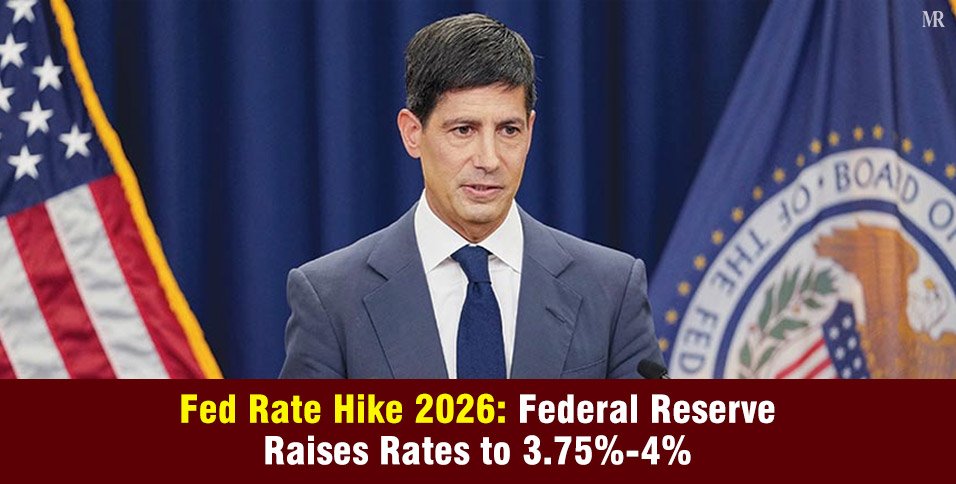
The Fed Rate Hike 2026 has raised the U.S. federal funds target range to 3.75%-4%, marking the Federal Reserve’s first interest rate increase since July 2023. The Federal Open Market Committee approved the quarter-point increase by a 12-0 vote on September 16, saying inflation remains elevated and the action will support a timelier return toward its 2% goal.
The Federal Reserve’s September 2026 rate hike decision also affects the outlook for borrowing costs. The Fed’s latest projections show a median federal funds rate of 4.1% at the end of both 2026 and 2027, compared with 3.8% and 3.6%, respectively, in the June projections.
Why Did the Fed Raise Interest Rates in September 2026?
The Federal Reserve raises interest rates in September because inflation remains elevated while economic activity continues to expand at a solid pace. The Fed said domestic spending has remained resilient, productivity growth is strong, capital investment is robust, and job gains have kept pace with the workforce.
The Fed inflation outlook remains focused on returning inflation to the central bank’s 2% target. The PCE inflation 2026 projection shows a median rate of 3.7%, compared with 2.3% for 2027, 2.1% for 2028, and 2% for 2029.
The September decision therefore combines tighter monetary policy with the Fed’s assessment that economic activity remains solid and inflation is still elevated.
What Did the Fed Change on September 16?
The Fed rate decision 2026 increased the federal funds target range by 25 basis points from 3.50%-3.75% to 3.75%-4%. The FOMC approved the decision unanimously during the September 15-16 meeting.
| Fed policy measure | Before September 16 | After September 16 |
| Federal funds target range | 3.50%-3.75% | 3.75%-4% |
| Rate change | N/A | 25 basis points |
| FOMC vote | N/A | 12-0 |
| Interest on reserve balances | 3.65% | 3.90% |
| Primary credit rate | 3.75% | 4.00% |
The changes to the interest rate on reserve balances and the primary credit rate took effect September 17.
How Does the Fed Rate Hike Affect Borrowing Costs?
The connection between the Fed rate hike and borrowing costs matters because changes in the federal funds rate can influence other short-term interest rates across the financial system.
Following the Federal Reserve rate increase, major U.S. banks, including JPMorgan Chase, Bank of America, Citigroup, and Wells Fargo, subsequently raised their prime lending rates from 6.75% to 7%. Prime-linked credit products can therefore become more expensive for affected borrowers.
The change can affect both consumer borrowing and business borrowing, although the actual impact depends on the loan type and benchmark used. The exact effect depends on the type of loan and the benchmark used, so the Fed’s quarter-point increase does not automatically add 25 basis points to every loan.
What Is the Fed Interest Rate Outlook for 2026 and 2027?
The Fed interest rate outlook 2026 shows a median federal funds rate of 4.1% at year-end, up from the 3.8% median projected in June. The Fed rate outlook 2027 also places the median rate at 4.1%, compared with 3.6% in the June projections.
The projections are not commitments to future policy. They represent individual FOMC participants’ assessments of the appropriate policy path based on their economic outlook.
The September projections show PCE inflation declining from 3.7% in 2026 to 2.3% in 2027. The projections also place the median federal funds rate at 4.1% at the end of 2027. That combination of easing inflation and an elevated projected policy rate shows why the central bank continues to focus on maintaining price stability.
What Happens Next After the Fed Rate Hike 2026?
The next Federal Reserve rate hike is not predetermined. The Federal Reserve’s September statement did not commit to a specific future increase and said the Committee will continue assessing incoming information and its implications for Fed monetary policy.
The Federal Reserve’s official schedule lists the next FOMC meeting for October 27-28, 2026. Policymakers will have additional inflation, employment and economic data to consider before that decision.
Under Fed Chair Kevin Warsh, the September decision puts the focus on how borrowing costs respond to the higher policy rate and how the projected rate path develops. The Fed’s current projections put the median federal funds rate at 4.1% at the end of 2027, but the central bank has not committed to that outcome.
Gurushanth S Jatti