Mirror Review
January 08, 2026
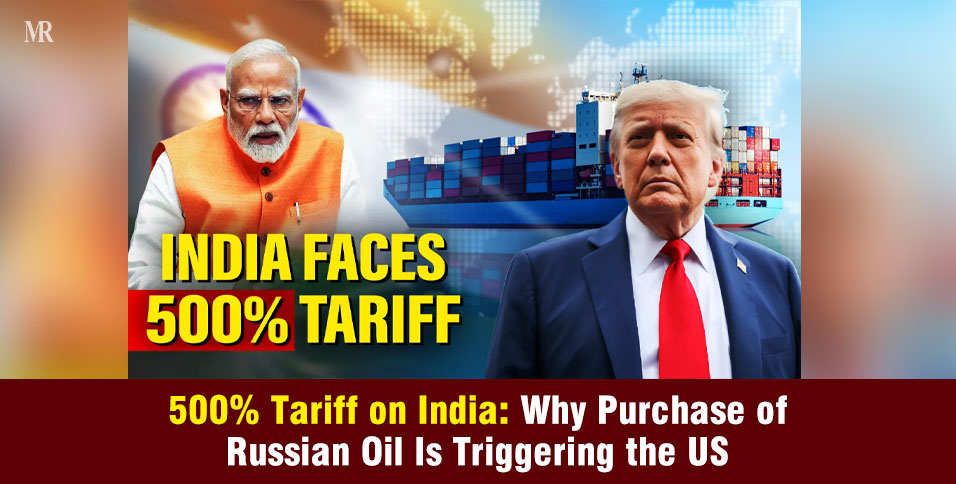
In early January 2026, the United States escalated pressure on India after President Donald Trump approved the Sanctioning of Russia Act 2025, a bipartisan bill that allows the United States to impose a 500% tariff on India and other countries that continue buying Russian oil.
The proposed tariff is aimed at cutting off Russia’s energy revenues, which the US says are helping finance Russia’s war in Ukraine.
If enacted, the measure could severely disrupt India–US trade and reshape global energy and diplomatic alignments.
What is the 500% Tariff on India?
A tariff is a tax placed on imported goods. Governments use tariffs to protect domestic industries or apply economic pressure on other countries.
Normally, tariffs range between 2% and 25%. However, a 500% tariff on India is extremely rare and punitive by modern trade standards.
To put this into perspective, an Indian product exported to the US with a value of $100 would face an additional $500 tax, raising its final cost to $600.
At such prices, Indian goods would become uncompetitive in the US market, effectively shutting them out altogether.
The proposed tariff authority comes from the Sanctioning of Russia Act 2025, sponsored by US Senators Lindsey Graham and Richard Blumenthal.
The bill requires the US President to review every 90 days whether Russia is engaging in peace negotiations over Ukraine.
If not, the law allows the US to impose massive tariffs on countries that are “knowingly” buying Russian oil, gas, or uranium.
Why Russian Oil Is the Trigger Point
At the heart of the issue is India’s growing reliance on Russian crude oil since the Ukraine war began in 2022.
As Western nations reduced or banned Russian energy imports, Moscow began selling oil at steep discounts to alternative buyers. India took advantage of this shift to secure cheaper energy.
By 2024, India was importing close to 2 million barrels of Russian oil per day, making Russia one of its largest crude suppliers.
This helped India keep fuel prices stable and manage inflation, but it also made New Delhi a central figure in the US’s sanctions debate.
From the US perspective, these oil purchases provide Russia with hard currency, allowing it to maintain government spending and military operations despite Western sanctions.
US lawmakers argue that as long as major economies like India continue buying Russian energy, sanctions remain ineffective.
Senator Lindsey Graham has described the 500% tariff on India as a tool of “maximum leverage,” intended to force large buyers to abandon Russian oil entirely.
How the Tariff on India Could Impact Trade
The consequences of a 500% tariff on India go far beyond energy policy. The tariff would apply to all Indian exports to the US, not just oil-related goods.
The US is India’s largest individual trading partner, with billions of dollars in annual trade.
Key Indian export sectors at risk include:
- Pharmaceuticals
- IT and software services
- Textiles and apparel
- Gems and jewelry
- Engineering goods
Even before this bill, trade tensions were rising. In August 2025, the US increased tariffs on certain Indian goods to around 50%, which the US described as a warning measure.
Following that move, Indian exports to the US reportedly fell by more than 20% in the second half of 2025.
A jump from 50% to 500% would amount to a near-total trade freeze, potentially causing job losses and economic stress in export-driven industries.
India’s Tariff Dilemma Due to the Purchase of Russian Oil
India has long followed a policy of strategic autonomy, also known as multi-alignment. This means India maintains relations with multiple global powers without formally siding with any one bloc.
New Delhi has repeatedly stated that its Russian oil purchases are driven by energy security and affordability, not political alignment.
Indian officials argue that providing affordable fuel to a population of 1.4 billion people is a national priority. However, the proposed 500% tariff on India signals that the US is no longer willing to tolerate this balancing act.
Under growing pressure, some Indian companies have already begun adjusting.
Major refiners, including Reliance Industries, have indicated that they may stop importing Russian crude in 2026 to avoid secondary sanctions, which are penalties imposed on foreign companies that do business with sanctioned Russian entities.
Despite these moves, US officials have made it clear that partial reductions may not be enough. The demand is for a complete exit from Russian energy trade.
End note
As the US Congress prepares to vote on the sanctions bill, the threat of a 500% tariff on India has become a defining issue in global trade and diplomacy.
The timing is particularly sensitive, coinciding with the expected arrival of the new US Ambassador to India, Sergio Gor.
While Prime Minister Narendra Modi and President Donald Trump have publicly emphasized strong bilateral ties, the reality of trade economics is creating a serious strain.
India now faces a difficult decision: continue its discounted Russian energy imports or protect its multi-billion-dollar trade relationship with the United States.
The outcome could reshape not only India–US relations, but also the future of global energy trade.
Maria Isabel Rodrigues