Did you know one man reshaped how over 400 million Indians access the internet—and became Asia’s richest in the process?
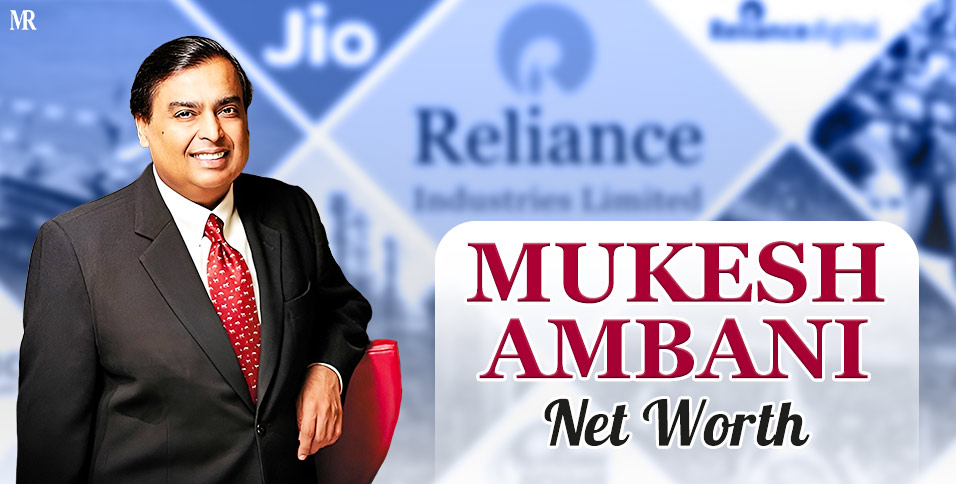
That man is Indian Industrialist Mukesh Ambani. His influence extends across petrochemicals, telecommunications, and sustainable energy.
Mukesh Ambani is best known for transforming Reliance Industries into a global powerhouse and for leading India’s digital revolution through Reliance Jio. He is also the son of legendary entrepreneur Dhirubhai Ambani, who laid the foundation of this empire.
As of 2026, Mukesh Ambani’s net worth is estimated to be over $100 billion, making him the richest person in Asia and one of the wealthiest individuals in the world.
In this blog, we’ll take a closer look at how he built this immense fortune, with a detailed timeline of his financial decisions.
Overview Of Mukesh Ambani Net Worth 2026
| Attribute | Details |
| Full Name | Mukesh Dhirubhai Ambani |
| Born | April 19, 1957 |
| Nationality | Indian |
| Role | Chairman & Managing Director, Reliance Industries |
| Mukesh Ambani Net Worth 2026 | $97 Billion to $108 Billion |
| Net Worth in Indian Rupees | ₹9.8 Lakh Crore |
| Key Businesses | Oil & Gas, Telecom, Retail, Green Energy |
| Major Companies | Reliance Jio, Reliance Retail, Network18 |
| Education | Stanford University (MBA – withdrew) |
The Hurun Research Institute recently released the 15th edition of the Hurun Global Rich List 2026. In this list, Mukesh Ambani emerged as the richest person in India and Asia with a net worth of ₹9.8 lakh crore.
This valuation places him 17th globally according to Hurun, while other indices like Forbes and Bloomberg rank him between 16th and 21st.
Mukesh Ambani’s Early Life and Educational Foundations
Mukesh Dhirubhai Ambani was born on April 19, 1957, in the British Crown Colony of Aden. His father, Dhirubhai Ambani, worked as a gas station attendant before starting a trading business.
The family moved back to India in 1958 to escape an unstable political climate. Initially, they lived in a modest chawl in the Bhuleshwar neighborhood of Mumbai.
Ambani’s upbringing emphasized frugal habits despite the growing success of his father’s textile business. For instance, he used public transportation and never received an allowance during his teenage years.
Moreover, Education played a critical role in shaping Mukesh Ambani’s technical mindset. He completed his secondary schooling at Hill Grange High School. Later, he earned a BE degree in chemical engineering from the Institute of Chemical Technology (ICT).
In 1979, Ambani enrolled for an MBA at Stanford University. However, he withdrew in 1980 to help his father build a polyester yarn plant. Dhirubhai Ambani believed that real-life skills are best harnessed through experience.
Consequently, Mukesh took command of a manufacturing project in a small village with a $100 million budget. This decision marked the beginning of his journey as a world-class industrialist.
The Defining Conflict: The 2005 Ambani Family Split
The death of Dhirubhai Ambani in July 2002 created a massive leadership crisis. Because the patriarch died without a will, a bitter public feud erupted between Mukesh and his brother Anil.
Anil Ambani accused Mukesh of corporate governance failures and unfair fund transfers. And the stability of India’s largest private-sector conglomerate was threatened by this dispute.
Ultimately, their mother, Kokilaben Ambani, intervened to resolve the issues amicably. She used a formula to split the family’s ownership in the group.
| Asset Allocation | Allotted To | Key Business Units |
| Petrochemicals & Refining | Mukesh Ambani | Reliance Industries, IPCL |
| Telecom & Finance | Anil Ambani | Reliance Infocomm, Reliance Capital, Energy |
This settlement allowed Mukesh Ambani to retain the core energy businesses while these units accounted for 90% of the group’s revenues at the time.
Resultantly, he consolidated his control over high-value industrial assets, which later enabled the surge in Mukesh Ambani’s net worth.
The Industrial Powerhouse: Building the Jamnagar Empire
After the split, Mukesh Ambani focused on scaling the energy ventures and directed the construction of the Jamnagar refinery in Gujarat. This facility became the world’s largest grassroots petroleum refinery, producing 660,000 barrels per day by 2010.
Ambani personally oversaw the project’s execution in the 1990s and reportedly lived in shipping containers for months to ensure that the project met its timelines. This relentless focus on execution excellence defined his leadership style. And by 1999, he commissioned the globe’s largest start-up petroleum refinery.
The Jamnagar complex grew into an integrated manufacturing hub combining petrochemicals, power generation, and port infrastructure, becoming the core cash engine for the conglomerate. For FY 2024-25, the Oil-to-Chemicals (O2C) segment alone reported a revenue of ₹6,26,921 crore ($73.4 billion).
The Digital Disruption: Launching Reliance Jio
In 2016, Mukesh Ambani’s source of wealth shifted dramatically toward technology when he launched Reliance Jio Infocomm Limited to disrupt the Indian telecom market. Ambani invested over $35 billion to build Jio, a nationwide 4G network, which offered free voice calls and extremely cheap data to Indian consumers.
This strategy rapidly acquired over 400 million users, consequently becoming the world’s second-largest telecom company by users after China Mobile. This disruption forced many famous Indian brands to exit the market or merge.
Attracting Global Tech Giants
The valuation of Jio surged during the COVID-19 pandemic. Ambani raised more than $20 billion by selling a 33% stake in Jio Platforms, which attracted some of the most powerful tech companies in the world, like Meta (9.99%) and Google (7.73%).
These deals validated Jio as a digital ecosystem rather than just a telecom carrier. Moreover, the influx of capital made Reliance Industries a net-debt-free company, and Mukesh Ambani’s net worth experienced a massive valuation jump.
The Retail Revolution: Dominating the Consumer Market
While Jio transformed digital services, Reliance Retail reshaped the Indian shopping landscape. Ambani led the development of Reliance Retail starting in 2006, which is now India’s largest retailer covering various consumption baskets, including grocery, electronics, and fashion.
Reliance Retail achieved record revenue of ₹3,30,943 crore ($38.7 billion) in FY 2025 and operates a unified network of 19,340 stores across the country.
Moving to Quick Commerce
Recently, Reliance prioritized hyperlocal quick deliveries with JioMart, India’s second-largest quick commerce company, which had a daily order run rate of 1.6 million in 2025.
Quick commerce now contributes about 20% of the total retail revenue of Reliance Industries.
Transitioning to Green Energy: The $75 Billion Bet
The Mukesh Ambani net worth is now tied to a sustainable future. He has pledged to invest $75 billion in renewable energy projects over 15 years.
Furthermore, Ambani intends to transform Reliance from a petroleum-based company into a green energy leader by building the Dhirubhai Ambani Green Energy Giga Complex in Jamnagar. This project spans 5,000 acres and includes four massive giga factories.
Ambani also intends to produce green hydrogen at less than $1 per kg. This price point would unlock massive industrial adoption across India. Moreover, he expects the new energy sector to match the oil-to-chemicals business in profitability within 5-7 years.
The AI Push: Building India’s Sovereign Infrastructure
In early 2026, Mukesh Ambani announced a huge $110 billion investment in AI infrastructure. This plan involves building a comprehensive artificial intelligence computing system across India over seven years.
Ambani emphasized that “India cannot afford to rent intelligence” and plans to fund gigawatt-scale data centers and a nationwide edge computing network. Construction is already underway for multi-gigawatt facilities in Jamnagar.
The first phase will offer 120 megawatts of capacity by the second half of 2026. Ambani aims to slash the cost of AI services just as he reduced mobile data prices with Jio.
Analyzing The Mukesh Ambani Source of Wealth
The bulk of Mukesh Ambani’s net worth comes from his 42% stake in Reliance Industries. This conglomerate has a market capitalization of approximately ₹19 lakh crore ($228 billion).
Segment Performance Breakdown (Q3 FY26)
| Segment | Operating Revenue | EBITDA |
| O2C (Oil-to-Chemicals) | ₹2.9 Lakh Crore | ₹16,507 Crore |
| Jio Platforms | ₹37,262 Crore | ₹19,303 Crore |
| Reliance Retail | ₹97,605 Crore | ₹6,915 Crore |
| Oil & Gas (Upstream) | – | ₹4,850 Crore |
Notably, the Digital Services and Retail segments primarily lead current revenue growth. The O2C segment continues to provide strong cash flows despite market volatility.
Furthermore, Reliance Consumer Products Limited (RCPL) contributed ₹5,000 crore in quarterly revenue after its demerger.
Future Growth Catalysts: The 2026 Jio IPO
The anticipated IPO of Jio Platforms is a major upcoming event for the Reliance share price. Ambani plans to list the company in 2026. This could potentially be India’s largest-ever initial public offering.
Reliance has reportedly hired 17 banks to manage the listing. The IPO will be structured as an “offer for sale” (OFS).
| IPO Detail | Projected Figure |
| Estimated Valuation (Jefferies) | $180 Billion |
| Target Raise | $1 Billion to $4 Billion |
| Stake Dilution | ~2.5% to 3% |
| Structure | Offer for Sale (OFS) |
Major foreign investors like Meta and Google are expected to pare about 8% of their individual holdings. This translates to a 0.8% stake sale by Meta, for example. This listing will unlock massive value for the conglomerate and likely increase Mukesh Ambani’s net worth significantly.
Mukesh Ambani’s Luxury Assets And Lifestyle
Mukesh Ambani’s net worth manifests in a collection of some of the world’s most expensive assets. These holdings range from a vertical palace in Mumbai to a fleet of customized private aircraft.
Antilia: The Billion-Dollar Residence
The Ambani family, one of the World’s Richest Families, resides in Antilia, a 27-story private building in Mumbai. Valued at approximately $1 billion, it stands as one of the most expensive private residences globally. The structure features three helipads, a 168-car garage, and a staff of hundreds to maintain operations.
The “Jio Garage” Car Collection
Mukesh Ambani owns India’s largest private car collection, frequently called the “Jio Garage”. This fleet includes over 170 vehicles, many of which are custom-armoured for high-level security.
- Armoured Rolls-Royce Cullinan: Estimated at ₹17 crore, featuring ballistic plating and a sealed fuel tank.
- Mercedes-Maybach S680 Guard: A “wheeled fortress” used by top global leaders, costing around ₹10 crore.
- Ferrari Purosangue: The first V12 SUV from Ferrari in India, valued at ₹12 crore.
- Lamborghini Urus & Bentley Bentayga: High-performance SUVs used frequently by the family.
A Fleet Of Private Jets
For global business travel, Ambani maintains a sophisticated fleet of private jets. These aircraft function as mobile command centers for Reliance executives.
- Boeing 737 MAX 9: The flagship aircraft, costing over ₹1,000 crore, including customizations. It features a private bedroom suite, boardroom, and high-speed satellite internet.
- Airbus A319 Corporate Jet: Custom-configured with hotel-style interiors.
- Dassault Falcon & Bombardier Global: Used for shorter regional hops and non-stop links to Europe and North America.
Reliance Foundation: Mukesh Ambani’s Philanthropy Initiative
Founded in 2010, the Reliance Foundation serves as the primary vehicle for the philanthropic initiatives of Reliance Industries. Under the leadership of Nita Ambani, the foundation has touched the lives of approximately 86 million people across India.
The foundation focuses on creating sustainable change through a multi-disciplinary approach. It nurtures stories of hope from the remotest villages to major metropolitan cities.
The core areas of impact include:
Rural Transformation, Health & Education, Sports for Development, Disaster Response, Urban Renewal, Arts, Culture & Heritage.
Mirror Review’s Analysis: Key Turning Points in Mukesh Ambani’s Wealth
Several defining moments helped shape the current Mukesh Ambani net worth. Each decision moved Reliance closer to its consumer-first, tech-heavy model.
- The 2005 Demerger: Ambani retained control of the high-revenue energy business, giving him the capital to expand.
- The Commissioning of Jamnagar: Building the world’s largest refinery provided a steady source of massive cash flows.
- Launching Jio in 2016: This pivot from “black gold” to data revolutionized the telecom industry and tripled Reliance’s valuation.
- The 2020 Stake Sales: Raising $20 billion during a global crisis turned Reliance into a net-debt-free powerhouse.
- The Green Energy Pivot: Committing $75 billion to sustainability ensures the company remains relevant in a net-zero future.
Together, these decisions position Mukesh Ambani not just as a top business leader but as one of the most powerful people in the world who is shaping industries, influencing markets, and driving large-scale economic transformation.
End Note
The journey of Mukesh Ambani’s net worth is a unique blend of industrial expertise and digital vision. He transitioned from building physical refineries to owning the digital pipelines of India.
As the chairman and managing director of Reliance Industries, Mukesh Ambani consistently identifies emerging trends before they go mainstream. Moreover, his current focus on green hydrogen and sovereign AI infrastructure proves a commitment to long-term national growth.
So why is Mukesh Ambani so rich?
Mukesh Ambani’s net worth reached the $100 billion mark through vertical integration and aggressive diversification. He used the massive cash flows of his energy business to fund world-class disruptions in telecom and retail.
Looking ahead, the 2026 Jio IPO and the operationalization of the green energy gigafactories will likely drive the next phase of wealth creation.
If you found this simplified breakdown of Mukesh Ambani’s net worth insightful, share it with fellow professionals, founders, and anyone interested in scaling strategies and building long-term wealth!
Maria Isabel Rodrigues