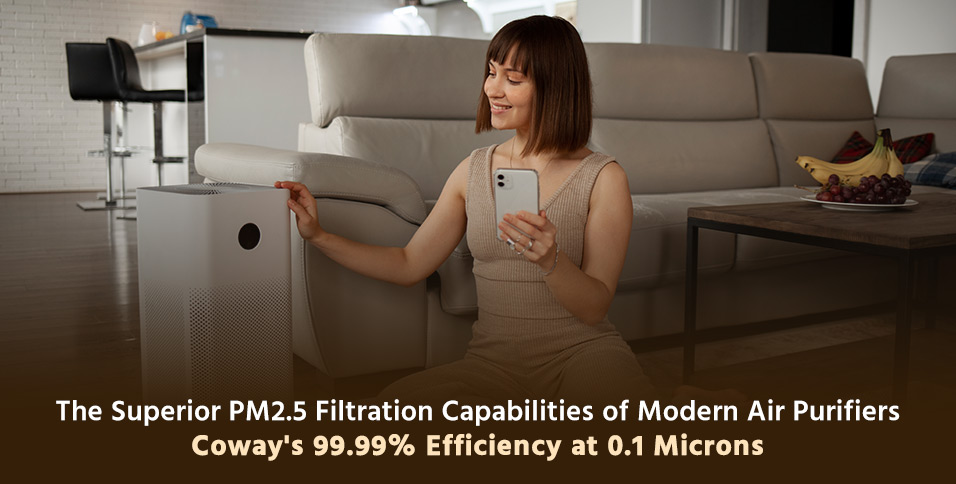
Air pollution has emerged as one of the most pressing public health concerns of the 21st century, with particulate matter 2.5 micrometers or smaller (PM2.5) posing particularly severe risks to human health. These microscopic particles, invisible to the naked eye, can penetrate deep into the respiratory system and even enter the bloodstream, causing a range of health problems from respiratory infections to cardiovascular disease and even cancer. As awareness of indoor air quality grows, air purifiers have become essential household appliances, with advanced models like those from Coway leading the industry with exceptional filtration capabilities that capture 99.99% of particles as small as 0.1 microns.
Understanding PM2.5 and Its Health Implications
PM2.5 refers to fine particulate matter with a diameter of 2.5 micrometers or less—approximately 30 times smaller than the width of a human hair. These particles originate from various sources including vehicle emissions, industrial processes, wood burning, cooking, and outdoor pollution that seeps indoors. What makes PM2.5 particularly dangerous is its size: these particles are small enough to bypass the body’s natural defense mechanisms in the nose and throat, traveling deep into the lungs and potentially entering the circulatory system.
The World Health Organization has identified PM2.5 as a Group 1 carcinogen, and exposure to elevated levels has been linked to increased mortality rates, reduced lung function, aggravated asthma, irregular heartbeat, and premature death in people with heart or lung disease. Children, elderly individuals, and those with pre-existing respiratory or cardiovascular conditions are particularly vulnerable. Given that people spend approximately 90% of their time indoors, where PM2.5 concentrations can be two to five times higher than outdoor levels, the importance of effective air filtration cannot be overstated.
Current Air Purifier Technologies and Their Limitations
The air purifier market offers various technologies, each with different capabilities for removing PM2.5 from indoor environments. Understanding these technologies helps contextualize why advanced filtration systems like Coway’s stand out in the marketplace.
HEPA Filtration
High-Efficiency Particulate Air (HEPA) filters represent the gold standard in mechanical air filtration. True HEPA filters must meet strict standards, capturing at least 99.97% of particles 0.3 microns in diameter. This specific size is chosen because it represents the Most Penetrating Particle Size (MPPS)—the particle size that is most difficult to capture. Interestingly, both larger and smaller particles are actually captured with even greater efficiency due to different physical mechanisms.
However, not all HEPA filters are created equal. Many manufacturers use terms like “HEPA-type” or “HEPA-like” to describe filters that don’t meet true HEPA standards. These filters may capture only 85-90% of particles, leaving a significant amount of harmful particulates circulating in indoor air. Additionally, standard HEPA filters typically specify their efficiency at 0.3 microns, but many harmful particles, including viruses, bacteria, and ultrafine combustion particles, are smaller than this threshold.
Activated Carbon Filters
While activated carbon filters excel at removing gases, odors, and volatile organic compounds (VOCs), they have limited effectiveness against particulate matter. Carbon filtration works through adsorption, where molecules adhere to the surface of the carbon material. This makes them excellent companions to HEPA filters but insufficient as standalone solutions for PM2.5 removal.
Ionizers and Electrostatic Precipitators
These technologies use electrical charges to attract and capture particles. While they can be effective against fine particles, they have several drawbacks. Many ionizers produce ozone as a byproduct, which is itself a harmful air pollutant. Additionally, particles collected on charged plates must be regularly cleaned, and any particles that fall off the plates before cleaning simply recirculate into the air. Their efficiency can also vary significantly based on airflow rates and particle characteristics.
UV-C Light and Photocatalytic Oxidation
UV-C light technology can destroy microorganisms but has minimal impact on particulate matter removal. Photocatalytic oxidation can break down certain pollutants but requires specific conditions to be effective and typically serves as a supplementary technology rather than a primary filtration method for PM2.5.
Coway’s Superior Filtration: 99.99% Efficiency at 0.1 Microns
While many air purifiers claim effective PM2.5 removal, Coway has distinguished itself by achieving 99.99% filtration efficiency for particles as small as 0.1 microns—significantly smaller than the 0.3-micron standard for traditional HEPA filters and three times smaller than the PM2.5 particles themselves. This enhanced capability represents a substantial advancement in air purification technology and offers several critical advantages.
Advanced Multi-Stage Filtration System
Coway air purifiers typically employ a sophisticated multi-stage filtration system that addresses the full spectrum of air pollutants:
Pre-Filter Stage: A washable pre-filter captures larger particles like dust, pet hair, and lint. This extends the life of the more advanced filters and maintains optimal airflow throughout the system’s lifecycle.
Deodorization Filter: Activated carbon filters effectively remove odors, gases, and VOCs that contribute to poor indoor air quality. This addresses the chemical dimension of air pollution that particulate filters alone cannot handle.
Green True HEPA Filter: Coway’s proprietary HEPA filter technology goes beyond standard specifications. While conventional HEPA filters target 0.3-micron particles, Coway’s advanced filters achieve 99.99% efficiency at 0.1 microns, capturing ultrafine particles that include:
- Viruses and bacteria (typically 0.02-0.3 microns)
- Combustion particles from cooking and traffic (0.01-1 micron)
- Secondary organic aerosols (0.1-1 micron)
- Industrial emissions and ultrafine particles
Vital Ion Technology: Some Coway models incorporate ionization technology that safely releases negative ions to further enhance particle removal without producing harmful ozone levels, meeting strict California Air Resources Board (CARB) certification standards.
Real-World Performance and Clean Air Delivery Rate
Laboratory testing conditions don’t always translate to real-world performance, which is why the Clean Air Delivery Rate (CADR) provides a more practical measure of effectiveness. Coway air purifiers consistently achieve high CADR ratings across all three measured pollutant categories: tobacco smoke (representing small particles), dust (medium particles), and pollen (large particles).
For example, popular Coway models like the Airmega series can clean rooms up to 1,560 square feet twice per hour, ensuring continuous purification and maintaining consistently low PM2.5 levels even in larger spaces. This rapid air turnover is crucial because air purifiers don’t just remove existing pollution—they must continuously capture newly introduced particles from cooking, cleaning, and infiltration from outdoors.
Smart Sensing and Adaptive Operation
Modern Coway air purifiers incorporate sophisticated air quality sensors that continuously monitor PM2.5, PM10, and other pollutants in real-time. The built-in laser particle sensors detect particle concentrations and automatically adjust fan speeds to maintain optimal air quality. This smart operation ensures maximum efficiency while minimizing energy consumption and noise levels during periods of better air quality.
The LED air quality indicators provide immediate visual feedback, displaying current pollution levels through intuitive color-coding systems. This transparency allows users to understand their indoor air quality conditions and observe the purifier’s impact in real-time, building confidence in the technology’s effectiveness.
The Science Behind 0.1 Micron Filtration
Capturing particles at 0.1 microns requires understanding the physics of particle behavior and employing multiple capture mechanisms simultaneously:
Interception: Particles following airflow streamlines come within one particle radius of a filter fiber and adhere to it.
Impaction: Larger particles with sufficient inertia cannot follow the air stream’s curves around fibers and collide directly with them.
Diffusion: Very small particles (below 0.3 microns) exhibit Brownian motion—random movement caused by collisions with gas molecules. This erratic path increases the probability of contact with filter fibers, making ultrafine particles paradoxically easier to capture than 0.3-micron particles.
Electrostatic Attraction: Some advanced filters incorporate electrostatic charges that attract particles, enhancing capture efficiency across all size ranges.
Coway’s ability to achieve 99.99% efficiency at 0.1 microns leverages all these mechanisms through precisely engineered filter media with optimal fiber diameter, packing density, and electrostatic properties. The filters are designed to maximize surface area and particle-fiber interactions while maintaining sufficient airflow to ensure high CADR ratings.
Beyond PM2.5: Comprehensive Air Quality Protection
While PM2.5 removal is critical, Coway’s advanced filtration also addresses other significant air quality concerns. The 0.1-micron capability means effective capture of:
Biological Contaminants: Most bacteria range from 0.2-10 microns, while viruses typically measure 0.02-0.3 microns. Coway’s enhanced filtration provides superior protection against airborne pathogens, particularly relevant in the post-pandemic era where indoor air quality and disease transmission have gained heightened attention.
Allergens: While many allergens like pollen are relatively large, the allergenic proteins can attach to smaller particles or fragment into smaller sizes. The comprehensive particle size coverage ensures thorough allergen removal.
Combustion Byproducts: Ultrafine particles from cooking, candles, and outdoor traffic infiltration are captured effectively, addressing a major source of indoor PM2.5 that standard filters might miss.
Investment in Long-Term Health
The superior filtration capability of Coway air purifiers for allergy represents more than just technical achievement—it’s an investment in long-term health protection. Research consistently demonstrates that reducing PM2.5 exposure leads to measurable health improvements, including reduced respiratory symptoms, fewer asthma attacks, improved cardiovascular function, and lower overall mortality risk.
For families with children, whose developing lungs are particularly vulnerable to air pollution, or elderly household members with compromised respiratory systems, the enhanced protection offered by 99.99% efficiency at 0.1 microns provides crucial health benefits that justify the investment in advanced air purification technology.
Conclusion
As scientific understanding of air pollution’s health impacts deepens, the demand for more effective air purification continues to grow. While many air purifiers offer basic PM2.5 removal, Coway’s achievement of 99.99% filtration efficiency for particles as small as 0.1 microns sets a new standard for indoor air quality protection. This enhanced capability, combined with smart sensing, high CADR ratings, and comprehensive multi-stage filtration, positions Coway as a leader in the air purification industry.
In an era where air quality directly impacts our health, productivity, and quality of life, choosing an air purifier with proven superior filtration capabilities is not merely about comfort—it’s about protecting what matters most. Coway’s advanced technology demonstrates that exceptional air purification is achievable, offering peace of mind and measurable health benefits for those who prioritize the air they breathe.