Most leaders do not change how an entire industry operates. Fewer still reshape how companies think about responsibility, culture, and impact. Marc Benioff did both.
Known today as the CEO Of Salesforce and a California tech billionaire, Marc Benioff helped move enterprise software from servers and contracts to the cloud, subscriptions, and continuous innovation.
In doing so, he did not just build Salesforce. He introduced the world to “Saas,” a new operating model for modern business, where software is delivered over the internet and accessed by subscription instead of being installed on individual computers.
This Marc Benioff biography offers practical lessons on reinvention, conviction, and long-term impact. So read on to be inspired!
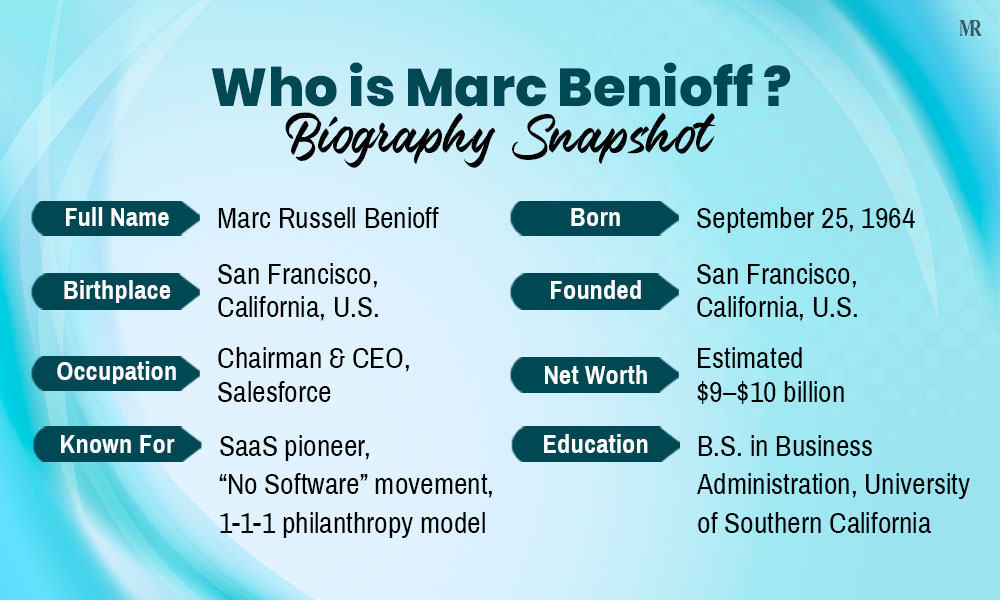
Who is Marc Benioff? Biography Snapshot
Early Life & Family Background (1964–1982)
- Birth, Family, and Upbringing
Marc Benioff was born on September 25, 1964, in San Francisco, California and is of Jewish heritage. He represents a fourth generation of his family to live in the city. His grandfather, Marvin Lewis, significantly influenced his worldview as a trial attorney and city supervisor. Notably, Lewis championed the creation of the Bay Area Rapid Transit (BART) system. His family also owned the local Benioff’s Department Store.
- Early Exposure to Technology
Marc Benioff grew up in Hillsborough and attended Burlingame High School. During the late 1970s, he developed a strong interest in computers and programming. He spent significant time learning to code and experimenting with software. At age fourteen, he sold his first program, How to Juggle, for seventy five dollars. This marked his first experience turning software into a commercial product.
- First Signs of Entrepreneurship
At fifteen, Marc Benioff founded Liberty Software to develop video games for the Atari 8 bit platform. He created games including Flapper and King Arthur’s Heir. These titles generated royalties that later helped pay for his college education. Consequently, he learned the importance of user engagement and scalability before entering the corporate world.
Education & Formative Years (1982–1986)
- College Education and Academic Interests
Marc Benioff attended the University of Southern California (USC), joining the Tau Kappa Epsilon fraternity. He graduated in 1986 with a B.S. in Business Administration. Years later, in 2014, USC recognized his professional impact by awarding him an honorary Doctor of Humane Letters.
- Marc Benioff’s Internship at Apple
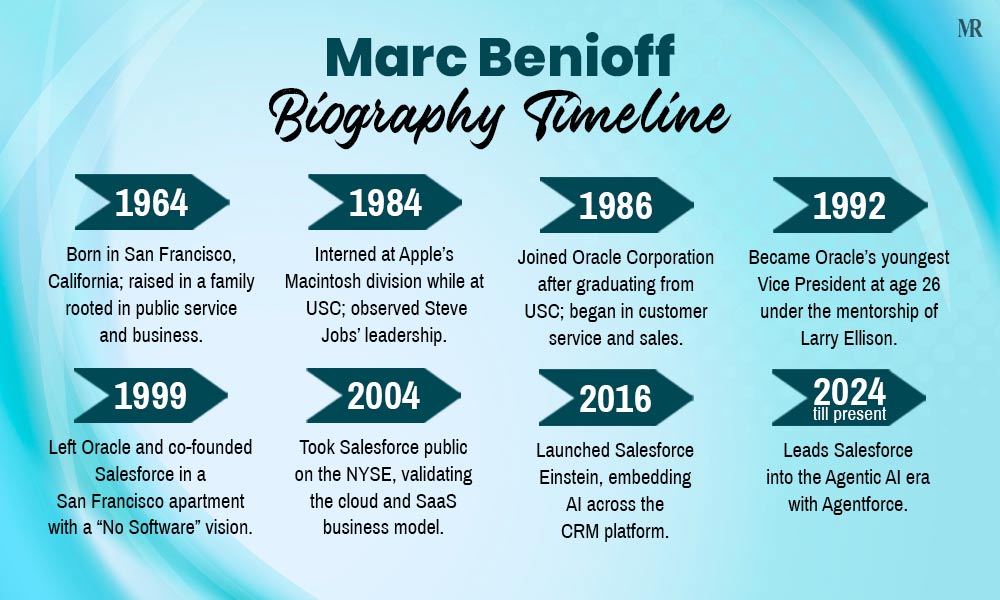
During his college years, Marc Benioff secured a pivotal internship at Apple in the Macintosh division. During the summer of 1984, he worked on assembly language programs for the Macintosh 68000 development system. At Apple, he witnessed Steve Jobs’ dynamic leadership and unique corporate culture firsthand. Marc Benioff considered Steve Jobs a major mentor and once stated there would be no Salesforce without him.
- Lessons From Early Successes and Failures
As a teenager, Benioff worked briefly at a jewelry store to save money for a computer. The role ended quickly when he was fired for using the wrong soap to clean the floors. The experience was minor, but it left a clear impression. Work carries expectations, mistakes have consequences, and setbacks are unavoidable,
The Oracle Years: Learning Inside Big Tech (1986–1999)
- Joining Oracle
Marc Benioff joined Oracle Corporation in 1986 immediately after graduating from USC. He initially worked in a customer-service role. His talent for sales and marketing quickly propelled him through the ranks of the organization.
- Rapid Rise Under Larry Ellison
At age 23, Marc Benioff earned the title of “Rookie of the Year”. At 26, he became the youngest vice president in Oracle’s history. During this period, he came under the direct influence of the co-founder of Oracle Larry Ellison, who became both his mentor and a close personal friend.
- What Benioff Learned From Oracle
During his 13-year tenure, Marc Benioff gained deep expertise in sales, marketing, and product development. However, he observed the “broken” nature of traditional software. Customers faced high upfront license fees, expensive hardware requirements, lengthy installations, and ongoing maintenance costs. Software updates were slow and disruptive. From Benioff’s perspective, the system worked well for vendors but poorly for users.
- Why He Eventually Walked Away
Marc Benioff took a sabbatical in 1996 to gain perspective on his career. While swimming with dolphins in Hawaii, the vision for cloud computing crystallized in his mind. He wanted to make business software as simple to use as Amazon. Consequently, he left Oracle in 1999 with Ellison’s $2 million initial investment to launch Salesforce.
The Idea That Changed Everything (1999)
- The “No Software” Vision
Marc Benioff defined the mission of Salesforce with the provocative marketing statement, “The End of Software”. Rather than installing applications from CD ROMs, he believed businesses should access software directly through the internet. He hired Bruce Campbell to create the iconic “No Software” logo to clearly differentiate his new model.
- Founding Salesforce
In March 1999, Benioff co-founded Salesforce in a small one bedroom apartment on Telegraph Hill in San Francisco. He worked alongside co-founders Parker Harris, Dave Moellenhoff, and Frank Dominguez. By the summer of 1999, the team grew to 10 employees.
- Early Skepticism From the Industry
Competitors like Siebel Systems initially dismissed the web-based model. In response, Marc Benioff used guerrilla marketing tactics to force the industry to choose between the “old way” and the “new way”. At times, he even hired actors to stage mock protests outside competitor conferences.
Building Salesforce From Scratch (1999–2004)
- Early Product Development
The first Salesforce version supported basic CRM functions like accounts, contacts, and opportunities. Marc Benioff drew inspiration from the usability of consumer websites to ensure the platform remained accessible. He focused on building a “multitenant system,” where multiple customers could securely share the same application, allowing Salesforce to scale efficiently from day one.
- First Customers and Revenue
By 2001, Salesforce had reached 3,000 customers. To support this growth, the company moved its offices to One Market Street in November 2000. Alongside sales execution, Benioff emphasized community building. Through initiatives like the #Trailblazer movement, he encouraged users to see themselves not just as customers, but as participants in a shared ecosystem.
- Surviving the Dot-Com Crash
When the dot-com bubble burst in 2000, Salesforce CEO Marc Benioff was forced to lay off 20% of the workforce. However, the crisis validated the subscription-based SaaS model. Companies preferred low-cost monthly fees over large capital investments during the downturn.
- Establishing the SaaS Model
As a result, Salesforce emerged from the crash with a stronger position. Benioff demonstrated that Software as a Service could support enterprise scale workloads reliably. In parallel, he formalized the company’s internal culture. By introducing the “Ohana” philosophy early on, often symbolized by Hawaiian shirts, he reinforced a sense of shared responsibility and long term commitment across the organization.
Salesforce Goes Public & Scales Globally (2004–2014)
- IPO and Market Validation
By 2004, Salesforce had reached a scale that demanded public scrutiny. On June 23, 2004, the company completed its initial public offering on the New York Stock Exchange, raising $110 million. With this milestone, the cloud computing model gained formal validation in public markets. Throughout this period, Marc Benioff remained at the helm as sole CEO, guiding the company through its first major phase of public company growth.
- Scaling Leadership and Culture
In 2005, he launched AppExchange, extending Salesforce beyond a single product into a broader application ecosystem. By 2008, Salesforce became the first cloud company to surpass $1 billion in annual revenue. At the same time, Benioff positioned social responsibility as a core element of Salesforce’s long term identity rather than a secondary initiative.
Reinventing Salesforce Multiple Times (2014–2020)
- Platform, AI, and Data Expansion
In 2014, Marc Benioff declared that Salesforce would become an “AI-first” company. Consequently, he launched Salesforce Einstein in 2016 to embed AI across the entire CRM platform. Alongside this effort, he prioritized building a strong data foundation to power future digital transformations
- Adapting Salesforce for the Enterprise Era
The acquisition of Slack introduced a new way of working inside enterprises. Through what Salesforce described as “swarming,” teams could collaborate digitally and resolve issues in real time. At the same time, Marc Benioff shifted the focus toward an all-digital, work-from-anywhere world. In 2025, Slack helped Salesforce employees save over 500,000 work hours.
Marc Benioff — Biography Timeline
Marc Benioff Leadership Style & Business Philosophy
- Management and Decision-Making Style
Marc Benioff practices human-centered leadership that integrates spiritual awareness with corporate purpose. Drawing on Buddhist philosophy and mindfulness, he applies these principles to daily decision making. At the same time, he emphasizes maintaining a “beginner’s mind,” encouraging openness to new ideas and continuous learning.
- Views on Stakeholder Capitalism
Marc Benioff Salesforce CEO, publicly challenges the traditional “shareholder primacy” playbook. He believes that customers, employees, and the environment are legitimate stakeholders in every decision. Furthermore, he argues that capitalism must serve the social good rather than just making money.
- The Role of Values in Leadership
Five core principles guide Benioff’s leadership:
- Trust
- Customer success
- Innovation
- Equality
- Sustainability
To support these ideals, he established an Office of Ethical and Humane Use to address complex issues around technology and responsibility. Ultimately, he believes that innovation without integrity is meaningless.
Criticism & Challenges
- Internal Challenges
In January 2023, Salesforce CEO Marc Benioff announced the mass dismissal of approximately 7,000 employees. He later admitted that the two-hour all-hands meeting over a call was a “complete dumpster fire”. Employees and observers pointed to the process as lacking discipline and empathy at a moment of high uncertainty.
- External Criticism
Marc Benioff sparked an uproar in 2026 after making a “joke” about ICE monitoring international employees at a conference. Over 1,300 employees signed a letter calling for a denouncement of ICE actions. Additionally, he faced backlash for suggesting that the National Guard should address public safety in San Francisco.
Marc Benioff Today (2020–Present)
- Salesforce in the AI Era
Marc Benioff is currently leading the “Agentic AI“ revolution at Salesforce. He declared that AI agents will revolutionize customer success by acting as always-on digital labor. Consequently, he is restructuring the entire company around this “agentic” vision.
In the Salesforce earnings report 2026, Marc said“We’ve rebuilt Salesforce to become the operating system for Agentic Enterprise, bringing humans and agents together on a trusted platform.” He further added,“The more intelligence moves to where work happens, the more valuable Salesforce becomes.”
- Benioff’s Current Focus
The primary focus today is Agentforce, an AI system built directly into the Salesforce platform. Alongside commercial use cases, Benioff has expanded into government and defense applications. Recently, Salesforce secured a $5.6 billion contract with the US Army for Missionforce, a national security focused AI initiative. At the same time, he has kept software engineering hiring flat while increasing headcount in sales and customer engagement for AI deployment.
Personal Life & Interests
Away from Salesforce, Benioff’s interests shift toward the ocean and the outdoors.
He enjoys scuba diving and sailing, activities that align with his long standing connection to Hawaii. He also owns several hundred acres of land there and collects Hawaiian artifacts.
This connection also shows up symbolically in his leadership style.
He frequently wears Hawaiian shirts to reinforce the company’s “Ohana” culture and even named his golden retriever Koa, after a native Hawaiian tree.
Philanthropy & Social Impact
- Philanthropic Initiatives
Marc’s spiritual philosophy changed significantly after reading the Dalai Lama’s The Good Heart.
Marc and Lynne Benioff have donated over $100 million to UCSF, specifically for children’s hospitals in San Francisco and Oakland. They also backed the 1t.org initiative to plant one trillion trees globally. Furthermore, in 2018, they purchased TIME for $190 million to protect it as a platform for change.
Most recently, the Benioffs announced a $150 million contribution in Hawai‘i to expand health care access and critical infrastructure, and they have donated over 440 acres of land to support affordable housing on the islands.
- The 1-1-1 Model
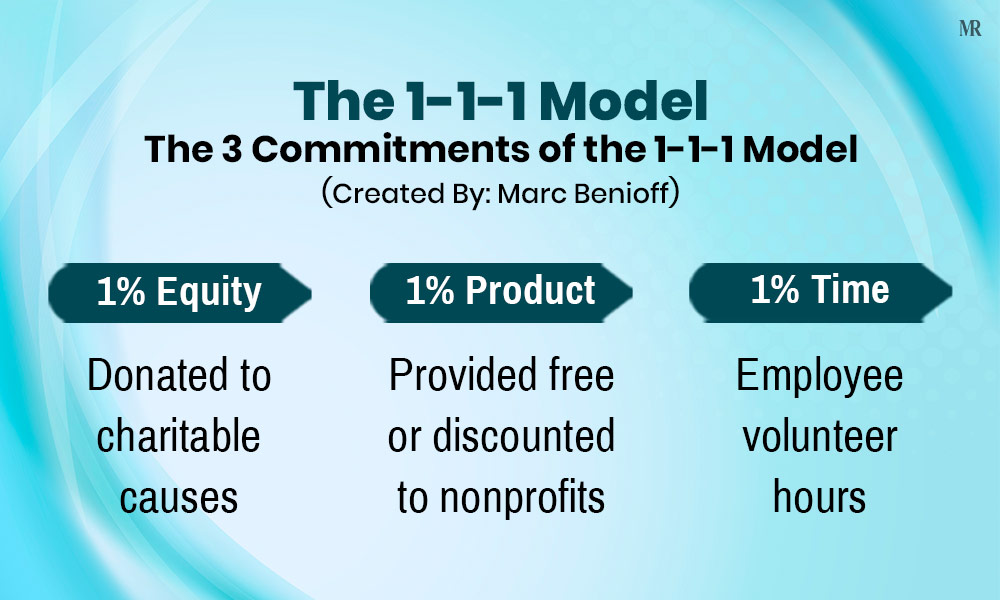
From the earliest days of Salesforce, Benioff institutionalized giving through the 1-1-1 model, pledging 1 % of company equity, 1 % of product, and 1 % of employee time to charitable causes. Today, over 20,000 companies have adopted this model through the “Pledge 1%” movement.
Legacy & Long-Term Impact on Cloud Computing
Salesforce CEO Marc Benioff will be remembered as one of the architects of modern cloud computing.
By championing Software as a Service, he helped overturn the on premise software model that dominated enterprise IT for decades.
Today, SaaS represents the majority of new enterprise software spending, and Salesforce stands as the category leader, generating over $41.5 billion in FY2026 annual revenue and serving more than 150,000 customers globally.
The “No Software” idea did not remain a slogan. It became an operating standard across the industry.
Alongside leaders like Jeff Bezos and Satya Nadella, Benioff helped define how cloud-first companies scale globally.
Conclusion
The biography of Salesforce CEO Marc Benioff highlights a career defined by bold risks and humanitarian values.
From his early days at Apple to founding Salesforce in a small apartment, he has consistently challenged the status quo.
His 1-1-1 model remains a blueprint for modern corporate responsibility.
Despite recent internal challenges, Benioff continues to lead the next evolution of technology through Agentic AI.
I encourage you to explore his books, Trailblazer and Behind the Cloud, to understand how business can truly improve the state of the world.
If you found this biography of Marc Benioff, the Salesforce CEO inspiring, share this story with founders, operators, and anyone rethinking what modern business leadership should look like!
Maria Isabel Rodrigues
FAQs
- What is Marc Benioff’s net worth in 2026?
Marc Benioff’s net worth in 2026 is estimated between $9 billion and $10 billion, primarily from his Salesforce equity, investments, and assets.
- Where does Marc Benioff live?
Marc Benioff lives primarily in California and also spends significant time in Hawaii, where he owns land and supports local philanthropic initiatives.
- Who is Marc Benioff’s wife?
Marc Benioff is married to Lynne Benioff, a philanthropist and co leader of the couple’s charitable initiatives.
- Is Marc Benioff a Democrat?
Yes. Marc Benioff is publicly aligned with the Democratic Party and has supported Democratic candidates and progressive causes, particularly around healthcare, climate, and equality.