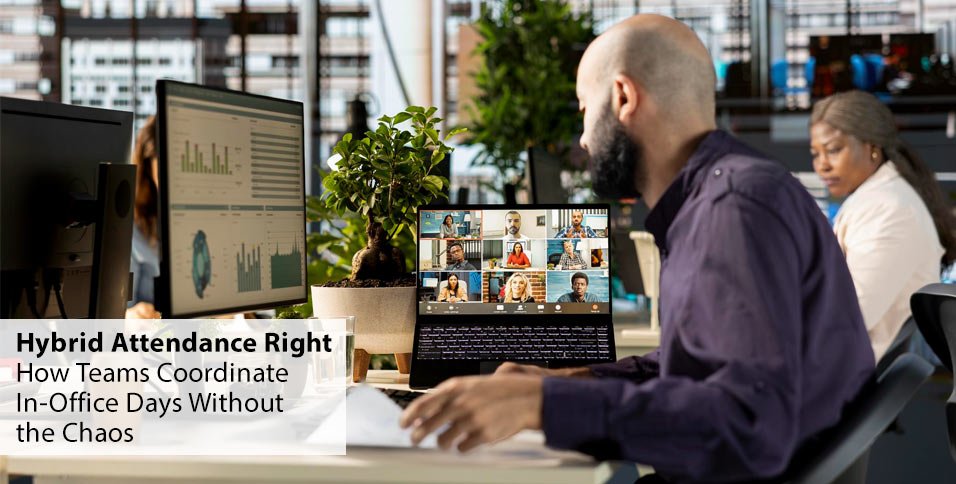
Most companies now have more people assigned to the office than they have desks for them. CBRE’s 2026 Global Workplace and Occupancy Insights puts global office occupancy at 111% of physical seats, yet average utilization only reached 53% in 2025.
Employees cluster onto the same two or three days and skip the rest. A single building runs over capacity on Tuesday and sits half empty by Thursday. Coordination is the real fix, and it’s a solvable problem once a team stops treating hybrid scheduling as an honor system.
Why Ad Hoc Scheduling Breaks Down
Most hybrid policies name anchor days. Few policies give employees a way to see who else has actually committed to those days. Each person is left guessing whether showing up is worth it.
A 2023 study published in the Proceedings of the National Academy of Sciences analyzed badge-access data from roughly 43,000 employees at a global technology company. Researchers from Purdue, MIT, and Microsoft found that an employee’s in-person attendance was 29% higher when their manager was in that day. Attendance climbed further as more teammates were also present.
Employees are picking their office days by watching what everyone else does. If a manager works from home on Tuesdays, the team quietly follows without anyone making it a policy. Coordination built this way holds together only as long as people can track who else is coming in from memory, which breaks down once a team grows past a handful of people.
The Three Habits That Close the Coordination Gap
Teams that get hybrid attendance right tend to share three specific habits, regardless of industry.
- Anchor Days Are Visible: A policy naming Tuesdays and Thursdays only works if people can see who else has committed to those days. A shared floor plan or calendar view does that.
- People Book Ahead of the Day Itself: Desk and room booking gives employees a guaranteed spot. It also gives facilities teams real reservation data. Badge swipes only produce a rough headcount estimate after the fact.
- Usage Data Gets Reviewed on a Set Schedule: Most companies skip regular reviews. Wakefield Research polled 400 U.S. commercial real estate and facilities decision-makers on behalf of Butlr in 2026. In the survey, 87% called understanding actual space usage a high priority. Just 19% said they base space-planning decisions on data. Most keep paying for floor space around headcount instead of actual attendance.
Where a Coordination Platform Helps
Visible anchor days and regular usage reviews both depend on one thing: a system people use. That need is why so many companies are evaluating desk-booking and coordination platforms right now.
Kadence built its reputation around syncing people, spaces, and schedules for hybrid teams. Its lighter footprint appeals to companies that want straightforward booking and attendance coordination without a bigger platform commitment.
OfficeSpace pairs desk and room booking with space planning, asset tracking, and analytics in one platform. That range matters for companies managing space across multiple floors or buildings.
Teams sizing up their options often start with a direct comparison of OfficeSpace and Kadence for desk booking, since the two platforms solve overlapping problems in different ways. The right fit comes down to whether a company needs booking on its own or booking as one piece of a larger space strategy.
A coordination platform earns its cost when in-office days become predictable for the people walking through the door.
Rolling Out a Coordination Platform That Sticks
Even the right software fails if the rollout is an afterthought. A few practices separate teams that adopt coordination tools smoothly from teams that end up back in a group chat asking who’s in the office tomorrow.
Start with one team or floor before going company-wide. Early friction is easier to fix at a small scale. A working pilot gives the rest of the company a reason to trust the new process.
Connect the tool to what people already use. Booking software that lives inside Slack, Teams, or the calendar someone already checks earns steady use. A tool that requires a separate login stops getting opened within a few weeks.
Repeat the expectation past onboarding. The same principle that makes leadership training stick applies here: habits form through repetition. Managers who visibly book their own desk each week establish the norm faster than a company-wide email ever will.
Build Visibility into How Your Teams Work
Employees need one shared place to see who’s coming in. That only works if the system is easy to use and someone reviews the data regularly. Teams that treat coordination as infrastructure are the ones whose in-office days work out the way they were planned.
Hybrid coordination is one piece of a much larger shift in how companies reorganize work. Technology is already changing which tasks people do and where they do them. Companies are rebuilding how teams show up and coordinate in person at the same time.