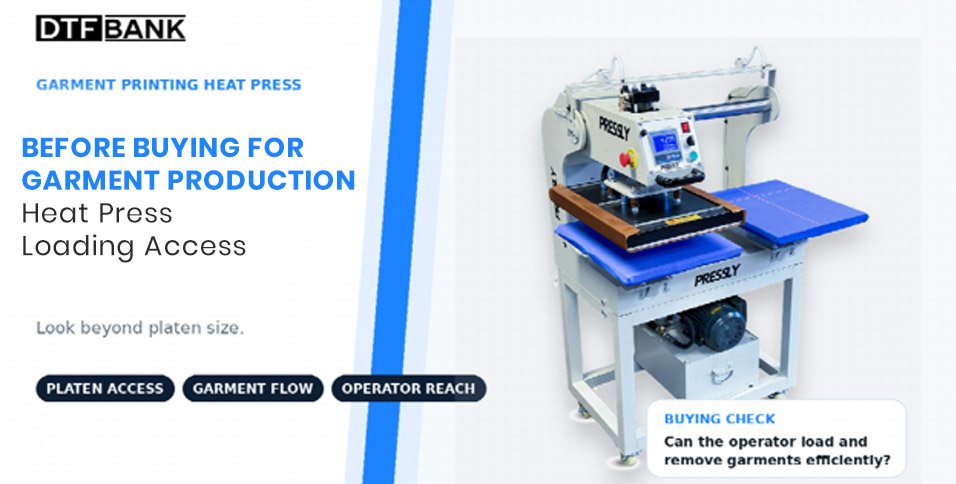
Heat press buyers naturally compare platen dimensions, pressure systems, temperature ranges, and production speed. Those specifications matter, but they do not completely describe what an operator experiences during a normal garment printing shift.
One of the most practical differences between presses is simply how easily a garment can be loaded, positioned, checked, and removed. A machine may offer enough platen area on paper while still making certain garments awkward to handle because of the space around the working surface.
For apparel shops comparing heat presses for garment printing, loading access deserves to be evaluated as a production feature rather than an afterthought.
Platen Size and Platen Access Are Different Questions
Platen dimensions tell you how large the pressing surface is. They do not tell you how comfortably an operator can work around that surface.
Two presses with similar nominal platen dimensions can create very different loading experiences depending on the machine structure, opening geometry, surrounding frame, and available working clearance.
This becomes important when a shop moves beyond basic flat T-shirts. Hoodies, sweatshirts, work shirts, bags, and other garments may require more material to be managed around the pressing area.
The useful question is therefore not only, “Will the design fit?” It is also, “Can the operator position the garment efficiently without fighting the machine?”
Observe Where the Garment Has to Go
When evaluating a heat press, imagine the complete loading movement rather than looking only at the center of the platen.
Where does excess fabric sit? Can the garment body move naturally away from the pressing zone? Is there enough room to position the intended print area without bunching unnecessary fabric around the workstation?
These questions become more important as garment construction becomes more complex.
An apparel shop may print a lightweight tee during one job and a bulky sweatshirt during the next. The required transfer may still fit comfortably within the platen, but the garment itself occupies considerably more space around it.
Consider the Operator’s View of the Print Area
Good loading access is also about visibility.
Operators need to confirm that the garment is positioned correctly before the press closes. A working area that is difficult to see can make alignment slower even when the machine itself is capable of fast cycles.
This is especially relevant when placement needs to remain consistent across a production batch. The operator should be able to see the working surface clearly enough to repeat the established positioning method without unnecessary reaching or repositioning.
Better visibility does not replace measurement or job standards, but it can make those standards easier to follow.
Think About Garment Loading as a Repeated Motion
A movement that feels slightly inconvenient during a product demonstration can become a meaningful production issue after hundreds of repetitions.
Consider how the operator approaches the platen, positions the garment, removes the finished piece, and prepares for the next cycle.
Does the workflow require repeated reaching around machine components? Does the operator need to reposition the garment more than expected before the print zone sits correctly? Does unloading interrupt preparation for the next piece?
The purpose of this evaluation is not to find a machine that eliminates every movement. It is to identify whether the machine layout supports the way the shop actually produces garments.
Test More Than One Garment Type
A buying decision based on one standard T-shirt can hide important workflow differences.
If possible, evaluate the press using representative garment categories from the shop’s normal workload. A basic tee can show general platen access, while a heavier or larger garment can reveal how the machine handles additional material around the printing area.
The objective is not to test every product the business may ever print. Instead, choose garments that represent the range of loading challenges operators regularly encounter.
This makes the evaluation more realistic than judging the machine from specifications alone.
Separate Application Technique From Machine Access
Loading access and transfer application are related but separate issues.
The correct temperature, time, pressure, and handling procedure should follow the relevant transfer and garment requirements. Easier platen access does not change those instructions.
What it can change is how easily the operator prepares the garment for that verified process.
Shops developing their application workflow can also review a dedicated guide to using a heat press for T-shirt printing, while keeping equipment selection and application technique as separate decisions.
Include Workstation Space in the Evaluation
The machine does not operate in isolation.
Loading access depends partly on how the press fits into the production area. A layout that looks comfortable in an open showroom may feel different once tables, transfer staging, garment stacks, and finished-product areas surround the machine.
Before purchase, think about where operators will stand and where incoming and completed garments will move.
The best equipment choice should support the actual workstation rather than forcing the workstation to compensate for the machine.
Buy for Usable Access, Not Only Published Dimensions
A large platen can be valuable, but usable garment access is what turns that surface into a productive workstation.
Compare how operators approach the platen, how easily garments can be positioned, how clearly the print area can be seen, and how naturally finished pieces can be removed.
Those observations add an important real-world layer to the specification sheet.
For garment production shops, the right heat press is not simply the machine with enough pressing area. It is the machine whose pressing area can be used repeatedly and efficiently throughout the working day.