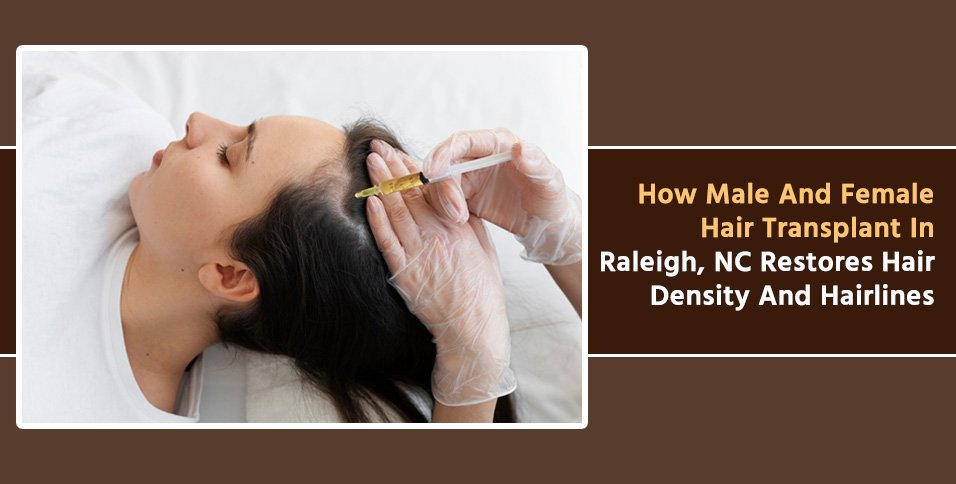
Hair loss affects millions of adults, impacting self-confidence and personal styling choices. Fortunately, modern medical advancements offer permanent solutions to thinning hair and receding hairlines. If you live in North Carolina and want to restore your natural hair pattern, seeking a female hair transplant in Raleigh, NC provides access to top-tier clinical expertise and advanced restoration techniques. Both men and women experience pattern baldness differently, meaning treatment plans must be highly customized. This article details how state-of-the-art procedures help patients regain their natural hair density. By understanding the distinct physiological approaches for different genders, you can make an informed decision about your restoration journey and find the right local specialists.
Understanding the Mechanics of Hair Loss by Gender
To understand how restoration works, one must first examine how hair loss manifests differently in men and women. Men typically experience androgenetic alopecia, which follows a predictable pattern. It starts with a receding hairline at the temples and thinning at the crown, eventually leaving a band of hair around the sides and back of the head. For this reason, a hair transplant for male in Raleigh, NC often focuses on rebuilding a strong, masculine hairline and filling in the vertex.
In contrast, women generally experience diffuse hair loss. Instead of a receding hairline, female pattern hair loss causes widespread thinning across the entire scalp, particularly along the part line. The frontal hairline usually remains intact, though the overall density decreases significantly. Because of these distinct patterns, surgical strategies must differ. Surgeons cannot treat diffuse female thinning the same way they treat localized male pattern baldness. For women, the goal is often to densify the existing hair patterns without damaging the surrounding healthy follicles. This requires a meticulous approach to graft placement, ensuring that the newly transplanted hair blends seamlessly with the remaining natural strands to create a fuller, natural-looking appearance across the top of the scalp.
Advanced Restoration Techniques: FUE vs. FUT
Modern hair restoration relies on two primary harvesting methods: Follicular Unit Extraction (FUE) and Follicular Unit Transplantation (FUT). Each method offers unique benefits depending on the patient’s hair loss pattern, scalp elasticity, and aesthetic goals.
The FUE Approach
During an FUE procedure, the surgeon harvests individual hair follicles directly from the donor area, typically the back of the head, using a specialized micro-punch tool. This technique leaves tiny, dot-like scars that are virtually invisible, even with short haircuts. FUE is highly popular for men who prefer to keep their hair short.
The FUT Approach
Conversely, FUT, or the strip method, involves removing a small strip of tissue from the donor area, from which individual follicular units are extracted under a microscope. This method often yields a higher number of viable grafts in a single session, making it highly effective for extensive thinning. When undergoing a female hair restoration procedure in North Carolina, many patients prefer FUT because they do not have to shave large portions of their scalp. The remaining hair easily conceals the linear scar. However, FUE remains an excellent option for those who want to avoid any linear scarring. Your surgeon will evaluate your donor hair density to recommend the ideal technique for your specific restoration needs.
Designing the Perfect Hairline for Men
Recreating a natural hairline is as much an art form as it is a medical science. For male patients, the hairline defines the face and frames the features, making its design crucial to a successful outcome. A poorly designed hairline can look artificial, while a well-crafted one remains completely undetectable.
When planning a hair transplant for male in Raleigh NC, experienced surgeons analyze several facial landmarks to determine the optimal position of the new hairline. They avoid creating a straight line, which looks unnatural. Instead, they design a slightly irregular, soft boundary that mimics natural growth patterns. Single-hair grafts are placed at the very front of the hairline to create a soft transition, while thicker, multi-hair grafts are placed further back to build density.
Age is another critical factor. A hairline designed for a twenty-year-old may look out of place on a fifty-year-old. Surgeons design mature hairlines that account for future aging, ensuring the results look natural for decades to come. By matching the angle and direction of the existing hair, the transplanted grafts blend perfectly, giving patients a youthful yet age-appropriate frame for their face that boosts self-esteem and restores a rugged, masculine profile.
Achieving Optimal Density for Women
While men often prioritize hairline advancement, women usually seek to restore lost volume and density. Female hair thinning can make the scalp visible under bright lights or when the hair is wet, which causes significant distress.
Addressing this issue requires a specialized approach. Performing a female hair transplant in Raleigh, NC involves placing grafts between existing hairs to increase overall density. This process, known as dense packing, requires extreme precision. The surgeon must carefully make recipient incisions without damaging the surrounding active hair follicles. If the surgeon places the grafts too close to existing hairs, it can cause temporary shock loss or permanent damage to the native hair.
To prevent this, specialists use high-powered magnification and ultra-fine blades or needles. They target areas of maximum thinning, such as the crown and the central part line, to create the illusion of a full head of hair. Additionally, because female hair loss can sometimes be linked to hormonal imbalances or thyroid issues, Raleigh clinics often conduct thorough medical evaluations before surgery. This ensures that the hair loss is stable and that the patient is an ideal candidate for a surgical procedure, leading to predictable, long-lasting density.
What to Expect During Recovery and Beyond
Understanding the recovery timeline helps patients manage their expectations and achieve the best possible results. Immediately following the procedure, the scalp will be tender, and small scabs will form around the graft sites. These scabs naturally fall off within ten to fourteen days.
Most patients can return to non-strenuous work within a few days. However, the real transformation takes time. Around two to four weeks post-surgery, the transplanted hairs will shed. This is a completely normal part of the process called shedding, and it indicates that the hair follicles are entering a resting phase before producing new, strong shafts.
Whether you undergo a male hair restoration procedure or a female restoration procedure, new hair growth typically begins around the third or fourth month. By month six, patients usually see noticeable improvement in density. The final results manifest between twelve and eighteen months, revealing thick, healthy hair that you can cut, style, and wash just like your original hair. Following post-operative care instructions, such as avoiding direct sunlight and heavy exercise during the first week, ensures optimal graft survival and maximizes the overall success of the transplant.
Conclusion
Hair loss can challenge your self-image, but modern hair restoration procedures offer a reliable, permanent solution. Whether you are seeking a female hair transplant in Raleigh, NC to address diffuse thinning or a hair transplant for male in Raleigh NC to redefine a receding hairline, local clinics provide advanced, customized care. By utilizing state-of-the-art FUE and FUT techniques, skilled surgeons can recreate natural-looking hairlines and restore youthful hair density. The key to a successful outcome lies in choosing an experienced specialist who understands the unique physiological differences in male and female hair loss. Taking the first step toward hair restoration can restore not just your hair, but also your confidence and peace of mind.