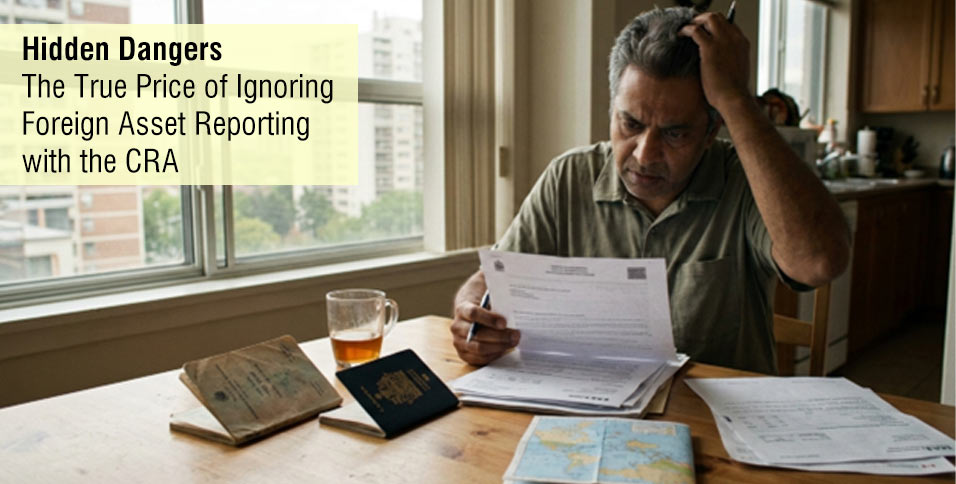
Picture a Toronto resident who quietly holds a U.S. brokerage account, a rental condo in Florida, and inherited shares from a family business in Hong Kong. The original cost of these assets combined exceeds $100,000 CAD at some point during the year, but they never appear on the Canadian tax return. What feels like a minor administrative oversight can rapidly escalate into tens of thousands in penalties, years of CRA audits, compounding interest, and in extreme cases, criminal scrutiny. Under Canadian tax law, all tax residents must annually disclose “specified foreign property” worth more than $100,000 CAD (original cost basis) using Form T1135, the Foreign Income Verification Statement. In an era where global tax authorities share information automatically, non-compliance is no longer a low-risk gamble.
Toronto’s unique position as one of the world’s most multicultural cities amplifies this risk dramatically. More than 51% of residents were born outside Canada, according to recent Statistics Canada data, and many maintain strong financial, familial, or property ties abroad. Neighborhoods like Scarborough, North York, Markham, Vaughan, and Mississauga are home to professionals, entrepreneurs, and retirees who inherit assets in Europe, invest in U.S. markets, own vacation properties in the Caribbean or Mexico, or hold stakes in family businesses in Asia. Bay Street executives and tech founders frequently manage offshore portfolios or trusts. Yet the Canada Revenue Agency (CRA) now receives detailed, automatic reports on these holdings through the Common Reporting Standard (CRS). Canada participates in exchanges with over 100 jurisdictions (and commitments extend to more than 120), meaning foreign banks, brokerages, and investment firms routinely transmit account balances, interest, dividends, and sale proceeds directly to the CRA. What was once considered private is now routinely visible.
The Reporting Requirement: Who Must File Form T1135
Canadian tax residents must file Form T1135 if the total cost amount of specified foreign property exceeds $100,000 CAD at any time in the calendar year. Specified foreign property includes foreign bank accounts, shares in non-resident corporations (not held in registered accounts), debts owed by non-residents, real estate outside Canada not used personally, and interests in foreign trusts or partnerships. It excludes property used in an active business abroad, personal-use assets, or holdings in Canadian-registered plans like RRSPs.
The threshold applies to the original cost, not current market value. For example, a Toronto resident who bought U.S. stocks years ago for $120,000, even if now worth less, must report if the cost basis remains above the limit. Failure to file carries strict penalties: standard late-filing fines reach $25 per day up to a maximum of $2,500 per year, plus interest. In cases deemed grossly negligent or knowing omissions, penalties climb to $500 per month for up to 24 months, capping at $12,000, with additional 5% levies on the unreported property value in severe instances.
Recent CRA compliance data shows thousands of T1135 penalty assessments annually, often totaling millions in recovered amounts. In one fiscal period, over 30,000 assessments occurred, many involving dual citizens or globally mobile individuals common in Toronto’s international workforce.
How Automatic Exchange of Information Changes the Game
The CRS, implemented through multilateral agreements, enables automatic sharing of financial account information between tax authorities. Canada exchanges data with over 120 participating jurisdictions, covering major financial centers from Switzerland to Singapore. Financial institutions in these countries report account details of Canadian tax residents, including balances, interest, dividends, and sales proceeds.
This network has dramatically reduced the ability to maintain undisclosed offshore holdings. CRA receives millions of records yearly, cross-referencing them against T1135 filings and income tax returns. Discrepancies trigger reviews, often leading to reassessments and penalties. For Toronto’s affluent communities in areas like Forest Hill or Bridle Path, where international investments are commonplace, this means even longstanding accounts can surface unexpectedly.
Statistics highlight the impact: offshore disclosures through the Voluntary Disclosure Program have uncovered hundreds of millions in unreported foreign income annually in recent years. Many cases involve T1135 non-filers who later faced audits after CRS data matches revealed inconsistencies.
Who Needs to Submit Form T1135?
Filing is mandatory for any Canadian tax resident if the total original cost (not current market value) of specified foreign property reaches or exceeds $100,000 CAD at any time during the calendar year. Covered assets include:
- Foreign bank accounts, savings accounts, or GICs
- Shares or units in non-resident corporations, mutual funds, or ETFs (unless held inside RRSPs, TFSAs, or other registered plans)
- Debts owed by non-residents (e.g., loans to family abroad)
- Foreign real estate held for investment or rental purposes (not personal-use cottages or vacation homes you regularly use)
- Interests in foreign trusts, partnerships, or offshore funds
Exclusions apply to property used exclusively in an active business carried on outside Canada, personal-use property under certain thresholds, and assets held in Canadian-registered retirement or savings plans.
The cost-basis rule catches many off-guard. A Toronto resident who purchased U.S. tech stocks for $180,000 in 2015 must report them today even if the portfolio is now worth only $90,000 because the original cost still exceeds the threshold. Penalties are unforgiving:
- Standard late or non-filing: $25 per day, up to $2,500 maximum per year, plus daily compounding interest.
- Gross negligence or willful omission: $500 per month for up to 24 months (capped at $12,000), plus potential additional penalties of 5% of the unreported property cost in prolonged cases.
Recent CRA compliance reports indicate tens of thousands of T1135 assessments annually, with millions recovered in penalties and back taxes. In the Greater Toronto Area, these cases disproportionately involve dual citizens, first- and second-generation immigrants, international business owners, and high-net-worth individuals, demographics heavily concentrated here.
The Impact of Global Data Sharing via CRS
The Common Reporting Standard, developed by the OECD and implemented since 2017, allows participating countries to automatically exchange financial account information. Canada actively shares and receives data with more than 100 jurisdictions, covering virtually every major offshore financial center: Switzerland, Luxembourg, Singapore, Hong Kong, the Cayman Islands, Bermuda, and many more.
Financial institutions abroad are required to identify accounts held by Canadian tax residents and report key details annually: account balances as of December 31, interest/dividend income, gross proceeds from sales, and more. The CRA imports millions of these records each year and runs sophisticated matching algorithms against T1135 filings and income tax returns. Discrepancies almost always trigger contact letters, audits, or reassessments.
For Toronto’s affluent and globally connected residents, this means longstanding accounts sometimes opened decades ago can suddenly surface. In neighborhoods like Forest Hill, Bridle Path, Lawrence Park, or the Annex, where international investments are commonplace, CRS data has already led to numerous voluntary disclosures and enforced collections. CRA statistics from recent years show hundreds of millions in unreported foreign income corrected through voluntary programs, with a significant portion tied directly to CRS mismatches.
Additional Fallout: Audits, Interest, and Extended Reassessment Periods
Beyond penalties, the consequences compound quickly. Unreported foreign property or related income extends the CRA’s normal three-year reassessment period to six years or indefinitely in cases of fraud or misrepresentation. Interest on any additional tax owed currently compounds at prescribed rates (around 9–10% annually in recent periods), turning a modest underpayment into a substantial liability over time.
Audits often begin with a simple letter requesting clarification, but they can expand to full reviews of multiple years, lifestyle analysis, and requests for extensive documentation. In Toronto’s high-cost environment where housing, education, and living expenses are among the highest in Canada unreported foreign rental income or capital gains can create apparent inconsistencies that heighten scrutiny. Severe negligence findings trigger the highest penalty tiers, and rare but possible criminal investigations for tax evasion carry even greater reputational and financial risk.
Life events frequently expose the issue: inheriting property from parents abroad, receiving a divorce settlement that includes foreign assets, or planning retirement distributions from offshore accounts. A professional in Etobicoke or Vaughan might delay reporting an inherited European apartment until selling it only to face retroactive penalties, interest, and reassessments spanning six or more years.
Everyday Examples: Common Mistakes and Their Costs
- A Toronto tech entrepreneur maintains a U.S. brokerage account originally funded with $170,000 CAD. Believing their Canadian accountant handled everything, they never filed T1135. CRS data from the U.S. triggered maximum $2,500 annual penalties for three years ($7,500 total) plus interest on unreported dividends exceeding $15,000.
- A family in Brampton owns a Florida rental condo purchased for $220,000 CAD. They diligently reported rental income but omitted T1135 disclosure. A CRS mismatch led to an audit, gross negligence penalties approaching $12,000, six years of reassessment, and additional interest on underreported depreciation recapture.
- A Markham resident inherits shares in a Hong Kong family corporation valued at $140,000 CAD cost basis. No income was generated initially, so they assumed no reporting was needed—until CRS flagged the ownership, resulting in multi-year late penalties and interest charges.
- A North York retiree holds a Swiss bank account from their pre-immigration days. Long dormant, it suddenly appears in CRA records via CRS, leading to voluntary disclosure to avoid harsher enforcement.
These scenarios are not rare in the GTA, where global connections through immigration, business, and family are the norm.
Smart Moves: Voluntary Disclosure and Compliance Strategies
The CRA’s Voluntary Disclosures Program remains one of the most effective tools for correction. When submitted voluntarily, completely, and before CRA contact, it typically eliminates penalties and waives a portion of interest. Recent program updates have streamlined the process and increased accessibility.
Best practices include:
- Tracking original cost bases meticulously (purchase price + improvements, not market value)
- Retaining foreign bank/investment statements and property records
- Reviewing holdings annually, especially after life changes
- Consulting professionals for complex situations involving trusts, partnerships, or multiple jurisdictions
Toronto offers abundant resources: community tax clinics, professional associations like CPA Ontario, and CRA webinars. However, personalized advice from a qualified tax accountant familiar with cross-border issues is invaluable for accurate classification, timely filing, and minimizing risk.
The Bigger Shift: Transparency in a Connected World
Global transparency initiatives like CRS represent a permanent change in international tax enforcement. Canada’s active participation closes loopholes that once existed for offshore holdings. For residents of diverse, internationally linked cities like Toronto where cross-border ties are an everyday reality — compliance is no longer optional; it’s essential to avoid unexpected financial and legal exposure.
Addressing oversights early prevents costs from escalating. A knowledgeable Toronto tax professional can clarify your specific obligations, prepare accurate T1135 filings, and guide you through voluntary disclosures or corrections with confidence.
For expert help with T1135 compliance, foreign asset reporting, voluntary disclosures, or cross-border tax planning, contact a trusted Experienced tax accountant Toronto to protect your finances and gain peace of mind.
Common Questions Answered
What exactly counts as specified foreign property for T1135 purposes?
Foreign bank/investment accounts, shares in non-resident corporations (outside registered plans), non-resident debts, non-personal-use foreign real estate, and interests in foreign trusts/partnerships. Active business assets abroad and Canadian-registered plan holdings are generally exempt.
How are penalties calculated for late or missing T1135 filings?
Standard late penalties: $25/day up to $2,500/year + interest. Gross negligence: $500/month up to 24 months ($12,000 max), with possible additional 5% on property cost in extreme cases.
Does the CRA really receive automatic information on my foreign accounts?
Yes, through CRS exchanges with over 100 jurisdictions. Foreign institutions report Canadian residents’ account details, which the CRA cross-checks against filings.
What should I do if I realize I’ve missed T1135 filings for past years?
Consider the Voluntary Disclosures Program for potential penalty/interest relief. Gather records promptly and seek professional advice to submit before CRA initiates contact, which limits relief options.