Compliance technology serves as a cornerstone for organizations tackling intricate regulatory demands, with a strong emphasis on automation, risk prediction, and seamless integration.
Early adoption of simplified compliance solutions can streamline operations right from the start, reducing complexity and enhancing efficiency across teams.
Embrace AI for Predictive Compliance
Rather than simply monitoring compliance, organizations are increasingly turning to artificial intelligence to predict compliance problems.
AI algorithms can review huge data sets to identify regulatory trends or employee behaviors that are likely to lead to noncompliance.
This can reduce the amount of manual review and improve decision-making precision.
Machine learning can be used to check that documents meet desired criteria or can generate rules or process maps from small amounts of input.
Explainable AI can allow the decisions made by artificial intelligence to be audited in situations where transparency is important.
If the processes are more accurate, responses are faster, and AI takes care of the ordinary and flags the different, organizations can change from being reactive to being more proactive with compliance becoming second nature.
Integrate Continuous Monitoring Systems
Continuous monitoring tools replace the lengthy periodic audit process with always-on monitoring that collects evidence by instrumenting the infrastructure.
These tools also provide dashboards for teams to see control deadlines, identify gaps, and view overall progress for multi-framework controls.
Instant notification of policy or operational deviations helps nip issues early, before they become expensive problems.
Centralized views help hold individuals accountable, so that everyone from the executive office to the factory floor can see compliance.
It can also work well for auditors who want evidence of compliance without last-minute changes, and who have to accommodate possible increases in data or requirements.
Prioritize Cyber Resilience Features
New threats to cybersecurity require more than just defenses.
Tests that verify recovery plans and advanced encryption designed to prevent new attack methods are both becoming compliance technology best practices.
This enables operations to persist even when under attack.
Automated anomaly detection and simulated incident modules allow for practice, meet data protection obligations, and help create a more mature overall risk framework, without real-world impacts to users or assets.
Regular updates help to keep systems ahead of known threats, and compliance protects the organization’s reputation and assets.
Adopt Compliance by Design Principles
Compliance by design is holistic and prevents costly fixes later.
Workflows should include ethics and compliance checks.
Anonymized whistleblowing and retaliation-free access to reporting mechanisms must be provided in increasingly scalable ways.
This reduces reputational risk by stopping issues before they grow.
Automation can also be applied to tasks like monitoring for trades or archiving communications, freeing staff for more productive endeavors.
Modular technologies can provide organizations with agility without forcing them to completely reengineer systems.
Automate Multi-Framework Reporting
Privacy, financial, and other regulations likewise require automated evidence collection, document version control, and submission, reducing human error and providing executives with real-time assessments of compliance across jurisdictions.
This is especially useful for global teams that are used to rapidly adjusting to changes.
Simple compliance solutions help map controls to multiple standards intuitively, hence saving time.
Dashboards focus attention on priorities, helping reports stay accurate and up to date, no matter how complex.
Enhance Data Analytics for Risk Forecasting
Advanced analytics drive compliance data into forecasts for strategy planning.
Rule engines validate tasks against requirements logically and predict future results in sustainability or supply chain trends.
By integrating financial and operational risks, leaders can optimize their resources, constantly reassess risks, and align their technology investments to their calculated objectives.
This future-proof approach will help teams tackle challenges as they arise.
Build Scalable Tool Integrations
Smooth integration with ERPs, security tech, and other solutions uncovers the true potential of compliance tech stacks.
No code tools allow even non-technical users to build workflows and avoid IT bottlenecks.
These vendor check-in and training rollout automations increased program maturity, allowing it to absorb data surges from expansion without performance sacrifice or additional hiring.
Future-proofing happens organically as adaptable connections are made and needs evolve.
Foster ESG-Aligned Technology
Embedded ESG means environmental, social, and governance measures are auditable, integrating carbon footprints and these risks across customary risk silos with reporting from suppliers to boardrooms.
Automation creates real impact and quantifiable metrics for all stakeholders.
The result: trusted real-time ESG insights, creating new markets.
Authority Insights on Long-Term Impact
Well-established practices such as the revision to the quality management standard are evidence of a more dynamic, risk-based, automated, and traceable quality system that provides agility.
These developments reflect the industry’s direction as most organizations are investing increasingly in technology.
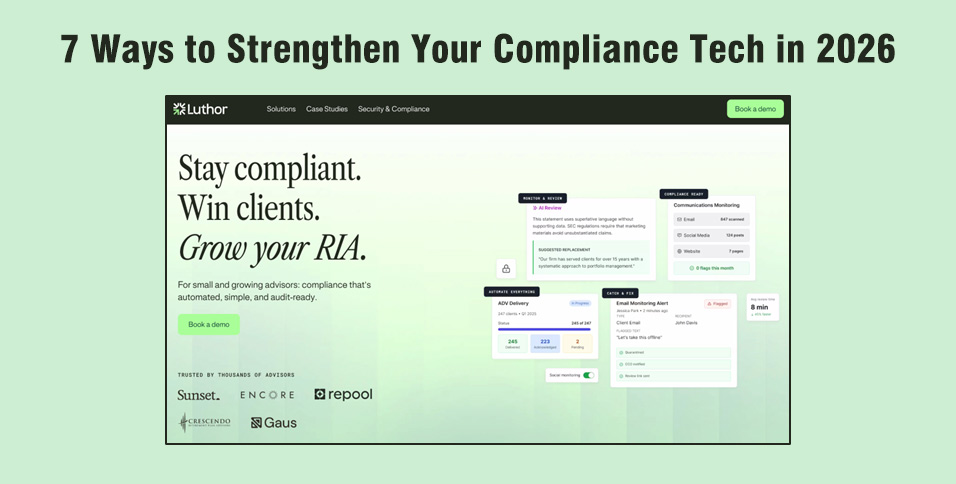
Luthor.ai, for example, is a smart agent that allows these kinds of changes to happen.
Additional Tactics for Maximum Impact
Leverage Low-Code Automation
Low-code development enables users to quickly build custom compliance applications from risk assessments to workflow approvals.
Drag-and-drop elements allow users to create apps without extensive coding.
This democratizes tech access, drives innovation, and ensures governance.
Strengthen Vendor Risk Management
Automated scoring and reassessments are tech-driven vendor checks that use real-time data feeds from multiple inputs to alert companies to third-party risks and tie into core controls.
Active supervision prevents chain disruptions due to alleged non-compliance with regulations.
Invest in User Training Modules
Interactive trainings embed technology and gamification, track completion rates and comprehension, and feed compliance dashboards, creating real-time awareness around compliance.
Continuous education makes knowledge a habit and reduces error.
These multi-tiered approaches to compliance technology provide organizations with the practical direction and a sense of progress that allows them to successfully navigate such complexity, and even thrive, in regulated environments.