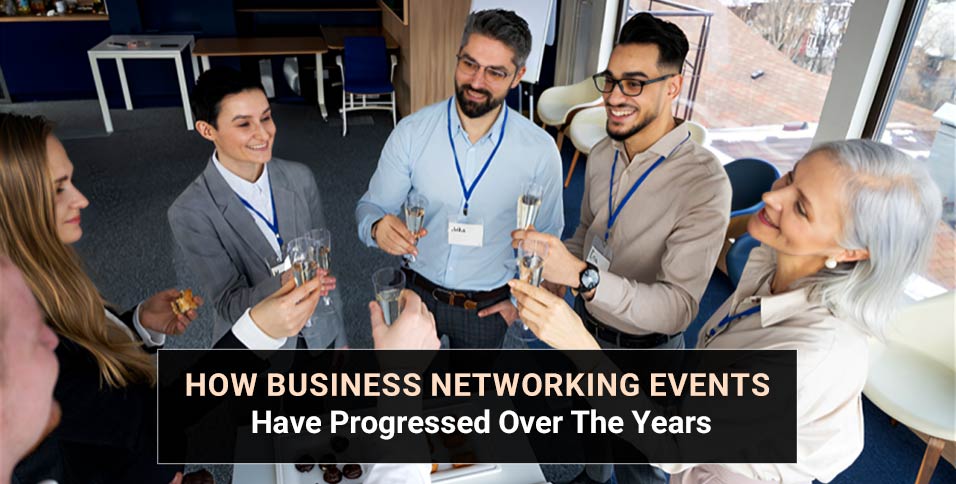
Business networking has undergone a remarkable transformation over the decades, evolving from simple gatherings in smoky conference rooms to sophisticated, technology-driven experiences. Today’s networking events leverage cutting-edge tools and strategies that previous generations could scarcely have imagined. This evolution reflects broader changes in business culture, technology, and professional expectations, creating more effective and engaging ways for professionals to connect.
The Traditional Era: Handshakes and Business Cards
In the mid-20th century, business networking typically meant formal gatherings where executives—predominantly men—exchanged firm handshakes and paper business cards. These events were often exclusive affairs, limited to specific industries or professional levels. The Chamber of Commerce meetings, industry conferences, and rotary clubs formed the backbone of business relationship building.
Statistics from this era show that approximately 85% of business relationships were formed through face-to-face interactions, with nearly 70% of executives reporting that their most valuable business contacts came from structured networking events. The process was linear and predictable: attend an event, collect business cards, follow up with phone calls or letters.
These traditional networking approaches were effective but limited by geography and social barriers. The typical professional’s network rarely extended beyond their immediate region or industry, with international connections reserved for those in the highest echelons of business.
The Digital Revolution: Online Platforms Emerge
The 1990s and early 2000s witnessed the first major transformation in networking with the rise of the internet. Early professional networking sites like LinkedIn (founded in 2002) began to supplement in-person networking. By 2005, digital business networking was growing at 40% annually, with professionals connecting across previously insurmountable geographic and industry boundaries.
Physical events also began to change. Conference organizers started incorporating basic technologies like digital registration systems and event-specific websites. Email follow-ups replaced much of the traditional post-event communication, increasing both the speed and frequency of networking interactions.
Despite these advances, in-person events remained largely traditional in format—presentations followed by mingling sessions with refreshments. The fundamental nature of networking as a predominantly face-to-face activity remained unchallenged, with digital tools serving primarily as organizational supplements rather than replacements.
The Experience Era: From Functional to Memorable
By the 2010s, networking events underwent another transformation as “experience” became the watchword of event planners. Business gatherings shifted from purely functional exchanges to memorable experiences designed to facilitate deeper connections. This shift was driven by research showing that meaningful relationships formed more readily in environments that stimulated engagement and creative thinking.
Event statistics from this period reveal a significant increase in budget allocation for experience elements, with companies spending 25-30% more on creating unique networking environments. Unconventional venues replaced hotel conference rooms, interactive activities supplanted passive presentations, and customized experiences became standard.
Technology integration accelerated during this period. Mobile event apps appeared at 78% of major conferences by 2015, allowing attendees to view schedules, connect with other participants, and exchange digital contact information. Custom RFID lanyards emerged as a revolutionary tool, enabling touchless check-ins, automated lead retrieval, and personalized attendee experiences.
These RFID-enabled credentials did more than simply identify participants—they transformed how people interacted at events. Attendees could exchange contact information with a simple tap, while organizers gained valuable data about movement patterns and engagement levels. By 2017, events utilizing RFID lanyards reported a 34% increase in meaningful connections made per attendee compared to events using traditional methods.
The Hybrid Revolution: Virtual and Physical Worlds Merge
The late 2010s saw networking events begin to experiment with virtual components, but it was the global pandemic of 2020 that forcibly accelerated this trend. Virtually overnight, networking went digital, with a 5000% increase in virtual event participation between February and April 2020.
Initially, these virtual gatherings were poor substitutes for in-person networking, with 67% of professionals reporting less satisfaction with purely online networking compared to traditional methods. However, rapid innovation produced sophisticated virtual platforms featuring AI-powered matchmaking, virtual reality networking lounges, and digital “handshakes” that exchanged contact information automatically.
As physical events returned, they didn’t simply revert to pre-pandemic formats. Instead, a hybrid model emerged, combining the best elements of both worlds. By 2023, 82% of major industry conferences offered significant virtual components, allowing remote attendance and extending networking opportunities beyond the physical event.
Technology integration deepened, with RFID lanyards evolving into sophisticated networking tools. Modern systems now incorporate near-field communication (NFC) capabilities, allowing attendees to share digital portfolios, presentations, and contact information instantly. Some advanced lanyards even feature small displays showing personalized schedules or notifications about networking matches nearby.
Today’s Landscape: Data-Driven Networking
Contemporary networking events are increasingly driven by data and artificial intelligence. Event platforms now collect and analyze information about attendees’ backgrounds, interests, and goals to facilitate more purposeful connections. According to recent industry reports, events using AI-powered matching algorithms see a 41% higher satisfaction rate among participants.
The physical components of networking have been reimagined through technology. Interactive displays, proximity-based networking alerts, and even augmented reality applications guide attendees toward valuable connections. RFID lanyards have become central to this ecosystem, serving as the physical link between attendees and the digital infrastructure powering modern events.
Current statistics show that events utilizing these advanced identification systems experience 37% more post-event follow-ups and a 29% higher conversion rate from introduction to business relationship. The humble lanyard has evolved from a simple credential holder to an essential networking tool that stores preferences, tracks interactions, and even measures engagement levels.
The Future: Immersive and Personalized
Looking ahead, business networking events are poised to become even more immersive and personalized. Emerging technologies like augmented reality, spatial computing, and advanced biometrics promise to further blur the lines between physical and digital networking.
Future events may feature personalized AI assistants accessible through wearable technology, guiding attendees to optimal connections based on real-time data. Holographic presentations could allow remote speakers to appear “in person,” while mixed reality environments could create specialized networking spaces tailored to specific industries or interests.
What remains constant is the human desire for meaningful connection. Despite the technological advances, research consistently shows that people still value authentic interactions above all. The most successful networking events of tomorrow will be those that leverage technology to enhance human connection rather than replace it.
As we move forward, business networking will continue to evolve, becoming more efficient, more accessible, and more effective. The days of collecting paper business cards in fishbowls may be behind us, but the fundamental purpose of professional networking—building relationships that create value—remains unchanged.