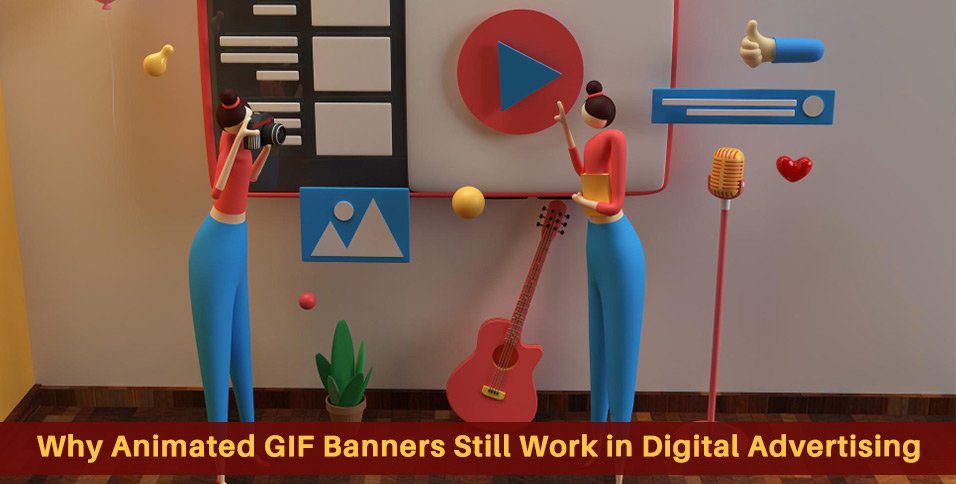
Every couple of years, some marketing publication writes the GIF banner obituary. Format’s too old. Replaced by HTML5. A relic. Then six months later, the same publication runs a piece on “why simple display is winning again” and the cycle resets.
What nobody at those publications seems to remember: GIFs work because they’re stupid. I mean that as a compliment. A GIF is a file. It loops. There’s no script to fail, no fallback to render, no JavaScript bundle for the network to scan. Drop it into an ad server, and it shows up on every placement that takes images, which is basically all of them.
That’s the actual reason the format won’t die.
The case against making them by hand, especially in 2025, is also pretty obvious. One campaign, ten sizes, three languages, two audience cuts. Multiply that out and you’re looking at sixty-plus creative units before you’ve shipped a single A/B test variant. If each one goes through Photoshop’s frame timeline (or worse, After Effects rendering out under GDN’s file weight cap), you’ve burned the whole sprint on file production.
I’ve watched a senior designer spend two days resizing one creative. Two days. For one banner family. By the time it shipped, the promo was over.
This is what a gif banner maker actually solves. Not “design quality” — most of the templated output is fine, and at production scale, “fine” beats “perfect-but-shipped-after-the-sale-ends” every time. What it solves is the headcount math. One person can do in an afternoon what used to take a designer a week. The first banner doesn’t feel different. The fiftieth does.
What good ones look like
A few things worth saying out loud, because reviewing freelance banner work makes me repeat them roughly once a month.
The first frame is the ad. Not the headline, not the loop, not the clever transition. The first frame. Users see it for somewhere between half a second and two seconds before they scroll. If that frame on its own doesn’t sell the offer, the rest of the animation is designer ego. Treat frame one like a standalone static, and you’re already ahead of maybe 80% of banners running right now.
Cap the loops. Two, maybe three. Endless looping reads as “broken page element” and a surprising amount of inventory now auto-blocks it. GDN does. Programmatic SSPs are catching up.
Match the color palette exactly. GIF’s 256-color palette can do weird things to gradients and brand reds in particular. A logo that’s “almost right” reads as off-brand, and nobody can quite explain why. Unsexy detail work matters more than the stuff people actually argue about in creative review.
Don’t put critical info only on the final frame. People bail before they get there. The CTA can live on the last frame. The price, the product, the brand — those need to be visible from the second one.
Where the format still beats the alternatives
Three situations, really.
Email. HTML5 doesn’t render in most email clients. Static images do, GIFs do, that’s the whole menu. If you’re running newsletter ads or transactional placements with promo banners, GIF is the only animated option on the table.
Long-tail programmatic. There’s a chunk of inventory — exchange-traded, mostly publishers you’ve never heard of — that still rejects HTML5 creatives for technical or policy reasons. GIFs go through.
Anything where weight matters. Sub-150 KB for a 300×250 GIF is achievable without much suffering. Doing the same in HTML5 with comparable visual quality is harder than people pretend. And weight affects viewability, which in turn affects everything downstream.
What I’d skip
Building one when the brief is small. One-week sale, two assets needed — a static plus a single GIF covers it. Don’t waste production cycles on HTML5 just because the trade press says HTML5 is the standard. The standard for what? Not this.
Putting animation on a banner that doesn’t need it. Some products sell on a clean product shot. Don’t animate for the sake of animating. Motion that doesn’t serve the message just trains the user to scroll past faster.
Twenty-five-plus years old as an ad unit. Older than half the people running campaigns. Every couple of years, someone declares it dead. And every couple of years, it keeps shipping.