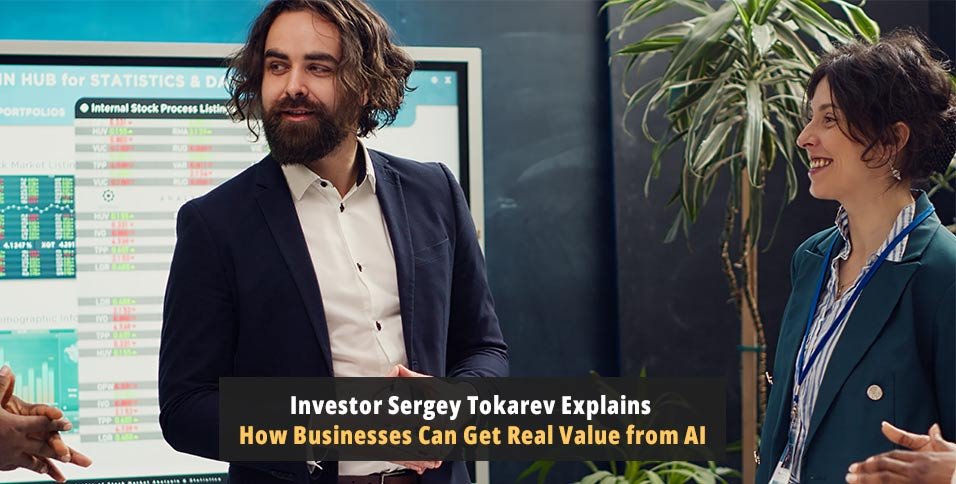
If you follow LinkedIn or read pitch decks from AI startups, it may seem that the corporate world has already entered a new era. Today, many companies are implementing autonomous AI agents that conduct audits, manage operations, negotiate contracts, and even replace entire teams. Sergey Tokarev, investor and founder of Tokarev Foundation, believes that the adoption of artificial intelligence (AI) can no longer be dismissed as mere hype, as the technology is already being actively used in business.
The gap between companies that implement AI properly and those that do not is growing. BCG research showed that only 5% of companies have systematically integrated AI across all their functions. Another 35% are scaling this technology but admit they could be moving faster. At the same time, most companies see almost no impact from AI on revenue and costs. Meanwhile, the most successful companies are, on average, seven times more likely to rebuild their business processes around artificial intelligence.
Why AI Should Not Be Evaluated at the Level of Individual Tasks
A workflow improves only when its bottleneck moves. At Roosh, analysts previously opened potential investments one by one and compared them with the fund’s criteria. An internal assistant built on Claude now ranks a long list by team excellence and market opportunity, with a short rationale for each company. Analysts begin their deeper research with the top 10 rather than screening 100 companies in sequence; productivity at this initial stage has increased roughly tenfold.
“AI does not fix poorly designed business processes. It only scales them. That is why companies should not simply automate a single step, but rebuild the entire workflow,” says Sergey Tokarev.
Why Working with AI Requires Control
The founder of Tokarev Foundation notes that when analysing any startup, AI can become the first analyst. It can help reconstruct the competitive landscape, analyse founders’ experience, review financing history, and flag data that requires closer examination. However, decisions about which startups or sectors to invest in should not be delegated to AI. A model can collect information and analyse data, but decisions, signatures, and accountability must remain with humans.
Sergey Tokarev is sceptical of the idea that human oversight of AI is only a temporary stage that will become unnecessary in the future. According to Deloitte, 77% of business leaders are concerned about risks associated with artificial intelligence, while 47% of users have made decisions based on incorrect model outputs.
AI Delivers Results Only Through Integration into Business Processes
Any AI model is only one component of a system, not a ready-made enterprise product. It can read contracts and analyse documents, but it cannot create a business outcome on its own.
This technology requires accurate information, clear rules, access control, and integration with CRM, ERP, and other internal systems. Once these conditions are met, it becomes a fully functional working product.
“Businesses should not expect AI to fully automate entire functions, such as customer support or the finance department. The best results appear where two conditions are met: complex input data and outputs that are easy to verify,” adds Sergey Tokarev.
The issue today is not whether an AI agent will replace an employee. The key question is where exactly AI is already creating measurable value for business.