Back in 1988, the Adani Group began as a commodity trading business started by Gautam Adani. Few would have expected it to grow into one of India’s largest business groups over the next few decades.
Today, the group has a presence across multiple industries and handles businesses that are closely linked to the country’s infrastructure and economic activity. Its companies are widely followed in the market, especially during large expansion announcements, earnings season, or major policy developments.
Since the group has companies operating in different sectors, each of them reacts differently to market events. Because of that, Adani Shares are usually tracked separately, with investors focusing more on individual business performance than the group name alone.
Which Sectors Does The Adani Group Operate In?
The Adani Group currently has 10 listed companies spread across different sectors.
Infrastructure and logistics form a major part of the group’s business presence. Companies such as Adani Enterprises and Adani Ports & SEZ operate in areas linked to ports, airports, cargo movement, and logistics networks.
The group also has a sizeable presence in the energy segment. Adani Power runs thermal power operations, while Adani Green Energy focuses on renewable energy projects across solar and wind. Adani Energy Solutions works in the power transmission space. Adani Total Gas, meanwhile, operates in the city gas distribution business.
The cement business came into sharper focus after the group’s expansion into companies such as ACC, Ambuja Cements and Orient Cement. Together, these businesses strengthen the group’s presence in construction materials.
Apart from infrastructure and energy, the group also has a presence in the media sector through NDTV and its digital and television news platforms.
Business-Wise Factors Affecting Adani Group Stocks
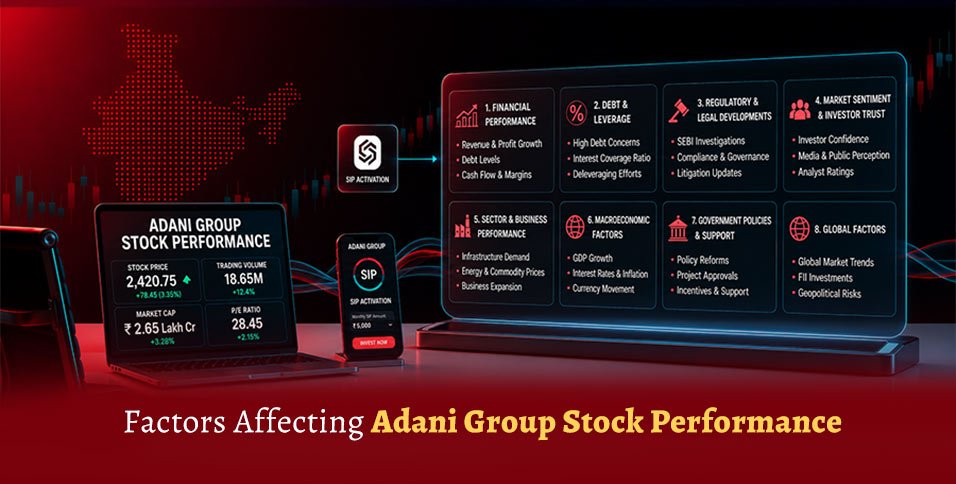
At times, developments related to the group itself can influence several Adani stocks together. Major announcements involving the founder, leadership decisions, large acquisitions, fundraising activity, or regulatory developments may affect overall market sentiment around the group.
However, the stocks are subject to sector-specific events, too. Since the Adani Group operates across very different industries, each company tends to respond to its own business conditions and sector trends. Some stocks may react more to infrastructure activity. Others may move based on energy demand, construction growth, or changes in commodity prices.
Infrastructure And Logistics Businesses
A large part of these businesses depends on overall economic activity. When infrastructure projects pick up and spending increases across areas like transport, logistics, and industrial development, companies in this segment tend to attract more market attention.
| Company | Share price in ₹ (As of 20 May 2026) | Market capitalisation in ₹ Cr (As of 20 May 2026) |
| Adani Enterprises Ltd | ₹2,715.00 | ₹3,49,315.00 |
| Adani Ports & SEZ Ltd | ₹1,749.00 | ₹4,06,303.19 |
Adani Ports & SEZ is closely linked to the overall trade movement. When cargo traffic across ports increases, the business generally gets more attention in the market. The company’s expansion with additional terminals and logistics infrastructure is also tracked because it adds to handling capacity over time. But if trade activity slows down globally, it can sometimes affect overall sentiment around port operators.
Adani Enterprises gets tracked for a different reason. The company has exposure to several emerging businesses and infrastructure projects, so investors often react to announcements around expansion, airports, data centres, or green hydrogen initiatives. Execution matters a lot in businesses like these. Such large projects also bring growth expectations. But they also bring funding requirements and timelines that markets watch carefully.
Power And Energy Businesses
Energy businesses within the group respond to a different set of triggers. Electricity demand, coal prices, renewable energy policy, and fuel availability all play a role here.
| Company | Share price in ₹ (As of 20 May 2026) | Market capitalisation in ₹ Cr (As of 20 May 2026) |
| Adani Power Ltd | ₹218.90 | ₹4,23,299.05 |
| Adani Energy Solutions Ltd | ₹1,319.00 | ₹1,60,010.85 |
| Adani Green Energy Ltd | ₹1,360.00 | ₹2,24,230.09 |
| Adani Total Gas Solutions Ltd | ₹617.95 | ₹67,247.89 |
The Adani Power Share Price usually comes into focus during periods of higher electricity usage, especially in peak summer months when demand rises across several states. Since the business depends heavily on thermal power generation, coal costs also become important because higher fuel expenses can put pressure on the company’s margins.
Adani Energy Solutions is part of the transmission and power infrastructure business. The company is usually in focus when new transmission networks, grid projects, or infrastructure additions are announced. At the same time, delays in approvals or execution sometimes become concerns for investors tracking the sector.
Financing also becomes important across infrastructure-heavy energy businesses. So, interest rates and borrowing conditions can influence market mood from time to time.
Adani Green Energy is linked closely to the renewable energy space. The company usually comes into focus whenever it announces large renewable projects or expansion plans. Since these projects take years and require significant investment, the market tends to react strongly to execution updates. Delays or funding-related concerns, however, can quickly change the tone around the stock.
Adani Total Gas operates in the city gas distribution business. The company’s expansion into newer cities and distribution areas is watched fairly closely because it can increase gas connections over time. However, fluctuations in global gas prices can sometimes affect sentiment around the sector.
Even within the energy space, the companies do not always react to the same developments in a similar way. Thermal power businesses, renewable energy companies, and gas distribution firms each respond to different business conditions.
Cement And Construction Businesses
Cement companies are influenced heavily by construction activity. Stronger demand from housing and infrastructure projects is generally seen as positive for the sector.
| Company | Share price in ₹ (As of 20 May 2026) | Market capitalisation in ₹ Cr (As of 20 May 2026) |
| ACC Ltd | ₹1,353.80 | ₹25,351.28 |
| Ambuja Cements Ltd | ₹428.20 | ₹1,05,977.45 |
| Orient Cement Ltd | ₹134.86 | ₹2,761.59 |
Companies such as ACC, Ambuja Cements, and Orient Cement are often discussed more actively when construction activity across the country starts picking up.
Capacity expansion is another area that gets attention in this space. At the same time, the cement business also depends heavily on operating costs. Fuel expenses, freight costs, and transportation charges can affect profitability quite sharply, especially during periods of cost inflation.
Demand conditions may also differ from one region to another. Strong construction activity in certain markets can support cement sales, while slower demand elsewhere may weigh on the overall sector.
Media Business
The media business operates very differently compared to infrastructure or energy companies.
| Company | Share price in ₹ (As of 20 May 2026) | Market capitalisation in ₹ Cr (As of 20 May 2026) |
| New Delhi Television Limited (NDTV) | ₹77.90 | ₹863.67 |
Here, the focus stays more on advertising revenue, television viewership, and digital traffic across platforms.
Growth in online audiences and stronger engagement levels can help media businesses attract advertiser interest. At the same time, competition within digital media remains intense. Viewer preferences in the media space can also change quite fast, especially with growing digital consumption.
Compared to the group’s other businesses, NDTV is driven more by audience reach and advertising demand than by raw material or infrastructure-related costs.
Conclusion
Companies within the Adani Group are often discussed together because they carry the same group identity, but their businesses operate on very different cycles.
Business performance across these companies can change for very different reasons. In some cases, the trigger could be demand in the sector itself. In others, it may come from expansion plans, operating costs, or even broader market conditions at a particular time.
Because of this, many market participants prefer tracking these companies individually rather than viewing the group as one single stock story. Platforms like Kotak Neo make that easier by allowing users to follow multiple Adani Group stocks, check price movement during market hours, and place trades from the same platform itself.
Disclaimer: This article is for informational purposes only and should not be considered investment advice from Kotak Neo. For compliance T&C and disclaimers, visit www.kotakneo.com/disclaimer