From finding a simple recipe to navigating a new city, we often say, “Just Google it!”. This simple phrase proves the incredible journey and impact of a company that started as a college research project. The history of Google is more than just the story of a search engine; it’s a story of innovation, ambition, and how technology has changed our access to information and the world itself.
So let’s explore the crucial moments that transformed a garage startup into a global technology powerhouse, one year at a time.
Timeline of Google From 1996 to 2025
| Time Period | Key Developments |
| 1996-2000 | -Project “BackRub” begins at Stanford (1996) -Registered Google.com domain (1997) -Official company launch with initial funding (1998) -Moved to Palo Alto from the Garage (1999) -Launched AdWords (2000) |
| 2001-2005 | -Launched Image Search (2001) -Launched Google News (2002) -Launched AdSense (2003) -Went public with an IPO and launched Gmail (2004) -Debuted Google Maps & Analytics (2005) |
| 2006-2010 | -Acquired YouTube (2006) -Announced the open-source Android OS (2007) -Launched the Chrome browser (2008) -Began self-driving car project (2009) -Released the Nexus One phone (2010) |
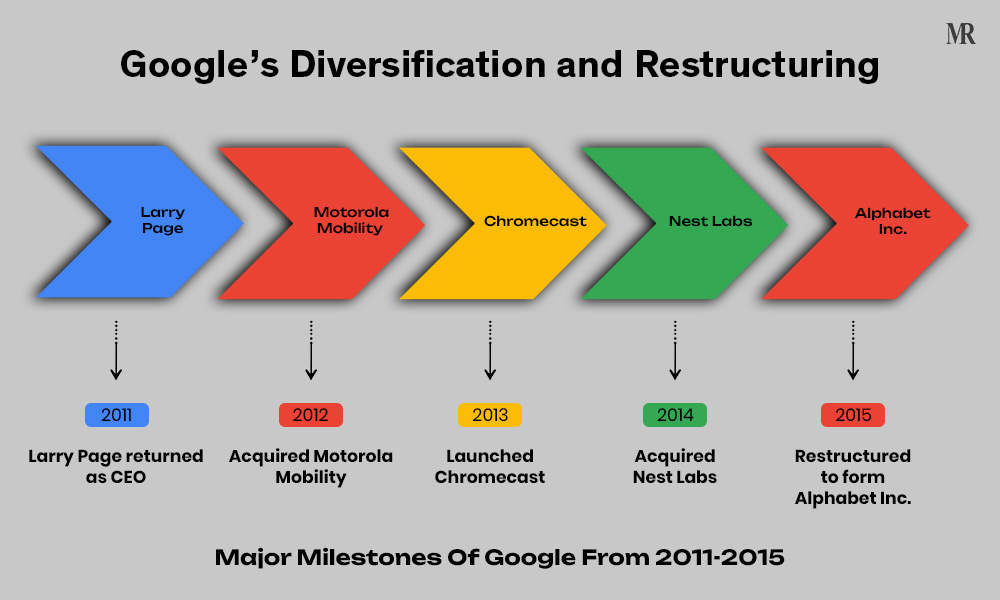
| 2011-2015 | -Larry Page returned as CEO (2011) -Acquired Motorola Mobility (2012) -Launched Chromecast (2013) -Acquired Nest Labs (2014) -Restructured to form Alphabet Inc. (2015) |
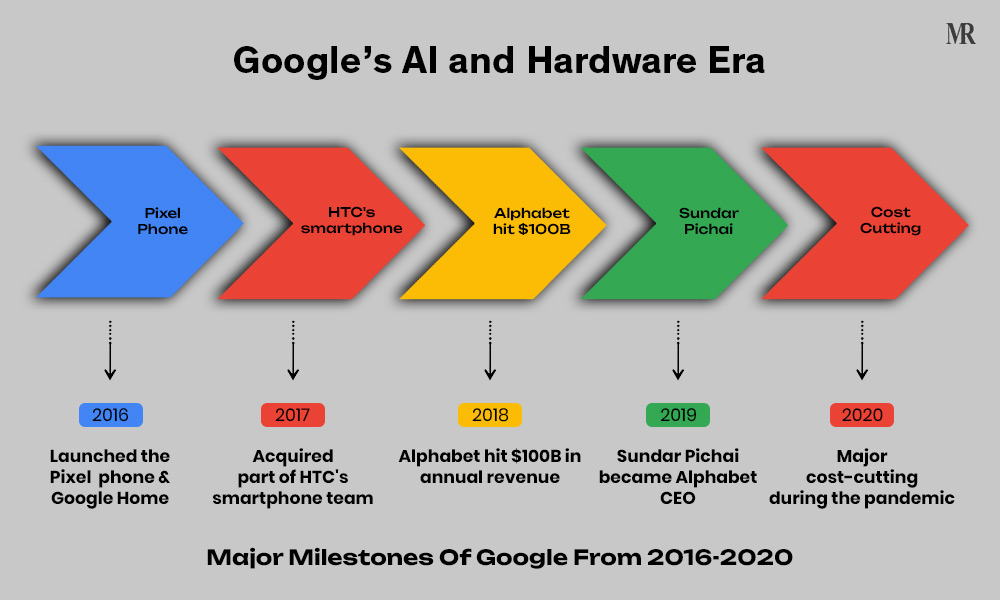
| 2016-2020 | -Launched the Pixel phone & Google Home (2016) -Acquired part of HTC’s smartphone team (2017) -Alphabet hit $100B in annual revenue (2018) -Sundar Pichai became Alphabet CEO (2019) -Major cost-cutting during the pandemic (2020) |
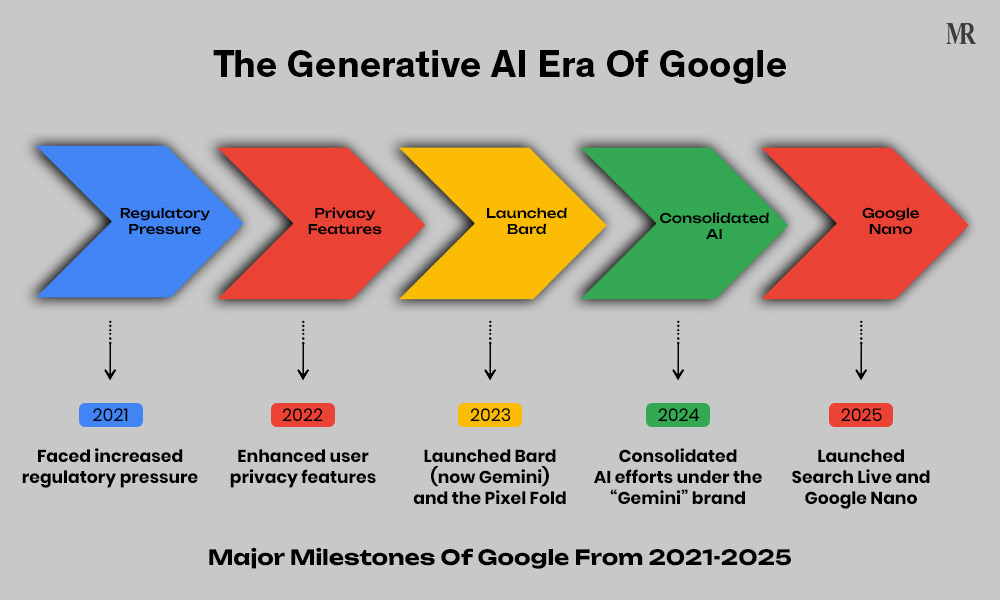
| 2021-2025 | -Faced increased regulatory pressure (2021) -Enhanced user privacy features (2022) -Launched Bard (now Gemini) and the Pixel Fold (2023) -Consolidated AI efforts under the “Gemini” brand (2024) -Launched Search Live and Google Nano (2025) |
The Generative AI Era (2021-2025)
The latest chapter in Google’s history is defined by the race for generative AI.
Google has focused its vast resources on developing and deploying powerful, multi-modal AI models across its entire product suite.
- In 2025, Google launches Search Live for real-time voice conversations and Google Nano to fight online scams in Chrome, Search, etc.
- In 2024, Google consolidated its AI products under the “Gemini” brand. This move combined its efforts and introduced its most powerful AI models to the public.
- In 2023, Google launched Bard (now Gemini), its conversational AI chatbot, to compete with OpenAI’s ChatGPT. It also expanded its Pixel lineup with the first-ever Pixel Fold and Pixel Tablet.
- In 2022, the company placed a heavy emphasis on enhancing user privacy and security. It introduced the “Privacy Guide” in Chrome to give users more control over their data.
- In 2021, Google faced increasing regulatory pressure and antitrust lawsuits around the world, particularly concerning its app store policies and search market dominance. Employees were also departing due to the incentive structures and other reasons.
Interesting Facts:
- Gemini, Google’s flagship AI, is “multimodal,” meaning it was designed from the ground up to understand and process different kinds of information—like text, images, audio, and code—simultaneously.
- The public launch of Bard in 2023 was to respond to the accelerating speed and adoption of competitive AI tools.
The AI and Hardware Era (2016-2020)
Google declared itself an “AI-first” company and embedded artificial intelligence into all its products.
This period also saw a serious, focused push into creating its own hardware to better showcase its software and challenge competitors directly.
- In 2020, Google responded to the global COVID-19 pandemic by enabling remote work for its employees and announcing various cost-cutting measures like slowing down hiring, focusing more on machines and data centers, etc.
- In 2019, Sundar Pichai was promoted to become the CEO of the parent company, Alphabet Inc., taking over from co-founders Larry Page and Sergey Brin. He is considered as first Indian-American CEO in the History of Google.
- In 2018, Google celebrated its 20th anniversary. In the same year, its parent company, Alphabet, reported annual revenues of over $100 billion for the first time.
- In 2017, Google deepened its hardware ambitions by acquiring a large part of HTC’s smartphone design team for $1.1 billion, bringing top talent in-house.
- In 2016, the company launched the Pixel, the first-ever “Made by Google” smartphone. It also released the Google Home smart speaker, powered by the new Google Assistant, to compete with Amazon’s Alexa.
Interesting Facts:
- In 2019, Google claimed it had achieved “quantum supremacy,” using a quantum computer to perform a calculation that would be practically impossible for even the most powerful supercomputers.
- Furthermore, Google Earth Timelapse was enhanced in 2019, allowing users to easily and interactively visualize the planet’s changes over the last 35 years.
Diversification and Restructuring (2011-2015)
As the company grew into a giant with projects ranging from smart homes to life sciences, a need for a new structure emerged.
This era was defined by diversification and a major corporate reorganization to manage its many ambitions.
- In 2015, Google welcomed its new CEO, Sundar Pichai. It also underwent a major corporate restructuring to form Alphabet Inc., a new parent company. This allowed Google to focus on its core internet products while letting other ventures, like Nest and Google X, operate independently.
- In 2014, Google acquired Nest Labs, a company known for its smart thermostat, for $3.2 billion. This was a huge push into the trending Internet of Things (IoT) and smart home market.
- In 2013, the Google Chromecast was launched. This small, affordable dongle made it incredibly easy to stream video and music from a phone or laptop directly to a TV.
- In 2012, Google acquired Motorola Mobility for $12.5 billion. The primary goal was to obtain Motorola’s vast portfolio of mobile patents to defend the Android ecosystem.
- In 2011, co-founder Larry Page returned to the role of CEO, and Eric Schmidt became the Executive Chairman. Google also launched Google+, its ambitious but ultimately unsuccessful social media platform designed to compete with Facebook.
Interesting Facts:
- During this time, Google’s acquisition strategy accelerated significantly, with the company buying, on average, more than one company per week.
- Sundar Pichai joined Google in 2004. He has overseen the development of popular Google products like Chrome, Drive, Gmail, Google Apps, and Android since then.
The Age of Google Domination (2006-2010)
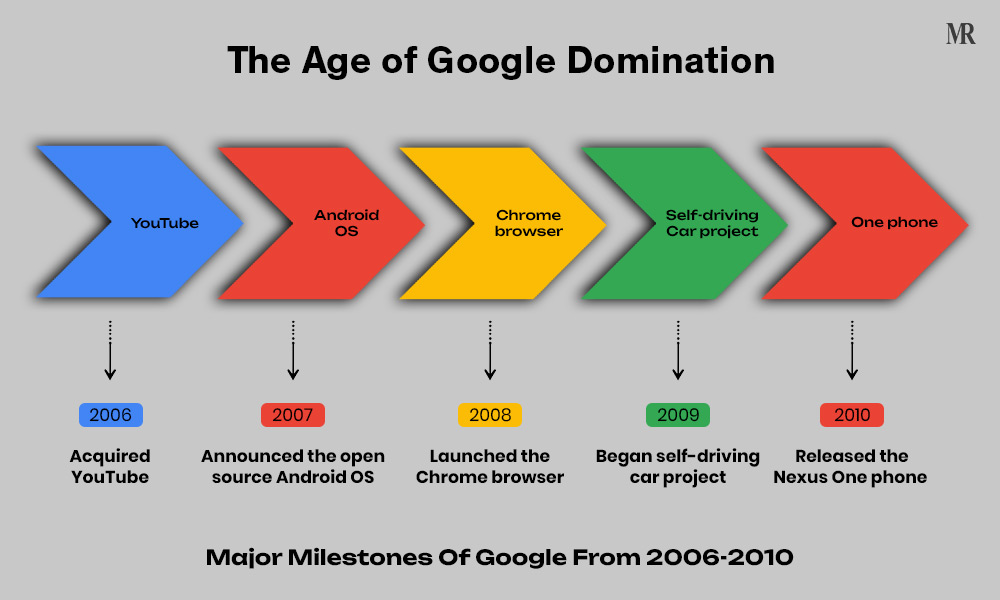
In this period, Google strengthened its dominance in search and advertising while making bold moves into new territories like mobile and video.
Its strategic acquisitions and product launches set the stage for the mobile-first world.
- In 2010, Google collaborated with HTC to launch the Nexus One, its first-ever branded smartphone.
- In 2009, the company began secretly developing self-driving car technology, a project that would later turn to be the independent company Waymo.
- In 2008, Google Chrome was released for Microsoft Windows and later ported it to Linux, macOS, iOS, and Android. It later launched 43 supported languages. The launch of the Chrome browser turned out to be one of the key phases in the history of Google.
- In 2007, Google acquired the company behind Android and officially announced it as an open-source mobile operating system, a move that would later dominate the smartphone industry.
- In 2006, Google made its most famous acquisition by buying the rapidly growing video-sharing site YouTube for $1.65 billion. This decision came after YouTube’s quickly growing platform was far too much for Google Video to overcome directly, so it outright bought the website.
Interesting Facts:
- Google’s first-ever tweet in February 2009 was “I’m feeling lucky,” written in binary code.
- The first interactive Google Doodle appeared in 2010 to celebrate the 30th anniversary of PAC-MAN, allowing users to play the game right on the homepage.
Google’s Explosive Growth (2001-2005)
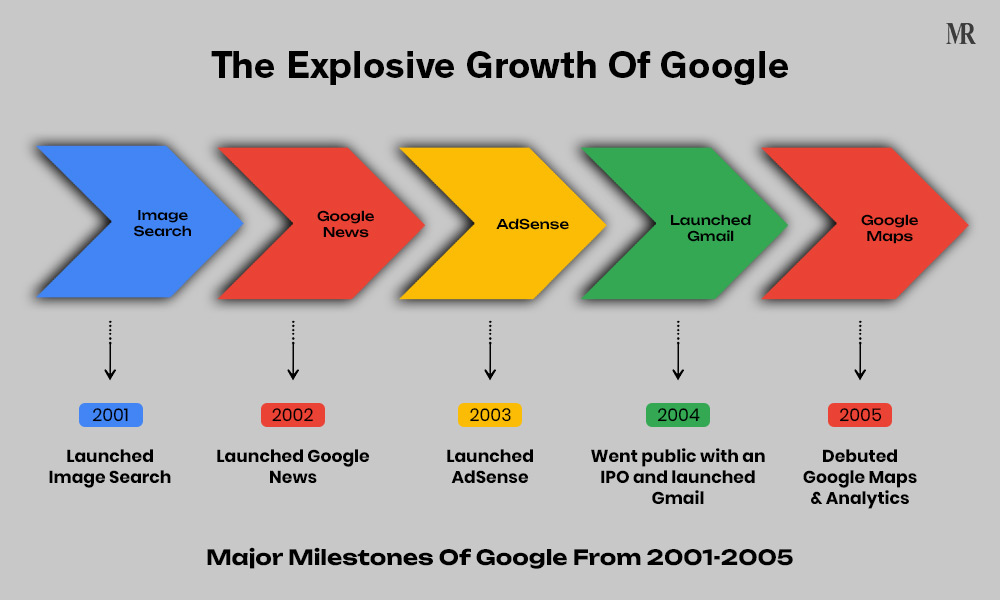
Now, with a solid foundation, came a phase of explosive growth in Google history.
This era saw the launch of products that would become essential tools for billions of people, expanding their reach far beyond simple web search.
- In 2005, Google Maps was launched, changing how we navigate the world with its searchable and zoomable interface. Furthermore, Google Analytics also debuted, giving website owners powerful insights for free.
- In 2004, the company went public with its Initial Public Offering (IPO) on August 19th. On April 1st of the same year, Google launched Gmail, with its massive 1GB of storage, which many initially dismissed as an April Fool’s joke!
- In 2003, Google introduced AdSense, a groundbreaking program that allowed website publishers to display targeted ads and earn revenue, normalizing online advertising. It was originally named Content Targeting Advertising.
- In 2002, Google News was launched, automatically collecting and organizing stories from thousands of news sources worldwide to provide a detailed overview of current events.
- In 2001, Eric Schmidt joined Google as its first chairman and later became its chief executive officer. Meanwhile, Larry Page became president of products.
Interesting Facts:
- Google Image Search was introduced in 2001, with over 250 million images in its search database. Its creation was inspired by the massive public demand to see Jennifer Lopez’s iconic green Versace dress from the 2000 Grammy Awards.
- The term “to Google” was officially added as a verb to the Oxford English Dictionary in 2006, securing its cultural significance.
The Beginning: A History Of Google (1996-2000)
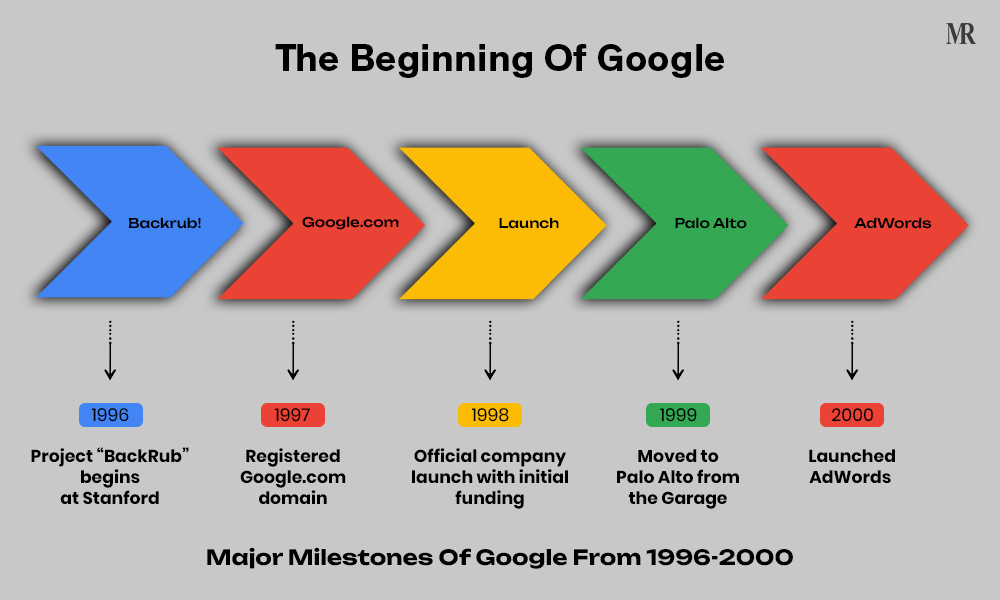
This period marks the birth of an idea that would change the internet forever.
From a Stanford dorm room, Larry Page and Sergey Brin began their mission to organize the world’s information, laying the foundation for the giant we know today.
- In 2000, Google launched AdWords, a self-service platform for creating online ad campaigns. This revolutionary concept became the financial backbone of the company.
- In 1999, the promising startup moved from a garage to an office in Palo Alto, California. Later that year, Google officially removed the “beta” tag from its logo, signaling it was ready for business!
- In 1998, the company was officially launched after receiving $100,000 in initial funding from Sun Microsystems co-founder Andy Bechtolsheim.
- In 1997, the domain google.com was officially registered on September 15th. This gave the project a proper name, Google in 1997, and a home on the web, moving away from its original name, “BackRub”.
- The history of Google in 1996, began as a research project at Stanford University. Founders Larry Page and Sergey Brin developed the core idea that a search engine ranking websites based on how many other sites linked to them would produce better results. The 1996 Google project also had an unofficial third founder—Scott Hassan, who played a key role, writing much of the code for “BackRub”, the first search algorithm of Google Search.
Interesting Facts:
- The name “Google” is a creative spelling of “googol,” the mathematical term for the number 1 followed by 100 zeros.
- The first Google server was housed in a custom rack built from LEGO bricks due to a tight budget.
- In 1998, the first Google Doodle, the Burning Man, designed by the co-founders Larry Page and Sergey Brin, was introduced to notify users of their absence in case the servers crashed. This is the most famous doodle in the history of Google.
Google’s Key Milestones Over the Years
As we come to the end of the detailed Google timeline, let’s take a look at its overview, consisting of the main events that shaped Google’s journey.
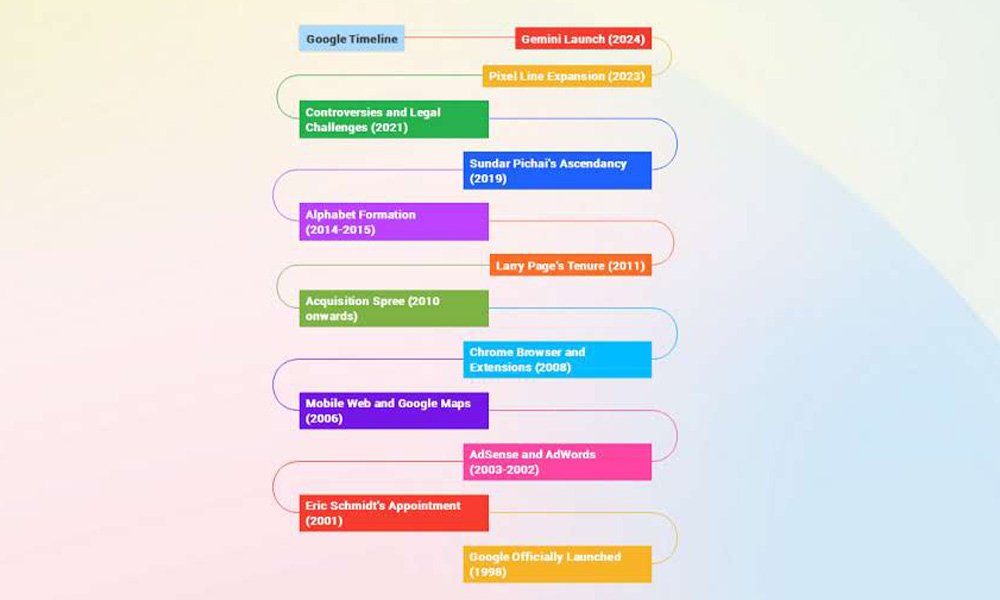
End Note On The Evolving History of Google
From its humble beginnings as a Google 1996 research project to its current status as a global AI-first company, the history of Google is a remarkable story of continuous evolution.
For over two decades, Google has not only organized the world’s information but has fundamentally changed how we work, communicate, and live.
As Google pushes further into the world of AI, its journey is far from over. It promises to shape our future in ways we are only beginning to imagine!
FAQs
1. When was Google created?
Answer: Google was created on 4th September 1998 by Larry Page and Sergey Brin. This official launch was a month after Sun co-founder Andy Bechtolsheim funded them.
2. Who initially funded Google?
Answer: Andy Bechtolsheim co-founder of Sun Microsystems initially funded Google by giving Larry and Sergey a $100,000 cheque in August 1998.
3. What is the full form of Google?
Answer: The official full form of Google is the Global Organization of Oriented Group Language of Earth.
4. What was the first Google search?
Answer: Larry Page and Sergey Brin, co-founders of Google, were demonstrating the accuracy of their search engine to computer scientist John Hennessy. The search keyword was “Gerhard Casper,” the name of Stanford University’s president at the time.
Also Read: The most awaited Google Pixel 5 is here! Along with Chromecast TV and Nest Audio