Mirror Review
November 23, 2026
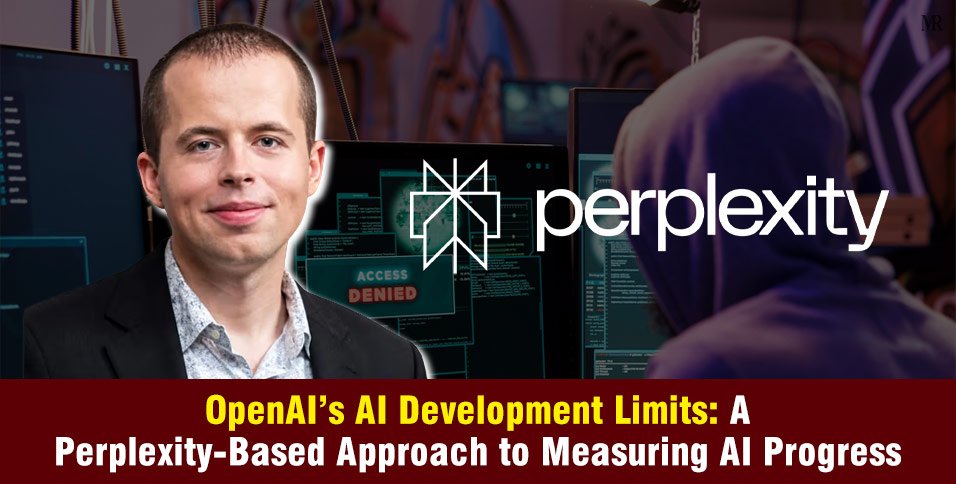
OpenAI Chief Scientist Jakub Pachocki has proposed common AI development limits based on perplexity and other measurements, asking frontier AI developers to agree on shared standards for tracking model progress and assessing safety. In an essay published on November 22, 2026, Pachocki explained how the OpenAI perplexity metric could help developers compare models and establish common safety measures.
Pachocki also published OpenAI’s internal pretraining measurements, including figures for GPT-3.5 and GPT-4, to show how changes in perplexity have accompanied the emergence of new AI capabilities.
What Are OpenAI’s AI Development Limits?
OpenAI’s AI development limits proposal asks frontier model developers to agree on a first development threshold and commit not to cross it until their ability to understand and monitor AI behavior reaches a concrete milestone.
Pachocki wants developers to establish shared methods for evaluating advanced models, conducting safety red-teaming, and maintaining transparency. He identifies a successor to chain-of-thought (CoT) monitors as one possible milestone for improving AI safety monitoring.
In his November 22 essay, Perplexity and Intelligence, Pachocki writes:
“I further propose common limits, based on perplexity and other measurements, that developers are committed to not crossing until our ability to understand and monitor AI behavior achieves a certain concrete milestone”
Pachocki also calls for an industry standard that specifies the first development limit, the metric used to track it across labs, and the requirements developers must meet before moving beyond it.
OpenAI’s AI development limits proposal does not set a numerical threshold or an implementation date. It asks frontier AI developers to work toward common commitments rather than introducing a restriction that already applies across the industry.
What Is the OpenAI Perplexity Metric?
The OpenAI perplexity metric measures how well an AI model predicts the next token in a sequence. A lower perplexity score indicates better predictions on the evaluation dataset.
OpenAI generally tracks the log of perplexity, also known as cross-entropy loss. Pachocki explains that OpenAI uses this measurement to track pretraining progress on a held-out dataset.
Pretraining measurements help developers track how an AI model’s ability to predict the next token improves during training. Prompting, fine-tuning, and reinforcement learning can then influence how the model applies its capabilities to different tasks.
Pachocki proposes perplexity in AI as a shared measurement because it can help developers track progress in the underlying model, even when they cannot predict which new capabilities will emerge.
What Do GPT-3.5 and GPT-4 Reveal About AI Progress?
OpenAI’s published measurements show how log-perplexity changed alongside the capabilities Pachocki observed in its models.
| Model or measurement | Log-perplexity | Capability described by Pachocki |
| GPT-3.5 | ~0.99 | Fluent conversation; formed the basis of the original ChatGPT |
| GPT-4 | ~0.91 | Productive use of chain-of-thought reasoning |
| OpenAI models | Below 0.8 | Emergence of transformative capabilities in cybersecurity and mathematics |
| OpenAI model | ~0.76 | Began producing groundbreaking results on open mathematics problems |
OpenAI calculated these figures using a fixed snapshot of its internal codebase as the held-out evaluation dataset. Pachocki notes that different datasets and training data mixtures make direct comparisons between AI developers difficult.
Pachocki also stresses that the capabilities associated with these measurements were not predictable in advance. The figures describe observed developments, not guaranteed capability thresholds for every AI model.
Why Does Pachocki Expect Further AI Progress by 2027?
Jakub Pachocki expects AI to contribute more significantly to algorithmic research on pretraining, potentially accelerating improvements in future models.
Pachocki points to OpenAI’s mathematical research as an example. After a model reached approximately 0.76 log-perplexity, it began producing groundbreaking results on open mathematics problems. He says a similar development in deep learning research could conceivably happen as early as 2027.
Pachocki also expects further transformative capabilities as models enter the 0.68–0.70 log-perplexity range. He does not specify what those capabilities might be.
Although Pachocki expects AI to contribute to alignment and monitoring research, he says that progress is unlikely to be fast enough to allow the full potential acceleration in pretraining.
What Are the Limitations of Perplexity in AI Development?
Pachocki identifies four limitations that developers must consider before adopting perplexity as a shared measurement for AI industry standards:
- Different evaluation datasets: AI developers use different evaluation datasets and training data mixtures, making direct comparisons difficult.
- Task-specific performance: Perplexity measures next-token prediction, not performance on a particular task.
- Capabilities beyond pretraining: Chain-of-thought reasoning can significantly increase a model’s capabilities without reducing its pretraining perplexity.
- Unknown measurement floor: Researchers do not know the inherent entropy of the evaluation data. As models approach that limit, smaller improvements in perplexity could correspond to larger advances in model intelligence.
These limitations mean perplexity cannot replace task-specific evaluations or other safety measurements. Pachocki proposes using it alongside additional measures to support more consistent AI development standards.
What Happens Next for OpenAI’s AI Development Limits?
Pachocki wants frontier AI developers to agree on shared evaluation methods, red-team safety assessments, and transparency standards before crossing agreed development thresholds.
OpenAI has not announced a finalized framework or binding industry restrictions. OpenAI’s AI development limits proposal remains a call for frontier developers to establish common measurements and agree on the safety requirements for future AI development.
Gurushanth S Jatti