Mirror Review
November 2, 2026
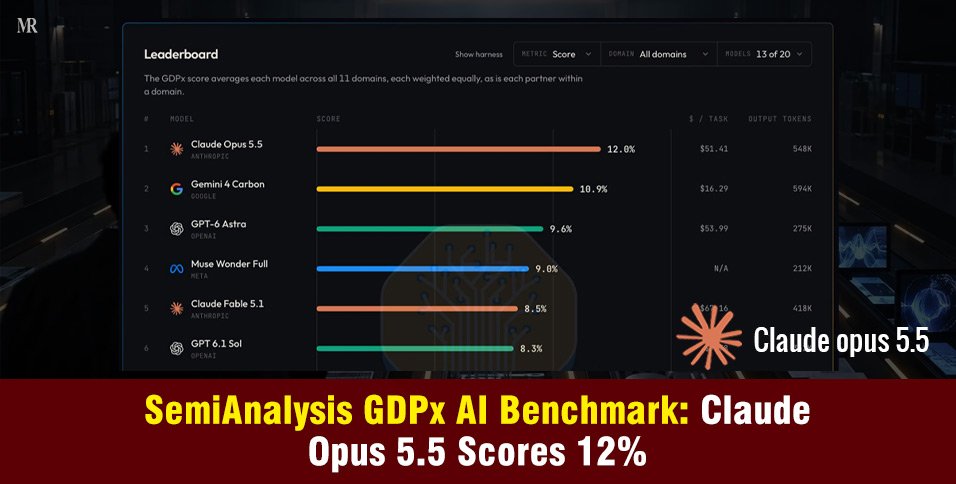
Claude Opus 5.5 has topped the initial SemiAnalysis GDPx AI benchmark, scoring 12.0% across a new evaluation of frontier AI models. Gemini 4 Carbon ranked second at 10.9%, followed by GPT-6 Astra at 9.6%, according to the official GDPx leaderboard.
SemiAnalysis introduced GDPx on November 2, 2026, as a frontier AI benchmark covering 206 tasks across 11 domains. The benchmark was developed with 14 specialized data partners. Its evaluations focus on tasks in areas such as chip design, cybersecurity, finance, biology, and software engineering.
What Is the SemiAnalysis GDPx AI Benchmark?
The SemiAnalysis GDPx AI benchmark evaluates frontier AI models across specialized professional and technical domains. SemiAnalysis describes GDPx as a benchmark for measuring agentic capabilities in areas it considers important for frontier AI development.
According to the official GDPx domains page, the benchmark covers 206 tasks across 11 domains:
- Chip design
- Cybersecurity
- Biology
- Finance
- Legal work
- Quantitative trading
- Recursive self-improvement
- Hardware design
- Materials science
- AI alignment
- Software engineering
SemiAnalysis developed GDPx in collaboration with 14 specialized data partners.
GDPx AI Leaderboard: Top-Ranked Models
The GDPx AI leaderboard lists 13 models in its overall ranking. Claude Opus 5.5 leads the published results, followed by Gemini 4 Carbon and GPT-6 Astra.
| Rank | GDPx benchmark model | Score |
| 1 | Claude Opus 5.5 | 12.0% |
| 2 | Gemini 4 Carbon | 10.9% |
| 3 | GPT-6 Astra | 9.6% |
| 4 | Muse Wonder Full | 9.0% |
| 5 | Claude Fable 5.1 | 8.5% |
| 6 | GPT 6.1 Sol | 8.4% |
| 7 | Claude Sonnet 5.5 | 8.2% |
| 8 | Gemini 4 Argon | 7.3% |
| 9 | Muse Wonder | 6.8% |
| 10 | DeepSeek 4.1 Flash 1017 | 5.4% |
| 11 | GPT-6 Luna | 5.1% |
| 12 | Grok 4.7 | 3.9% |
| 13 | GLM 5.3 | 2.7% |
The GDPx leaderboard currently displays results for 13 of the 20 models listed in its model comparison.
How Does the SemiAnalysis GDPx AI Benchmark Measure AI Agent Capabilities?
The AI agent benchmark uses different grading methods depending on the task. GDPx combines binary and continuous grading, with the overall score calculated from the average of three attempts.
SemiAnalysis’s official leaderboard methodology specifies:
- 206 tasks: Evaluations cover 11 domains.
- Equal domain weighting: Each domain contributes equally to the overall score.
- Equal partner weighting: Each data partner receives equal weight within its domain.
- Three attempts: The benchmark averages scores across three attempts.
- Task-specific grading: Tasks use binary or continuous scoring, depending on their evaluation requirements.
SemiAnalysis specifies a default time limit of eight hours for GDPx tasks, although some evaluations use shorter limits.
What Do the GDPx Benchmark Results Show?
The GDPx benchmark results also identify leading models across individual domains.
In its benchmark announcement, SemiAnalysis reported these domain leaders:
- Claude Opus 5.5: Quantitative trading, hardware design, and chip design.
- Gemini 4 Carbon: Biology and software engineering.
- GPT-6 Astra: Recursive self-improvement and materials science.
SemiAnalysis said all models scored zero on its finance tasks under binary grading. It also found that its legal tasks were too difficult for models to earn scores under the intended binary grading. The leaderboard therefore reports average partial scores for both domains.
SemiAnalysis attributed lower overall scores for Claude Opus 5.5 and GPT-6 Astra partly to their safety classifiers. It also presented an alternative ranking excluding cybersecurity, biology, and AI alignment, the three domains where SemiAnalysis said safety classifiers sometimes affected model performance.
What Does the SemiAnalysis GDPx AI Benchmark Mean for AI Evaluation?
The SemiAnalysis GDPx AI benchmark highlights how frontier AI models perform across specialized domains, while showing the limitations of relying on a single overall score to assess their capabilities.
SemiAnalysis described its initial results with the statement, “even the best model scores just 12%.”
The 12% figure represents Claude Opus 5.5’s score under GDPx’s task-specific grading and scoring methodology. It is not a measure of overall AI intelligence or a direct estimate of how much professional work the model can complete independently.
SemiAnalysis plans to update the GDPx benchmark every three to six months, according to its announcement. These updates will provide opportunities to track changes in frontier AI model performance across its 11 domains.