You can visualize your teen driving their friend to school on an electric bike. At the same time, you are thinking about how much traffic there will be at that intersection and what you should do about a rather big electric-powered bicycle being left in your house.
Both are fair.
Selecting an electric bicycle for young adults requires selecting a model that will be fun to ride and can be handled with ease by the young adult. Appearance is important to the young adult. Fit, brakes, storage space, and appropriate assistance should be important to all.
The problem is that the bicycle with the largest capacity battery or highest advertised speed may not be appropriate for the intended use. A heavier model could pose problems at the school parking area. A recreational bicycle might have restrictions on its use along the chosen path. Additionally, a frame that was purchased “to allow for growth” could be difficult to operate currently.
Below you will find six alternatives that have been developed for various applications. One alternative is suitable for riding on paved surfaces, while another provides easier storage options and a third alternative can be used as a replacement for recreational activity. You should first determine where your teenager intends to go, then consider all of the details.
How to Choose an Electric Bike for Teenagers
First, when comparing electric motors, you should take into account what an average day would look like. An electric bicycle would have to go from the area where it was stored to the place where the user can transport themselves along with everything they may need to bring with them. After that, the electric bicycle has to be able to get to the destination and ultimately park safely.
Check those details.
With only a few short minutes, you will be able to determine what is necessary to prepare for your child’s first day of kindergarten. You may choose to measure the opening of the door to your child’s classroom or contact the school directly.
Match the Bike to Riding Readiness
Children’s experience using a standard bicycle will be helpful, but they should also practice with an electric-assisted bicycle since it weighs more and operates differently (e.g., when accelerating) from a standard bicycle.
Is your child able to ride his/her bike safely? Can he/she safely stop? Does he/she look around before turning or changing lanes, while keeping the bike going straight? How carefully does he/she approach each crosswalk? Your child’s ability to exercise good judgment when riding is just as important as his/her ability to balance the bike.
The American Academy of Pediatrics says that Class 1 e-bikes are good for 12-15 year old mature children. They say that 16 year olds can ride either Class 1 or Class 2 e-bikes. It is also important to look at what the manufacturer recommends for age, as well as local law.
This list will serve as a starting point for older teens to evaluate each model separately.
Understand E-Bike Classes
Many U.S. jurisdictions use three common classes:
| Class | General Operation | Typical Assisted-Speed Limit |
| Class 1 | Assistance while pedaling | 20 mph |
| Class 2 | Includes throttle assistance | 20 mph |
| Class 3 | Higher-speed pedal assistance | 28 mph |
Labels can be used to describe how a bicycle functions. Rules for accessing the labels will need to be checked; there are variations in the minimum age to operate a bicycle, mandatory helmet use, what constitutes a bicycle, and where bicycles may be ridden.
Find out from the seller what the exact configuration is that will be delivered to your home. Also, if there are any settings that can alter its performance, learn what they are and how to adjust them.
The use of the “lower speed” method as an indicator of whether a bike falls into a certain legal category is also not sufficient in and of itself to determine if the bike meets the criteria for that category.
Check the Rules for the Complete Route
Look further than the streets you live on. When children travel to school, they may use a variety of routes including roads, shared paths and school grounds. Each of these will have their own specific set of rules.
You can start by looking up state laws on the PeopleForBikes state law resource. Then check the most recent information from the appropriate transportation department, city/township government, or trail organization.
Call the school as well. Inquire about which types of bicycles are permitted, if there are any required bicycle safety courses, if you will need a bicycle parking permit, and where you may store your battery.
This should be done prior to purchasing. It’s incredibly disappointing to select a school bicycle only to find out at some point down the road that either a portion of the route or the school itself will not permit its use.
Get the Fit Right
Buy for the person who is currently standing before you. A large bike frame may make every single stop and sharp turn on the bike harder, as well as make everyone wait for you to grow.
When fitting, ask your child to get on and off several bikes. Make sure that both of the brake levers are easily accessible from both sides and that the handlebars turn freely.
Then try a slow turn, a complete stop, and a restart.
Height charts can help narrow down your choices, but two people with the same height can have very different arm spans and leg lengths. If you can arrange to have a professional fitting at your local bike shop, that is an added bonus.
Consider Weight and Storage
The motor isn’t going to be helpful if your teen is trying to back the bicycle out of a tight space like a crowded bike rack, or if they’re struggling to move the bicycle through a small opening such as a narrow gate.
Try that first.
After getting off your bike, move it. Turn the bike around in a small area. Notice how close you are to your front door and where you typically put your bike while inside your house.
A folding frame allows you to deal with your physical limitations regarding storage space, however, you will need to find someone to transport your folded bike. Your bike may also seem smaller than it really is. This means that a seemingly small bike could be significantly heavier than you initially thought.
Make sure that the plan of having an adult help you with daily activities can actually work.
Budget for Ownership
Leave enough space for a helmet, a good lock, routine maintenance, and other items that the cyclist may require such as lights or bags.
Before buying, ask a local store if they sell the exact model of bicycle you are looking for. While some stores can help with tire changes and brake adjustments, others will not be able to diagnose problems with your bike’s electrical system.
Read the return terms as much as you read the warranty. Look into how quickly a replacement battery will be shipped, and whether there are any assembly required to install it.
A simpler bike to repair can be a better option for families than a cheaper bike that will require more money and time to maintain.
Top 6 Electric Bike Picks for U.S. Families
These 6 models provide various options for families to begin with. The first 5 models should be considered for standard family cycling requirements based on the riders eligibility and the allowed route. The R6 is a model that provides a different recreational activity.
This is based on the products’ published documentation, not an on-site, side-by-side evaluation. Please be sure to verify which specific model of the product you are ordering is the correct version for use in the United States prior to ordering.
| Model | Main Reason to Consider It | Check Before Buying |
| Aventon Soltera 2.5 | Active pavement riding | Frame fit and operating-age guidance |
| Lectric XP Lite2 | Folding storage | Weight and folding procedure |
| Electra Townie Go! | Relaxed riding position | Exact model version |
| Trek Verve+ 1 Lowstep LT | Local dealer support | Size and service availability |
| Velotric Breeze 1 | Adjustable assistance | Delivered speed configuration |
| VICTRIP R6 | Compact recreational format | Weight and permitted use |
1. Aventon Soltera 2.5: For Active Pavement Riding
The Aventon Soltera 2.5 would be a good choice for an older teen that likes to ride bikes. According to Aventon, this bike has a torque sensor, hydraulic disc brakes and can travel up to 46 miles on a single charge.
Its City Ebike design provides an acceptable starting point for paved school runs and daily commuting.
During the fitting process is when useful questions will be asked. Will help arrive on a regular basis? Will the cyclist have no problem reaching the brake levers? How does the bicycle feel when making a sharp turn?
Think about the school bag too. A comfortable test ride with no weight in your hands does not determine how the everyday load of books and supplies is going to be carried.
Why consider it: A familiar bicycle format for a teen who likes active riding.
Prior to purchasing: Verify dimensions, manufacturer’s rider specifications, and how you will store the product.
2. Lectric XP Lite2: For Folding Convenience
The choice is yours to decide on storage. When a large bicycle blocks the path of others, then you may find that the Lectric XP Lite2’s ability to fold is worth considering.
Lectric’s standard advertisement states that their electric bicycle has an average top speed of 20 mph with power assist, and can travel up to 45 miles on a single charge.
Find out the dimensions of the area where you plan on putting your furniture. Then find out what it will take to get your furniture to that area. Although folding is an option to help reduce the size of the furniture for transport, you will still need to try lifting and moving the furniture to see if you can do so successfully.
All people that are going to be folding the bike should go through a practice run of the process, as well as have an understanding of how to inspect the hinges and latches on the bike prior to going for a ride.
Why consider it: Your household needs a bike that takes up less storage space.
Before You Purchase: Please make sure that you check the folded size of the product, the weight of the product, and what type of riders are required to use the product as described in the user manual.
3. Electra Townie Go!: For Relaxed Cycling
Teenagers who prefer to ride in an upright position may want to consider the Electra Townie Go! as a possible choice for a more relaxed riding style.
Be aware of the name: Electra separates the Townie Go! S (which can reach speeds of 28 mph), and the Class 2 Townie Go!, which has an electric motor that provides assistance at speeds up to 20 mph.
Try the exact version you’re considering.
To make sure your choice is as good for riding as it is for sitting, have the rider ride the bike in different situations. Have them ride around corners, apply the brakes, turn their head to see what is behind them, and then stop a few times.
Why consider it: The rider prefers an upright position for everyday cycling.
Before you buy: Check to see if your controls are accessible to you, how confident you are in stopping, and if the specific model of vehicle you want is eligible for what you plan on using it for.
4. Trek Verve+ 1 Lowstep LT: For Dealer-Supported Ownership
Shopping locally will make your first e-bike experience much smoother. It’s a good idea to consider the Trek Verve+ 1 Lowstep LT if you can get fit by a local shop and have them perform regular maintenance. Trek has placed this model in the “comfort-bike” category of their U.S. Verve+ line.
That support is valuable for its practicality. Before your first journey, someone can show you how far you will be able to travel using the controls on your vehicle; they can also provide you with information about the controls and suggest appropriate accessories.
Ask exactly what model of Verve+ is currently available. In addition to knowing what type of Verve+ model is available, find out if the retailer can provide an electrical service.
Why consider it: Your family wants accessible, in-person support.
Check for availability of size, product in stock, if it is appropriate for your riding style, and the included services prior to purchasing.
5. Velotric Breeze 1: For Adjustable Assistance
The Velotric Breeze 1 is available with either a step through frame and your choice of how much help you would like from the motor. There are two different sizes listed on Velotric’s website, along with the weight of the bike (48 lbs.), as well as a feature called SensorSwap that allows you to choose whether you want the motor to respond based on how hard you pedal (torque) or how fast you turn the pedals (cadence).
For an appropriate older youth, these settings will allow the family to find a satisfactory answer.
Test them calmly.
Select a controlled environment to test starts, turns, and stops. Find a setting that is most likely to produce consistent results, then verify your machine’s pre-configured speed settings. Do not assume your machine will match another machine you have previously observed.
Why consider it: The family wants to compare and adjust assistance behavior.
Before buying: Review the manual, frame fit, and configuration controls.
6. VICTRIP R6: For Carefully Matched Recreational Use
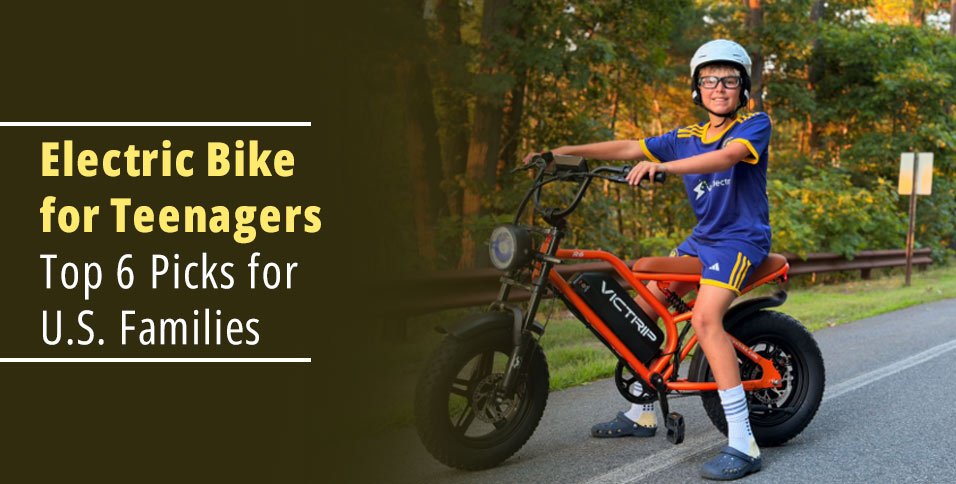
Families considering small recreational moped style vehicles will likely find the VICTRIP R6 of interest. The VICTRIP website provides a suggested user height range of 4 feet 9 inches to 5 feet 11 inches, a total weight of 72 pounds, and maximum speeds of 28 miles per hour.
Even though this is a small motorcycle, the weight should be considered. Ask the rider to show you how well he/she can maneuver and control it.
The product should be purchased only for older teens who are capable, meet all manufacturer requirements, and have access to an acceptable and allowable area to ride. The way the product looks does not indicate its safety for beginners nor does it indicate that users will be able to use it on bicycle paths.
Why consider it: The family wants a compact recreational format.
Prior to purchase: Verify operational age range, weight capacity, product type/class, and whether it has been authorized for use in your area.
Getting a Teen E-Bike Ready for Everyday Riding
Before a new bike can be relied upon for daily travel, there are some common procedures to follow. Where does the bike lock get placed? Who inspects the tire pressure? What will happen if the normal route is unavailable?
Work those out.
The initial few weeks can be used to resolve minor issues prior to their everyday difficulties.
Practice Before Riding Independently
Select an even surface that is free from any movement by automobiles. Have the rider begin their experience on the bicycle without any power assistance to allow them to become familiar with the weight of the bicycle, the brakes, and how to steer the bicycle.
After introducing the lowest assistance level, you will practice until both your start-ups and stops become consistent.
Useful exercises include:
- Stopping before a marked line.
- Looking behind without drifting.
- Restarting after a complete stop.
- Dismounting and walking through a narrow gap.
- Parking the bike securely.
Teach the throttle individually if the bike has a throttle. Explain that you may accidentally give the bike input when you are getting on the bike or moving around it.
These exercises do not require you to rush. Completing several laps without error does not indicate that you are ready for the road.
Plan School Trips Together
Go over the route with your teen-age son/daughter on the day/time that he/she will be riding back and forth to/from school. Road conditions can vary greatly from what you would see when driving the same road on a lazy Sunday afternoon.
Be mindful of driveways, opened doors of parked vehicles, bad condition of roads and poor lighting at road crossings. Describe when you should walk your bike instead of riding it.
Agree on an alternative for roadwork or a blocked path.
Also, try to practice locking up your bicycle, taking everything off of your bicycle, and ensuring there is enough space for everyone else. Try to plan ahead for the amount of time you need to get to your destination, so if you start late, you don’t feel like you have to rush to arrive at your destination.
Carry Equipment Correctly
A school/sports bag will determine the amount of weight you may be able to carry on your bicycle. Please select bags that can be used on your bicycle and always stay within the manufacturer’s suggested weight limit.
Do not allow your straps to touch the wheels, chain or any other moving part. In addition, please avoid hanging any loose bags from the handle bars.
Practice with all items on board. When practicing your standard procedure for starting up and parking with the same volume of gear as you normally would have, it’s very likely to feel quite different than practicing without any gear on board.
A budget will initially include a helmet, a good lock, and proper lights. Additional items should only be added once it has been established that they will assist in resolving a problem and that the controls remain available.
Establish a Charging Routine
Prior to delivery of your car, pick an area where you want to charge your vehicle and then follow the manufacturers instructions.
When charging, have an adult present, and do not charge overnight while you sleep or while you are away from home. Use either the original charger provided with your product or one that has been recommended by the manufacturer.
UL needs to know if you’re certified for the particular electrical system. UL says that when reviewing an electrical drive, battery and charger, they review all three as one complete package (UL 2849). It isn’t possible to say each component has its own certification, and therefore the total system is certified.
Issues with your battery should be reported simply. If you find your battery to be physically damaged, swollen, overly warm, or functioning oddly, stop using it immediately. For help fixing these problems, contact the manufacturer of the battery.
Make Maintenance a Habit
Prior to every ride check that the tires are properly inflated, brakes work correctly, the wheels are securely attached to the vehicle and the battery is firmly attached. Check your owner’s manual for proper tire inflation pressures and recommended maintenance intervals.
Teach your teenager how to let you know when they notice changes in their vehicle. This will allow them to check out a new sound from the engine, or a rubbing brake pad before they head off to school.
The act of cleaning can serve as a way to inspect your device. Please consult the instructions provided by the manufacturer about how you should handle water and electrical parts.
Along with maintaining a centralized file that includes the serial number, receipt, and maintenance history of each item you purchase; you will also have to develop a process for repairing those items that break down, if you cannot repair them on your own.
Set Clear Family Expectations
“Be careful” can mean many things. Prior to allowing your child to ride alone, be certain that he/she understands what is required of him/her.
Helmet, route, weather, riding after dark, and use of cell phone while operating the motorcycle are discussed. Decide if you would permit your friend to use the motorcycle.
Before you take someone on a trip with you, discuss who is going to be in your car. Then come to an agreement that a parent must be present when you make changes to the vehicle’s speed and/or power.
Lastly, the last thing that you need to instruct your teen on is what to do in the event of an accident (a fall, a breakdown, etc.). It would be helpful if your teen understands who he/she needs to notify (you, emergency services) and where he/she needs to wait for assistance.
I recommend that you get in touch with me after the first week of your project. If you have had trouble or felt awkward doing any of the tasks associated with your project, it would be much better for us to discuss these issues rather than just to remind you to concentrate.
Conclusion
An electric bicycle’s suitability for a young adult will depend on who will be riding the e-bike and where the person intends to use it. After considering the first two criteria (rider and trip), there are several other considerations when choosing an e-bike, such as the fit of the e-bike to the rider, the ease of handling the e-bike, the manufacturer’s operational guidelines for the e-bike, and whether or not it is permissible to operate the e-bike within your jurisdiction.
Then try it.
A correctly sized bicycle can be used comfortably for all parts of your ride – from removing it from where it’s stored, to riding, to stopping, and then locking it up when you reach your destination.