Manufacturers have always balanced speed, quality, cost, and customer expectations. Today, the challenge is keeping up with how quickly those expectations can change. Production schedules shift, customers request smaller or more customized runs, and skilled labor is not always easy to find.
Automation can help manufacturers respond, but the goal is not simply to make machines work faster. It is to create adaptable processes that can handle changing production demands while maintaining consistent quality.
That requires a thoughtful approach. A rigid automated system can simply replace one bottleneck with another. Flexible operations come from automating the right tasks while keeping skilled people involved where experience, judgment, and problem-solving matter most.
Automation Is Becoming More Adaptable
Traditional automation often made the most sense in high-volume environments. If a factory produced thousands of identical parts, specialized equipment could repeat the same process with impressive efficiency. Changing that process could be expensive and time-consuming.
Newer automation technologies are changing the equation. Programmable equipment, robotics, sensors, machine vision, and modern control systems can make it easier to switch between jobs or adjust processes. Advances in sensors, software, and vision systems are also making robotics more practical for a wider range of manufacturers.
That flexibility can be especially useful when production needs vary from week to week. A manufacturer might automate loading and unloading while keeping setup decisions with an operator. Another might use robotic material handling to move parts between workstations without building a fixed conveyor system.
Flexibility can also extend beyond the factory itself. When demand rises beyond internal capacity, manufacturers can combine automation with outside metal fabrication services for selected components or production stages. That approach can add capacity without bringing every process in-house.
The result is a manufacturing model built around options rather than one fixed production path.
Where Automation Makes a Practical Difference
Cutting, forming, machining, and welding all contain tasks where repeatability matters. Automation can take over carefully defined portions of those processes while operators focus on setup, monitoring, inspection, troubleshooting, and improvement.
In cutting operations, automated equipment can repeatedly follow programmed dimensions and reduce variation that can occur during manual processing. Integrated material handling can also keep machines supplied, reducing idle time between cycles.
Forming operations can benefit in similar ways. Automated controls help maintain consistent settings, while programmable equipment makes it easier to reproduce established processes. When a job returns months later, stored programs and documented settings help teams return to the required process more efficiently.
Machining presents another opportunity. Automated part loading can keep equipment productive longer, while sensors and monitoring systems provide information about machine conditions. This does not eliminate the need for machinists. It changes where their attention is most useful.
Welding automation can support consistent movement, speed, and positioning in suitable applications. Skilled welders still play an important role in setup, process development, quality control, and jobs with high variability or difficult access.
Automation can also support inspection. Machine vision and sensor-based systems can check certain characteristics during production rather than waiting until a completed batch reaches final inspection. Earlier detection gives teams a chance to address a process issue before they invest more time and material.
These applications help explain the continued adoption of industrial robotics and other automated systems across manufacturing.
People and Processes Still Determine the Results
Buying automated equipment does not automatically create an efficient operation. If a process is poorly designed, automation may simply repeat its problems faster.
Manufacturers first need to understand the workflow. Where does work consistently slow down? Which repetitive tasks consume skilled labor? Where does variation affect quality? Which operations create safety or ergonomic concerns? Answering questions like these helps identify areas where automation can provide practical value.
Employees also need to understand the technology they are expected to use. The National Institute of Standards and Technology provides manufacturing resources through its Manufacturing Extension Partnership, including support related to technology adoption and workforce development. As operators work more closely with robotics, data systems, and other digital technologies, training can help employees move from repetitive tasks toward supervising equipment, solving process problems, maintaining systems, and improving production.
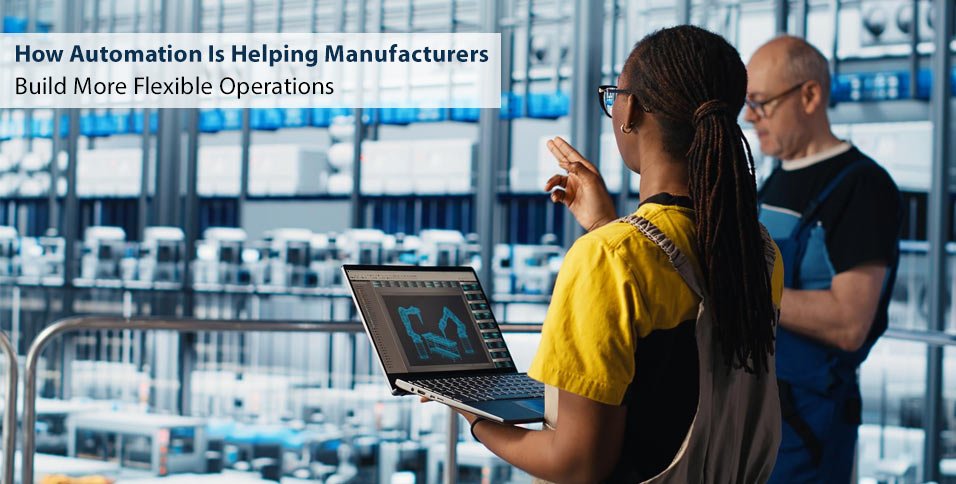
This combination of technology and human expertise is valuable when conditions change. Machines excel at repeating tasks. Employees can recognize unusual conditions, make judgment calls, and adapt a process when a new product or production challenge appears.
Manufacturers that treat automation as a tool for their workforce, rather than a substitute for sound processes, are better positioned to make technology useful across a wider range of production needs.
Flexibility Is Becoming the Real Advantage
The strongest case for manufacturing automation is not simply that it can speed up production. Its broader value is the ability to create an operation that can respond without losing control of quality or efficiency.
Flexible automation can help manufacturers move between jobs, increase capacity, reduce repetitive work, collect useful process information, and make better use of skilled employees. Outside production partners can add another layer of flexibility when internal equipment or staffing cannot absorb a sudden change in demand.
The factory of the future does not have to be a lights-out facility filled with machines and few people. A more practical model pairs adaptable technology with employees who understand the product, the process, and the customer’s requirements.
As production becomes more variable, that combination can matter more than automation alone. Manufacturers that build adaptable systems, develop skilled teams, and continuously improve processes can respond to change without rebuilding their operations every time demand shifts.