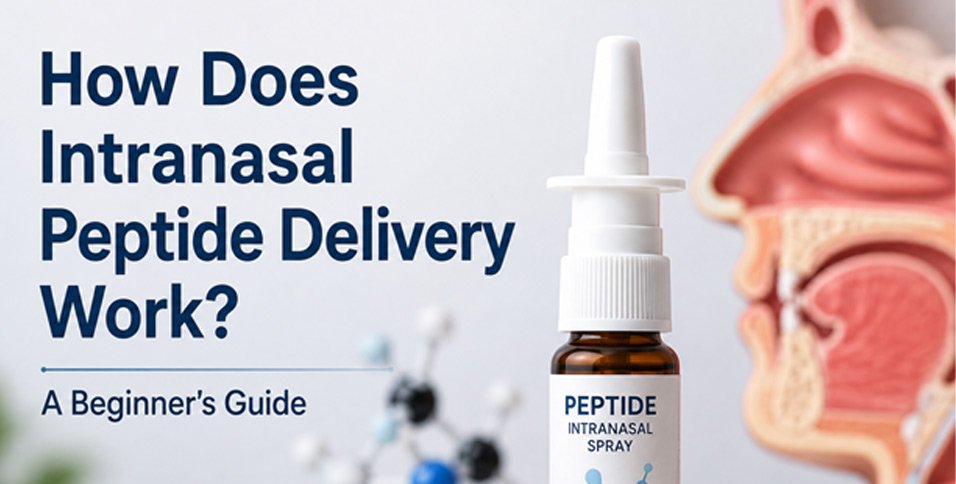
Peptide research has expanded considerably as scientists investigate how short chains of amino acids interact with biological systems. One area receiving particular attention is intranasal delivery. Instead of introducing a research compound through a traditional route, intranasal formulations are designed around the nasal cavity as the delivery environment.
Understanding how this approach works requires looking at basic nasal anatomy, formulation science, absorption, and the challenges associated with peptide stability.
What Is Intranasal Peptide Delivery?
Intranasal peptide delivery refers to studying peptide compounds in formulations designed for administration through the nasal cavity. The nasal passage contains a mucosal surface with a rich blood supply, making it an interesting area for pharmaceutical and biomedical research.
A nasal formulation typically consists of the active research compound combined with other ingredients that help create a stable and usable preparation. The formulation must be evaluated carefully because peptides can be sensitive to environmental conditions such as temperature, pH, and moisture.
For researchers interested in nasal peptide research, understanding the delivery environment is just as important as understanding the peptide itself.
Why Is the Nasal Route Interesting?
The nasal cavity has several characteristics that make it attractive for research into alternative delivery systems. The mucosal lining provides a relatively accessible biological interface, while the nasal cavity itself is highly vascularized.
However, an interesting delivery route does not automatically mean that a compound will be effectively absorbed. Researchers need to examine many variables, including molecular size, formulation characteristics, mucociliary clearance, and the chemical properties of the compound.
This is why intranasal peptide delivery is best understood as a complex formulation and research problem rather than simply a different way to administer a compound.
What Happens After a Nasal Formulation Is Applied?
At a basic level, a nasal formulation comes into contact with the nasal mucosa. From there, researchers study what happens to the compound within the local environment.
Several outcomes are possible. Some material may remain near the application site, some may interact with the mucosal surface, and some may be cleared through normal nasal processes. Researchers therefore examine how long a formulation remains available and how its physical and chemical properties change over time.
The formulation itself can significantly influence these processes.
Why Formulation Matters
Peptides are generally more complex than many small-molecule compounds. Their structure can make them vulnerable to degradation, aggregation, or other changes.
A well-designed research formulation therefore requires careful consideration of stability and compatibility. Researchers may evaluate pH, concentration, excipients, container compatibility, storage conditions, and other characteristics.
These considerations are also important when comparing different peptide nasal spray formulations.
What Researchers Measure
Intranasal delivery studies can examine several characteristics. Depending on the research question, scientists may evaluate stability, concentration, absorption characteristics, distribution, and biological activity in appropriate experimental models.
Importantly, laboratory findings should not automatically be interpreted as evidence of human clinical effectiveness. Preclinical research is designed to answer specific scientific questions and often represents an early stage of investigation.
Exploring Nasal Peptide Research Products
Researchers who want to examine different nasal formulations may encounter a range of products presented specifically for laboratory research. A Nasal Spray Category can provide an overview of available research formulations and their individual specifications.
For a specific example of a nasal research formulation, the N-acetyl Semax Spray product page provides information about its listed formulation and research positioning.
Conclusion
Intranasal peptide delivery combines biology, formulation science, and analytical research. The nasal cavity offers an interesting environment for studying alternative delivery methods, but successful research requires careful attention to peptide stability, formulation design, mucosal interactions, and experimental conditions.
As research continues, understanding these fundamentals can help readers distinguish between a delivery concept, a laboratory formulation, and evidence demonstrating clinical use. That distinction is essential when evaluating emerging peptide research.
Also Read: Precision Medicine in 2026: How Peptide Therapy Is Transforming Preventive and Regenerative Care