Most conversations about business risk focus on the visible kind: market shifts, regulatory change, reputational fallout from a bad quarter. Fewer business leaders spend the same energy on a quieter category of risk, the kind that starts as an ordinary operational decision and only later reveals itself as a liability question. It rarely announces itself as strategic. That’s exactly why it tends to get missed.
When a customer is injured on a company’s premises, the story that reaches the public often follows a familiar pattern. A slip near a wet floor. A falling display. A poorly lit car park. The incident gets pinned on whoever was closest to it, the cleaner who hadn’t mopped yet, the junior manager on shift that night. Rarely does anyone ask the harder question. Who decided that floor didn’t need checking as often? Who signed off on the lighting budget getting pushed to next quarter?
That’s the blind spot, really. Public liability risk can develop well before someone gets hurt. It can develop earlier, through decisions about how risks are identified, assessed and managed.
Where the decisions actually live
Business owners and managers don’t tend to see themselves as the point of failure in a liability claim. Fair enough, they’re not the ones walking the floor. But the conditions contributing to an incident may involve decisions made well above the operational level. A maintenance schedule was deferred because the budget was tight that year. Staffing cuts to customer-facing areas, which meant hazards got noticed and fixed less often. A new site opened, a new market entered, without anyone updating the risk assessment that used to cover the old one.
None of these look like liability decisions when they’re made. They look like ordinary cost decisions, growth decisions. Their potential significance may only become apparent after something goes wrong.
This is part of why liability, treated purely as a legal or insurance matter, gets managed too late. By the time a claim lands, some of the decisions relevant to the circumstances may have been made months, or even years, earlier by someone who’s already moved on to other priorities.
What Reasonable Risk Management Looks Like Across Markets: US, Australia and Beyond
Legal obligations can vary depending on the jurisdiction and circumstances, but reasonable risk management is an important consideration in addressing potential liability. In practice, organisations cannot reasonably eliminate every conceivable hazard, which makes appropriate risk identification and management important. That’s a different standard from flawless operations, and it reinforces the importance of having appropriate risk-management processes in place. This applies across jurisdictions, whether under public liability frameworks in Australia, premises liability principles in the United States, or occupiers’ liability rules elsewhere, even though the specific legal tests and terminology differ from one jurisdiction to the next.
Taking Australia as one example, questions about foreseeability, reasonable precautions and the circumstances surrounding an incident may become relevant in the context of a public liability claim, depending on the applicable law and facts. Occupiers may have legal duties and responsibilities toward people who enter their premises, depending on the applicable law and circumstances. A clear record of risk assessments, decisions and remedial measures may also assist an organisation in explaining how relevant risks were identified and managed.
What this means for leadership, not just operations
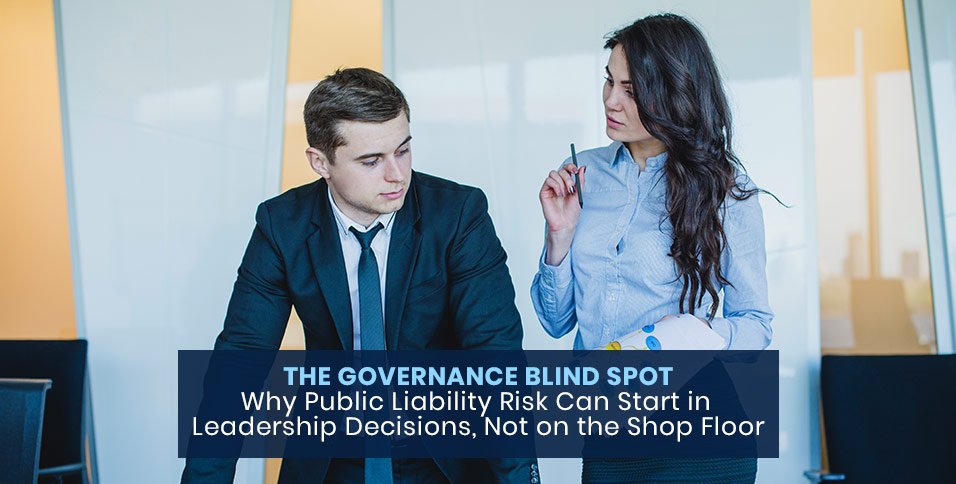
If liability risk can be influenced by decisions made above the operational floor, it belongs on the agenda of whoever’s making those decisions, not just in an incident-response plan sitting with legal or facilities.
A fair test for any business owner or leadership team. Does anyone at the top actually see the maintenance backlog, or just a summary that says “on track”? Is there visibility into where staffing’s been trimmed in customer-facing roles, and whether that trim carries any documented safety rationale? When a new site or service line launches, does it get its own risk assessment, or does it just inherit whatever assumptions sat in the last one?
None of this turns business leaders into safety officers. It just means treating liability exposure as a governance input, same as cash flow, same as reputational risk, instead of something that only becomes visible once a claim shows up.
The pattern worth remembering
The organisations that handle this well aren’t the ones with zero incidents. Incidents happen. That’s the nature of running physical operations, serving customers, managing people day to day. The organisations that handle it well are the ones where, when something does go wrong, there is a clear record showing how the risk was identified, considered and addressed. Often, that record is built through decisions and processes that may not have appeared directly connected to liability risk at the time.
Public liability isn’t a shop-floor problem wearing a legal label. It’s a leadership problem that happens to surface on the shop floor. Catching that early, before a claim forces the question, can make the difference between an organisation that can clearly explain its decisions and one that has limited documentation to draw upon.