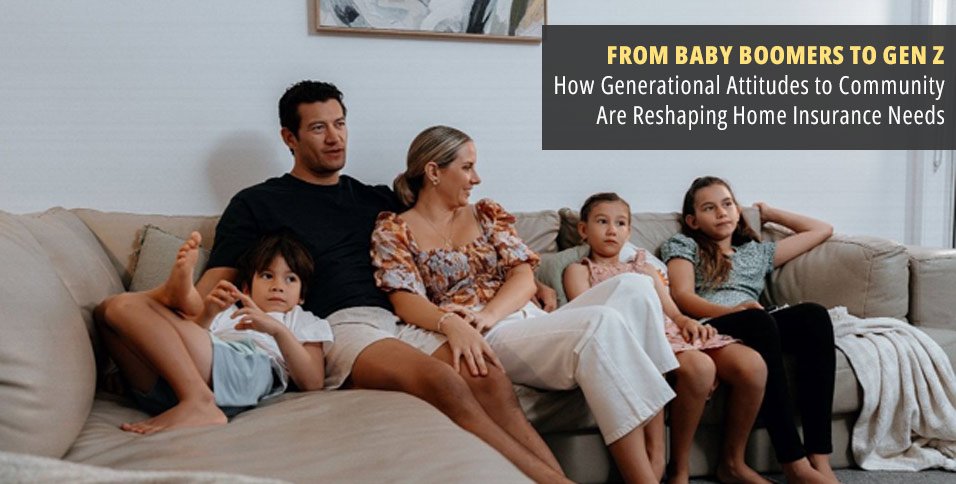
Community has always meant different things to different generations, and the gap between how younger and older Australians experience neighbourhood life appears to be widening. The idea of an unwritten code of neighbourly conduct is alive and well across the generations, but belief in the rules and adherence to them are turning out to be two very different things.
For homeowners, renters and everyone in between, these shifting attitudes carry real implications for how people think about protecting their homes and belongings.
A generational divide in neighbourly behaviour
Gen Z Australians are just as likely as anyone else to believe that unwritten neighbourhood rules exist, with roughly two-thirds agreeing there is an informal code most people follow. Where the generations diverge is in practice. Younger Australians are considerably less likely to actually follow these rules day-to-day, while Baby Boomers stand out as the generation most committed to living by them.
This is not necessarily a sign that younger Australians care less about their neighbours. It more likely reflects a different rhythm of life, more shared housing, more frequent moves, less time spent at home during daylight hours, and a general shift towards individualised, fast-paced living. Older Australians, often more settled and more likely to have lived in the same home for decades, have simply had more time to build the habits that come with long-term community ties.
Why community still matters, even when it looks different
Despite these differences, new research from Youi Insurance is clear that Australians of all ages still see genuine value in having good neighbours nearby. Just over half of respondents said that having neighbours close by makes them feel safer and more supported, a reminder that community, even in its smallest and most informal form, still plays a meaningful role in day-to-day wellbeing.
This sense of safety in numbers has quiet implications for how people think about home security and insurance. A close-knit street where neighbours look out for one another’s homes may be less exposed to certain risks than one where nobody knows anyone else’s name. It is not something a policy can measure directly, but it shapes the broader picture of how safe a home actually is.
Interestingly, this is one area where younger and older Australians appear to agree, even if they arrive at the same conclusion from different directions. Older residents often build this sense of safety through decades of familiarity with the people around them. Younger Australians, who may move more frequently and know fewer neighbours by name, sometimes recreate a similar effect through local social media groups, community apps and shared interest networks. The mechanism looks different, but the underlying desire for a supportive local network appears to be consistent across the generations.
How generational living patterns show up in insurance needs
The way different generations live has a direct bearing on the type of cover that makes sense for them. Younger Australians in share houses or rental properties are more likely to need contents insurance that protects personal belongings without the burden of covering a building they do not own. Frequent moves also mean flexibility matters, with portable policies and simple online management becoming more important than they might have been a generation ago.
Older Australians, particularly those who have owned the same home for many years, tend to place more weight on comprehensive building cover, protection for long accumulated contents, and policies that account for renovations or additions made over time. Their longer tenure in one place also means they are more likely to have witnessed, or been directly involved in, the kind of neighbourhood disputes the research highlights, giving them a more practical understanding of why liability and boundary cover matter.
What this means for families spanning multiple generations
Many Australian households do not fit neatly into a single generational category. Adult children living at home for longer, grandparents contributing to the family budget, and multigenerational households becoming more common all mean that a single home can contain very different attitudes to community and very different insurance needs under one roof.
In these households, it often falls to whoever manages the family’s finances to reconcile these different expectations into a single, coherent insurance strategy. A grandparent who has lived in the same street for forty years might assume everyone shares their sense of neighbourhood obligation, while a grandchild working shifts and socialising outside the local area may barely know the neighbours’ names. Both perspectives are valid, and a good home insurance policy should be flexible enough to accommodate the realities of a household that does not conform to a single generational pattern.
Insurance in an increasingly individualised Australia
As Australians of every generation lean into a more individualised style of community living, valuing connection but on their own terms, insurers are having to think about flexibility in the same way. A one-size-fits-all approach to home insurance makes little sense when a 24-year-old in a share house and a 68-year-old in a long-owned family home have such different risk profiles and expectations.
Youi‘s approach to home insurance reflects an understanding that no two households live the same way, even if they are separated by nothing more than a shared fence. Tailoring cover to actual living circumstances, rather than assuming everyone needs the same protection, is becoming increasingly important as generational attitudes to community continue to shift.
Key takeaways
Belief in unwritten neighbourhood rules is strong across every generation, but actually following them varies significantly, with Baby Boomers the most consistent rule followers and Gen Z the least.
- More than half of Australians say nearby neighbours make them feel safer and more supported, underlining the ongoing value of community even in a more individualised era.
- Younger Australians in share houses and rental properties typically benefit most from flexible contents insurance, while older, long-term homeowners tend to prioritise comprehensive building cover.
- Generational differences in how people live are prompting insurers to offer more tailored, flexible policies rather than a single standard approach.
- Understanding these shifting patterns helps every household, regardless of age, make more informed decisions about the type of home insurance cover that actually suits their circumstances.