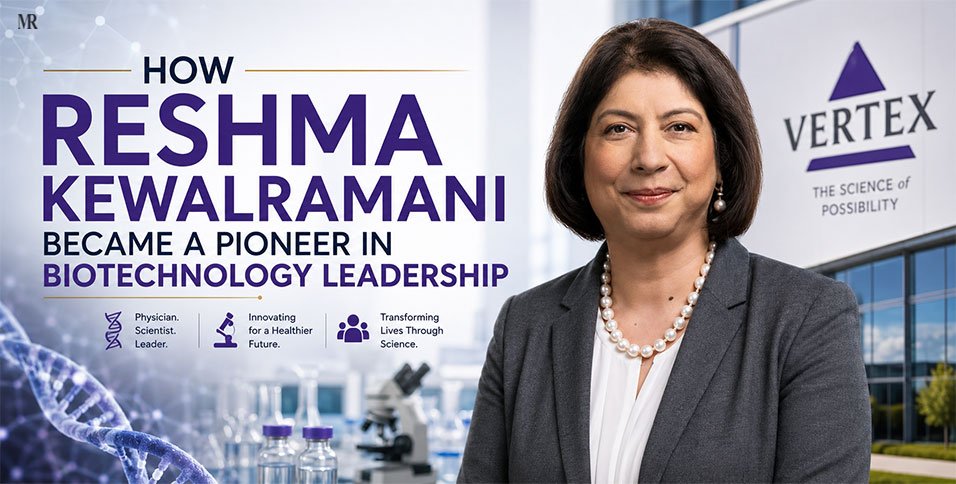
Biotechnology has transformed the way diseases are diagnosed and treated, giving hope to millions of people through breakthrough medicines and gene-based therapies. Behind many of these advances are leaders who can bridge the worlds of medicine, scientific research, and business innovation.
One such leader is Reshma Kewalramani. Her journey from practicing nephrology to leading Vertex Pharmaceuticals reflects how clinical expertise can shape the future of global healthcare. Under her leadership, Vertex has expanded beyond cystic fibrosis, pioneered the world’s first approved CRISPR gene-editing therapy, and introduced innovative non-opioid pain treatments.
Her career offers more than a leadership success story. It demonstrates how bold decisions, scientific curiosity, and a patient-first mindset can transform both a company and an industry.
Who Is Reshma Kewalramani?
| Full Name | Dr. Reshma Kewalramani, M.D., FASN |
| Current Position | President and CEO of Vertex Pharmaceuticals |
| Company | Vertex Pharmaceuticals Incorporated |
| Nationality | Indian-American |
| Education | Boston University (B.A./M.D.), Harvard Business School (General Management Program) |
| Profession | Physician, Nephrologist, Biotechnology Executive |
| Years at Vertex | 9 years (joined in 2017) |
| CEO Since | April 1, 2020 |
| Industry | Biotechnology and Life Sciences |
| Known For | First female CEO of a major U.S. biotech company |
| Major Achievement | Approval of CASGEVY (CRISPR therapy) and Journavx (non-opioid pain treatment) |
Reshma Kewalramani is an Indian-American physician-scientist and corporate executive who serves as the President and CEO of Vertex Pharmaceuticals. She gained international recognition in April 2020 when she became the first woman to head a major publicly traded U.S. biotechnology firm.
Before taking the helm at Vertex, she accumulated more than fifteen years of clinical practice, academic research, and drug development experience. She originally joined Vertex in 2017 as Senior Vice President and Chief Medical Officer after a twelve-year tenure at Amgen.
Under her direction, Vertex expanded its primary focus beyond cystic fibrosis into serious diseases such as sickle cell disease, beta-thalassemia, type 1 diabetes, and acute pain. According to official corporate statements, her management strategy centers on targeting the underlying biological causes of disease rather than merely treating ongoing symptoms.
Reshma Kewalramani’s Early Life and Childhood in India
Reshma Kewalramani was born in Mumbai, India, in 1973 to a Sindhi Hindu family. She grew up in a supportive household where education and hard work were central family values. Reflecting on her family’s expectations, she once noted with humor that the expected career choices were engineering, medicine, or priesthood, and she chose medicine.
At age eleven, her family immigrated to the United States in search of broader professional and educational opportunities. The family settled in Long Island, New York.
During her teenage years, Reshma spent weekends helping her father manage a small clothing and electronics shop in Manhattan. Working behind the counter taught her early lessons in customer service, clear communication, and business operations.
Educational Path and Specialized Medical Training
Reshma Kewalramani’s education began with exceptional academic achievements during her high school years, paving the way for her acceptance into a competitive seven-year joint program.
- Boston University (1991–1998): She completed her combined Bachelor of Arts and Doctor of Medicine degree, graduating Phi Beta Kappa and Summa Cum Laude.
- Internal Medicine Residency (1998–2001): She completed her internship and residency training in internal medicine at Massachusetts General Hospital in Boston.
- Nephrology Fellowship (2001–2004): She completed specialized fellowship training in kidney disease through the combined nephrology program at Massachusetts General Hospital and Brigham and Women’s Hospital.
- Harvard Business School (2015): She completed the General Management Program to formalize her administrative and executive skill set.
During her time in Boston, Reshma Kewalramani worked toward becoming what academic medicine calls a triple threat, which refers to a physician who excels equally at patient care, medical teaching, and laboratory research.
Her years treating patients with kidney disease gave her firsthand exposure to the gap between scientific discovery and available treatments. That perspective later influenced her approach at Vertex, where research is driven by the goal of solving diseases at their biological root rather than managing symptoms.
Reshma Kewalramani’s Early Career: Transition From Physician to Drug Development
After completing her fellowship, Reshma Kewalramani practiced as an attending nephrologist and established her own research laboratory in Boston. However, she soon recognized a fundamental disconnect in her career goals. While her academic laboratory focused on basic scientific discoveries, it was detached from the practical process of turning those discoveries into actual patient treatments.
As quoted in her 2023 Babson College address, she explained her decision to leave academia:
“I realized if I wanted to do that, drug discovery, clinical trials, make new medicines, that actually happens in industry, whether it’s biotech or pharma. That’s really the heart of where that action is.”
In 2004, she decided to transition into the pharmaceutical industry. She and her husband left Boston and relocated to California so she could accept a role in clinical research at Amgen. Moving meant taking a major risk while raising six-month-old twin sons. Over the next twelve years at Amgen, she advanced through multiple leadership roles, eventually becoming Vice President of Global Development.
Joining Vertex Pharmaceuticals and Rising to Chief Executive
Vertex Pharmaceuticals is a Boston-based biotechnology company known for developing breakthrough therapies for serious diseases, including cystic fibrosis, sickle cell disease, and acute pain. The company has become a global leader in precision medicine through its focus on treating diseases at their underlying biological cause.
Reshma Kewalramani joined Vertex in February 2017 as Senior Vice President of Clinical Development and Medical Affairs after spending 12 years at Amgen. Her expertise in clinical research and drug development quickly earned her broader leadership responsibilities.
Her rise at Vertex was quick:
- February 2017: Joined as Senior Vice President of Clinical Development and Medical Affairs.
- April 2018: Promoted to Chief Medical Officer and Executive Vice President, leading global clinical development, regulatory strategy, and medical affairs.
- July 2019: Named successor to longtime CEO Jeffrey Leiden as part of a planned leadership transition.
- April 1, 2020: Became President and Chief Executive Officer, making history as the first woman to lead a major publicly traded U.S. biotechnology company.
She assumed leadership at a crucial moment, with the responsibility of building on Vertex’s success in cystic fibrosis while expanding the company’s research into new areas of unmet medical need.
Key Turning Points and Decisions That Defined Her Leadership
- Transitioning From Medicine to Biotechnology
Leaving academic medicine was the first defining decision in Reshma Kewalramani’s career. Although she enjoyed treating patients and conducting research, she realized that universities often lacked the funding and infrastructure needed to transform scientific discoveries into approved medicines. By moving into biotechnology, she expanded her impact from caring for individual patients to helping develop therapies that could benefit millions worldwide. Her background as a physician also gave her a unique perspective, allowing her to evaluate scientific and business decisions through the lens of patient care.
- Breaking Barriers in Biotechnology Leadership
When Reshma Kewalramani became President and CEO of Vertex Pharmaceuticals on April 1, 2020, she became the first woman to lead a major publicly traded U.S. biotechnology company. Beyond being a historic milestone, her appointment challenged long-standing assumptions about leadership in the life sciences industry. She demonstrated that a physician-scientist could successfully lead one of the world’s most innovative biotechnology companies while guiding complex research, regulatory, and commercial operations.
- Driving Innovation Through Science
One of Kewalramani’s defining leadership principles has been focusing on diseases with well-understood biological causes rather than pursuing incremental improvements. Under her leadership, Vertex continued investing in transformative therapies designed to treat the root cause of disease. This disciplined research strategy strengthened the company’s reputation as a biotechnology innovator and reduced reliance on short-term, low-impact projects.
- Expanding Vertex Beyond Cystic Fibrosis
Rather than depending solely on Vertex’s success in cystic fibrosis, Kewalramani broadened the company’s research pipeline into multiple high-need therapeutic areas, including:
- Sickle cell disease and beta-thalassemia: Advanced gene-editing therapies through the partnership with CRISPR Therapeutics.
- Acute pain: Led the development of Journavx, a first-in-class non-opioid pain treatment.
- Type 1 diabetes: Expanded investments in stem cell-derived islet cell therapies.
- Kidney disease: Supported research into targeted therapies for APOL1-mediated kidney disease.
This diversification transformed Vertex from a cystic fibrosis specialist into a broader biotechnology leader.
- Leading Through Global Challenges
Kewalramani assumed the CEO role at the height of the COVID-19 pandemic, when pharmaceutical companies faced unprecedented operational challenges. She maintained research activities, ensured uninterrupted medicine supplies for patients, and kept critical clinical programs moving forward despite global disruptions. During her tenure, Vertex also achieved major milestones, including the approval of CASGEVY, the world’s first CRISPR-based gene-editing therapy, and Journavx, the first new class of non-opioid pain medicine approved in more than two decades.
- Why Reshma Kewalramani Is Considered a Biotechnology Pioneer
Reshma Kewalramani is widely recognized as a pioneer in biotechnology leadership because she combines medical expertise with bold scientific vision. She has broken gender barriers as the first woman to lead a major public biotech company, expanded Vertex beyond its traditional focus on cystic fibrosis, championed breakthrough treatments in gene editing and pain management, and demonstrated that patient-centered innovation can drive both scientific progress and long-term business growth.
In a profile written for TIME Magazine, Ginkgo Bioworks CEO Jason Kelly praised her executive vision: “She knows how to effectively push the limits of science while navigating the drug-approval process. She told us that when you are doing something innovative, if it sounds crazy or impossible, that’s OK, it’s only because no one has done it before.”
Reshma Kewalramani’s Major Achievements and Industry Honors
Regulatory Breakthroughs
- CASGEVY Approval: In late 2023, Vertex achieved FDA approval for CASGEVY, making it the world’s first approved therapy using CRISPR gene-editing technology for sickle cell disease and transfusion-dependent beta-thalassemia.
- Journavx Approval: As reported in official company updates, the FDA approved Journavx in January 2025. This marked the first new class of non-opioid pain medication approved by federal regulators in over two decades.
Corporate Rankings and Awards
- TIME Woman of the Year (2026): Recognized by TIME Magazine as one of the world’s top women leaders for her contributions to biotechnology and healthcare access.
- Fortune Most Powerful Women: Named to Fortune’s annual list of the 100 Most Powerful Women in Business and Most Powerful People in Business.
- Harvard Business School Alumni Achievement Award: Awarded for executive excellence and leadership in medical innovation.
- Golden Door Award: Awarded by the International Institute of New England, recognizing outstanding contributions by foreign-born citizens.
Leadership Lessons from Reshma Kewalramani for Business Professionals
- Let Patient Outcomes Guide Business Decisions
Keeping patient health as the primary goal simplifies internal decisions regarding resource allocation and project prioritization. When research teams focus on changing medical outcomes, commercial success follows naturally.
As Reshma Kewalramani remarked during a Babson Commencement address:
“We don’t do incremental improvement, we innovate to transform or cure, and we serially innovate. We simply are relentless in that way, and our own history has taught us to be like that.”
- Take Calculated Risks
Career progression often requires stepping away from comfortable, predictable paths. Moving from clinical practice to the corporate sector involved temporary uncertainty, but it allowed her to impact thousands of lives rather than one patient at a time.
- Ask the Right Questions
Effective leadership does not require having every answer in advance. Instead, strong leaders build multidisciplinary teams composed of specialized experts and ask targeted questions that guide sound decision-making.
In her 2023 Babson address, she shared practical advice for future leaders:
“Do things that make you uncomfortable, know that you’re going to have a team of people around you, and that it’s actually more important to know how to ask all the right questions than it is to have all the right answers.”
Conclusion
As a top women CEO, Reshma Kewalramani shows how uniting medical practice with clear executive strategy can change modern corporate leadership. Her path from a young immigrant student in Long Island to an influential chief executive demonstrates the value of disciplined decision-making and patient-centered purpose.
By directing capital into curative gene therapies and non-addictive pain treatments, she continues to set new performance standards for drug discovery. Her work at Vertex Pharmaceuticals provides a practical model for future scientists and women leaders in biotechnology who want to build high-impact careers.
Maria Isabel Rodrigues