Mirror Review
August 06, 2026
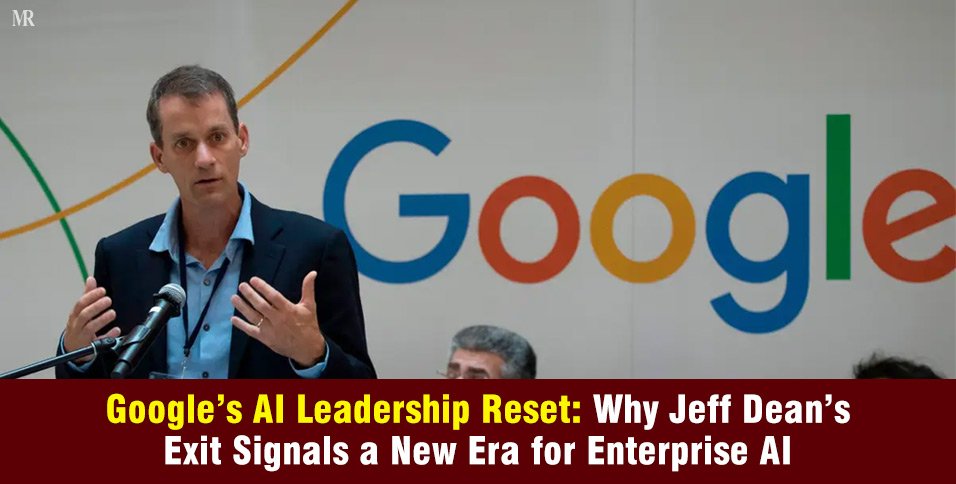
Jeff Dean leaves Google after 27 years, marking one of the biggest leadership transitions in the company’s AI history. At the same time, Alphabet reshaped its artificial intelligence leadership on August 5 and 6, 2026, appointing new leaders to guide the next phase of Google DeepMind’s strategy, in one of the biggest organizational shifts in Google DeepMind’s history.
Jeff Dean, Google’s chief scientist and its 30th employee, left after 27 years to co-found an AI research startup called Discovery Loop. At the same time, Demis Hassabis moved into a new role as Alphabet’s Chief Scientist and Chair of Google DeepMind, while Koray Kavukcuoglu took over daily operations as Senior Vice President of Google DeepMind.
The changes come as Google faces mounting pressure from Anthropic and OpenAI in the enterprise AI market, and they mark a turning point in how the company plans to compete going forward.
Google’s Major Leadership Restructuring
Alphabet CEO Sundar Pichai announced the changes in a public post titled “The next chapter of our AI momentum.” He described the restructuring as an operational step needed to scale Google’s AI business, not a response to a crisis. Pichai noted that the Gemini app has surpassed 950 million monthly active users, underscoring the scale Google now needs to manage.
Hassabis, who won the 2024 Nobel Prize in Chemistry for his work on AlphaFold, will focus on artificial general intelligence and Isomorphic Labs, DeepMind’s drug discovery arm. In a memo to DeepMind staff, he said humanity has reached a “pivotal moment” where AGI is “close at hand.” Kavukcuoglu, a 13-year DeepMind veteran who co-created DQN and WaveNet, now reports directly to Pichai and oversees the Gemini model ecosystem, frontier research, and developer products.
Why Jeff Dean Leaves Google After 27 Years
Dean joined Google in 1999 and helped build the infrastructure that runs much of the modern internet. He co-authored MapReduce, Bigtable, and Spanner, and later co-founded Google Brain, which produced TensorFlow and the Tensor Processing Unit program. In his farewell note to Google’s roughly 190,000 employees, Dean recalled watching the company’s search index scale by a factor of 100 during his tenure.
He is joined at Discovery Loop by Google Senior Fellow Sanjay Ghemawat, former DeepMind VP of Research Oriol Vinyals, and Google Brain co-founder Quoc Le. Together, they built systems ranging from AlphaStar to the Gemini foundation models, making their exit a significant loss of institutional knowledge for Alphabet.
Inside Discovery Loop
Discovery Loop is a Public Benefit Corporation focused on automating the scientific method. The company wants AI systems that can independently form hypotheses, write code, run experiments, and refine results without human input. Its first phase targets internal machine learning research, using ideas that trace back to Quoc Le’s 2020 AutoML-Zero project. Later phases aim to tackle chip design, materials science, and drug discovery.
The startup raised an undisclosed seed round co-led by Radical Ventures and Khosla Ventures, with participation from Lightspeed Venture Partners, Kleiner Perkins, and Doerr Capital. Alphabet joined as a founding investor and primary cloud partner, giving Discovery Loop access to compute resources while keeping a financial stake in whatever the team discovers.
What This Means for Google’s AI Strategy
The reorganization splits Google’s AI ambitions into two tracks. Kavukcuoglu now runs the commercial side, tasked with industrializing Gemini and defending Google Cloud’s enterprise contracts. Hassabis takes the long-term research track, concentrating on AGI safety and biology through Isomorphic Labs.
Google recently released Gemini 3.5 Flash, Gemini 3.5 Flash-Lite, and Gemini 3.5 Flash Cyber, aimed at enterprise workloads that need low-cost, high-volume inference.
The flagship Gemini 3 Pro adds a “Deep Think” reasoning mode, though its full rollout has lagged behind schedule. Pichai confirmed that pre-training for Gemini 4 is already underway.
Impact on Enterprise AI Customers
For businesses running on Google Cloud, the immediate product roadmap stays intact. Google’s Antigravity development platform, built on Gemini 3 Pro, now has more than 2.4 million weekly active users and is speeding up internal code refactoring projects.
The bigger question is whether Google can keep pace on reasoning and coding benchmarks now that some of its most experienced infrastructure engineers have left. Enterprise buyers are increasingly spreading workloads across multiple AI providers rather than committing to one vendor, which raises the stakes for Gemini’s performance relative to rivals.
Competitive Landscape
Anthropic’s Claude models captured 34.4% of enterprise AI spending by April 2026, according to spend-data platform Ramp, edging past OpenAI’s 32.3% for the first time. Enterprise Technology Research found Claude’s adoption rate nearly doubled year over year, and Anthropic’s coding agent, Claude Code, now holds roughly 42% of the coding tools market. Anthropic’s annualized recurring revenue reached an estimated $50 billion by mid-2026.
This shift matters for Google because Google Cloud currently profits from reselling Anthropic’s models alongside its own. Long-term margins depend on customers choosing Gemini natively, which puts direct pressure on Kavukcuoglu’s team to close the performance gap.
Investor Perspective
Alphabet’s stock fell between 4.0% and 5.4% on the news, wiping an estimated $160 billion to $200 billion off its market capitalization in intraday trading. The selloff followed a Q2 2026 earnings report that showed $119.8 billion in consolidated revenue, up 24% year over year, with Google Cloud revenue jumping 82% to $24.8 billion. Alphabet also raised its 2026 capital expenditure guidance to between $195 billion and $205 billion, which pushed free cash flow to negative $5.9 billion for the quarter and lifted total debt to roughly $100 billion.
Investors are weighing strong cloud growth against the cost of losing senior AI talent at a moment when Google is spending more than ever to compete.
Future Outlook
Google has not disclosed Discovery Loop’s valuation, the exact terms of its cloud computing agreement, or a firm launch date for the full Gemini 3 flagship. What is clear is that Alphabet chose to fund the departing researchers rather than compete against them directly, a hedge that keeps their future breakthroughs tied to Google’s infrastructure.
The coming months will show whether Kavukcuoglu’s more product-focused leadership can close the gap with Anthropic and OpenAI, and whether Hassabis’s shift toward AGI and biotech pays off at Isomorphic Labs. For enterprise customers, the practical impact will depend less on the reorganization chart and more on whether Gemini models keep pace on the benchmarks that matter for daily business use.
Conclusion
Jeff Dean leaves Google at a pivotal moment for Alphabet, but the broader story is how the company is reshaping its AI leadership to strengthen its position in the enterprise AI market. By splitting commercial execution from frontier research and financially backing the researchers who left, Alphabet is betting it can defend its position without losing access to their future work. Whether that bet pays off will depend on Gemini’s performance against Anthropic and OpenAI over the next several quarters.
FAQs
1. Why did Jeff Dean leave Google?
Dean left after 27 years to co-found Discovery Loop, a startup focused on automating scientific research using AI. He was joined by fellow Google veterans Sanjay Ghemawat, Oriol Vinyals, and Quoc Le.
2. What is Discovery Loop?
Discovery Loop is a Public Benefit Corporation building AI systems that can independently hypothesize, code, run, and evaluate experiments. It plans to start with machine learning research before expanding into physical sciences and drug discovery.
3. Who is replacing Jeff Dean at Google?
No single person directly replaces Dean. Demis Hassabis became Alphabet’s Chief Scientist and Chair of Google DeepMind, while Koray Kavukcuoglu was promoted to Senior Vice President of Google DeepMind to run day-to-day AI operations.
4. How does this affect Google’s Gemini roadmap?
Kavukcuoglu now oversees Gemini’s development, including the upcoming Gemini 4 model, which is already in pre-training. Google says its commercial AI roadmap continues as planned despite the leadership changes.
5. Did Alphabet invest in Discovery Loop?
Yes. Alphabet is a founding investor and the primary cloud computing partner for Discovery Loop, giving it a financial stake and compute access despite the researchers leaving the company.