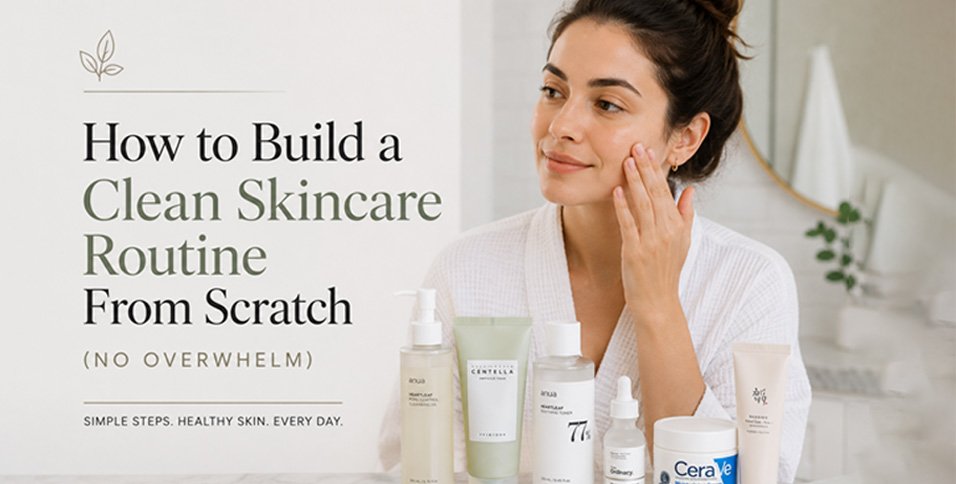
Your shelf shouldn’t be a skincare lab.
You’ve probably seen endless product recommendations and complicated steps online. It feels overwhelming.
But a clean skincare routine doesn’t have to be complicated. The best routines are often the simplest ones.
Healthy skin doesn’t require multiple products. Rather, too many products can do more harm than good.
The real secret is understanding what your skin actually needs. And that starts with just a few basic steps. That’s cleansing, moisturizing, sunscreening. Nothing more. Once you get those right, everything else becomes easier.
- Ready to start fresh? Grab your soap bar with a loofah and give your skin a gentle reset!
Morning vs. Evening Routine At A Glance
| Morning Routine AM | Evening Routine PM |
| Cleanse or just splash with water | Remove makeup first with micellar water if worn |
| Apply vitamin C serum (optional) | Cleanse thoroughly |
| Moisturize | Apply the treatment serum (optional) |
| Sunscreen | Moisturize |
5 Steps To A Clean Skincare Routine From Scratch
Step 1: Figure Out Your Skin Before Buying Anything
Don’t buy products yet.
First, understand what your skin actually needs. Here’s a simple test. Wash your face with a gentle cleanser. Pat it dry. Don’t apply anything else. Wait one hour. Then check how your skin feels.
- Dry skin feels tight, rough, or looks flaky.
- Oily skin looks shiny, especially on the forehead, nose, and chin.
- Combination skin has an oily center zone (or T-zone) but dry or normal cheeks.
- Sensitive skin gets red, itches, or stings easily.
Your skin type can change over time. Hormones. Weather. Stress. Age. All play a role. A routine from 5 years ago may not work today. That’s normal.
Step 2: Wash Your Face the Right Way
Cleansing is essential.
It removes dirt, grease, sweat, dead skin cells, and pollution from your skin. It also washes away old sunscreen and makeup from the day.
- Do this twice daily.
- Use lukewarm water.
- Gently massage the cleanser onto your face for 30-60 seconds.
- Then pat dry with a clean towel.
- Never rub or scrub hard.
A proper cleanse prepares your skin to absorb other products. Skip this step, and it leads to clogged pores and dullness.
Choose a gentle, balanced cleanser. If your skin feels tight or squeaky after washing, the cleanser is too harsh.
| Dry Skin | Oily Skin | Sensitive Skin |
| Creamy formulas | Gel cleansers | Fragrance-free options |
At night, remove heavy makeup first. You can use a wipe-off cleanser or an oil-based product. Then follow with your regular wash. This double method cleans deeply without irritation.
Step 3: Add A Loofah
Use a loofah with your soap bar or body wash for body scrubbing. A lot of soaps come with loofahs inside. You can use those, too.
- Scrub your arms, legs, and back with a loofah once a week.
- Use gentle circular motions. This helps remove dead skin cells and boost blood flow.
- Don’t scrub your face. Keep it soft to avoid irritation.
Step 4: Add a Serum for Extra Help (Optional)
A serum is a thin, concentrated liquid.
Its tiny molecules go deep into your skin. This step is optional. But it’s helpful for specific concerns like dullness or fine lines.
- Apply serum after cleansing while your skin is slightly damp.
- Use only a few drops.
- Gently press it into your face and neck.
- Wait about 1 minute before the next step.
Serums work harder than regular moisturizers because they hold more active ingredients. They target your main concerns directly.
| In the morning | At night |
| Try a serum with vitamin C. This brightens your skin and fights environmental damage. | Use something with bakuchiol or peptides. These help repair and firm your skin. |
Start with just one serum. Give your skin 2 weeks to adjust before adding another. Using too many at once can irritate your skin.
Step 5: Lock in Moisture Every Time
Moisturizer keeps water inside your skin.
The nourishing ingredients of moisturizer hydrate plus support your skin’s protective barrier. This barrier keeps good things in and bad things out.
Such a product can have oils, butter, aloe vera, and glycerin. They are all humectants that do the main job.
- Apply moisturizer to damp skin after your serum.
- Use gentle upward strokes.
- Cover your face and neck.
- Do this both morning and night.
Not only dry skin. Oily skin needs hydration, too. When you skip moisturizer, your skin may produce more oil to make up for the loss. A good moisturizer keeps everything balanced and calm.
| For Dry Skin | For Oily Skin | For Sensitive Skin |
| Richer creams | Lightweight gels | Fragrance-free formulas with ceramides |
Step 6: Smear Lotion/Body Butter Every Day
The skin on your arms, legs, hands, and body also loses moisture.
After you shower or bath, while your skin is still slightly damp, get a lotion or body butter. Damp skin absorbs moisture better than dry skin.
- Apply the product.
- Use gentle, circular motions to massage it for 5-8 minutes.
- Target your limbs, back, stomach, and dry areas like elbows and knees.
| For Dry Skin | For Oily Skin | For Sensitive Skin |
| Body butter | Lotion | Fragrance-free |
Step 7: Use Sunscreen Daily
Sunscreen is the most important step.
Nothing else comes close. Sun damage causes the most visible aging and increases skin cancer risk. So, you must need sunscreen to keep your skin from UV rays.
- Apply sunscreen as the last part of your morning routine.
- Use enough to cover your face and neck fully.
- Do this every single day. Rain or shine. Summer or winter.
Sun damage happens on cloudy days. It goes through windows. No fancy serum can undo what sun protection prevents. This one habit makes the biggest difference of all.
Look for broad-spectrum sunscreen with SPF 30 or higher. Mineral options with zinc oxide are gentler on sensitive skin. Find a lightweight formula that doesn’t leave a white look.
Sunscreen is non-negotiable. If you only do one thing for your skin, let it be this.
Once your skincare basics are locked in, makeup sits so much better too – if smoothing texture is your goal, these best makeup primers for mature skin work beautifully over a well-prepped base.
Keep Nights Simple for Repair
Your night routine has a different job.
While you sleep, your skin repairs itself from the day’s stress. Blood flow increases. Cell turnover speeds up. So, at night,
- Cleanse Thoroughly
This removes sunscreen, pollution, and any leftover makeup.
- Apply Your Treatment Serum
This is optional if you use one. Try ones with hyaluronic acid, niacinamide, or peptides.
- Finish With Moisturizer
This will keep your skin hydrated and nourished.
That’s all you need.
Your daytime moisturizer works fine at night, too. No need to buy something separate unless you want to.
Note: If you do want a night cream, look for niacinamide to strengthen your barrier or peptides for firming.
Never use sunscreen at night. Your skin doesn’t need UV protection while sleeping. Let it breathe and focus on renewal instead.
This simple evening skincare routine can support your skin’s natural repair window perfectly.
Go Slow With New Products
Starting a new routine feels exciting.
But layering too many new products at once can overwhelm your skin.
- Add one new product every 2 weeks.
- Use it consistently before adding another.
If a reaction happens, you’ll know exactly which product caused it.
This approach saves you trouble. Adding five products at once makes it impossible to tell what’s working and what’s hurting.
Your skin needs time to adjust. Patience prevents irritation and wasted money. Curious what consistent skincare actually looks like over time? This retinol before and after breakdown shows exactly why patience pays off.
Start With The Basics
- Cleanser
- Moisturizer
- Sunscreen
Master these for 2 to 4 weeks. Then consider adding a serum. Later, try gentle exfoliation once or twice weekly if needed.
Expect to wait 6 to 8 weeks to see real changes. That’s one full skin cycle. Hydration in your skin improves in days. But texture and tone can take longer. You just have to be consistent.
FAQs
What is the 4-2-4 rule in skincare?
The 4-2-4 rule is a cleansing method. 4 minutes with oil-based cleanser, 2 minutes with foam, then cold rinsing for 4 minutes. It deeply removes makeup, sunscreen, and buildup without over-drying your skin.
Which two serums cannot be used together?
Avoid mixing vitamin C with benzoyl peroxide. This oxidizes and reduces effectiveness. Also, be careful pairing retinol with strong acids like AHAs or BHAs, which can irritate your skin.
What is Gen Z looking for in skincare?
Gen Z looks for simple, transparent skincare with clean ingredients, affordable prices, and real results. They prefer minimal routines, skin barrier support, and brands that are honest, inclusive, and eco-conscious.
What is the Korean 7 skin method?
The Korean 7 skin method involves applying toner in 7 light layers, patting each layer before the next. It delivers deep, bouncy hydration without heavy creams.