Accenture CEO Julie Sweet stands as one of the most powerful leaders in modern business by managing a global team of over 770,000 employees across 120 countries. She took the top role at Accenture in 2019 and became Chair of the Board in 2021. Under her leadership, the firm grew its annual revenues to $69.67 billion in 2025. Moreover, Julie Sweet also guides major corporations through cloud migration, modern artificial intelligence, and digital operations.
If you are interested in knowing more about her background as a corporate lawyer, her career timeline, her management style, and the key reasons Accenture CEO Julie Sweet ranks among top women CEOs globally, keep reading!
Accenture CEO Julie Sweet at a Glance
Julie Sweet built a broad career spanning top-tier corporate law and global tech management. The table below outlines her career and personal background.
| Category | Details |
| Full Name | Julie Terese Sweet |
| Current Position | Chair and Chief Executive Officer (CEO) |
| Company | Accenture plc |
| Nationality | American |
| Education | B.A. from Claremont McKenna College; J.D. from Columbia Law School |
| Years at Accenture | Joined in 2010 (16 years) |
| Became CEO | September 1, 2019 |
| Became Chair | September 1, 2021 |
| Known For | Corporate governance, workforce reskilling, AI implementation, cloud adoption |
Julie Sweet’s Early Life and Education
Julie Sweet grew up in a supportive family environment in Southern California. Her father worked as a paint contractor, and her mother was a homemaker. She actively participated in high school speech and debate competitions, winning a national championship in high school speech. This early background taught her how to present complex arguments clearly, build confidence under pressure, and speak to large groups.
Later, Julie Sweet earned her Bachelor of Arts degree from Claremont McKenna College in 1989. She later attended Columbia Law School, earning her Juris Doctor degree in 1992. Her legal education gave her sharp analytical skills, a deep understanding of corporate law, and the ability to evaluate risk for large corporations. These skills served as a strong base for her later shift into business management.
Julie Sweet’s Early Career Before Accenture
Before joining Accenture, Julie Sweet spent 17 years practicing law at Cravath, Swaine & Moore LLP, one of the most prestigious law firms in the United States. She specialized in corporate finance, mergers and acquisitions, and general corporate governance.
1. Starting as a Lawyer
She began her career as an associate at Cravath in 1992. Her daily work involved corporate financing, joint ventures, and complex deal structures for large public companies.
2. Joining Cravath, Swaine & Moore
Between 1992 and 2010, her work at Cravath placed her in the middle of major corporate boardroom discussions. She represented major clients on Wall Street, helping companies execute complex financial transactions and navigate international corporate laws.
3. Becoming a Partner
In 1998, she became a partner at Cravath, Swaine & Moore. She was one of only a few women partners at the firm during that era, proving her skills in corporate dealmaking and finance.
4. Major Corporate Clients
During her decade as a partner from 1998 to 2010, she represented high-profile global clients in technology, retail, and financial services. She helped companies handle public offerings, cross-border acquisitions, and regulatory compliance.
5. Transition from Law to Business Leadership
In 2010, Accenture recruited her to serve as its General Counsel. This move brought her legal background directly into technology consulting. Over the next decade, her role expanded from risk management to sales, operational growth, and overall business strategy.
Julie Sweet’s Career Timeline
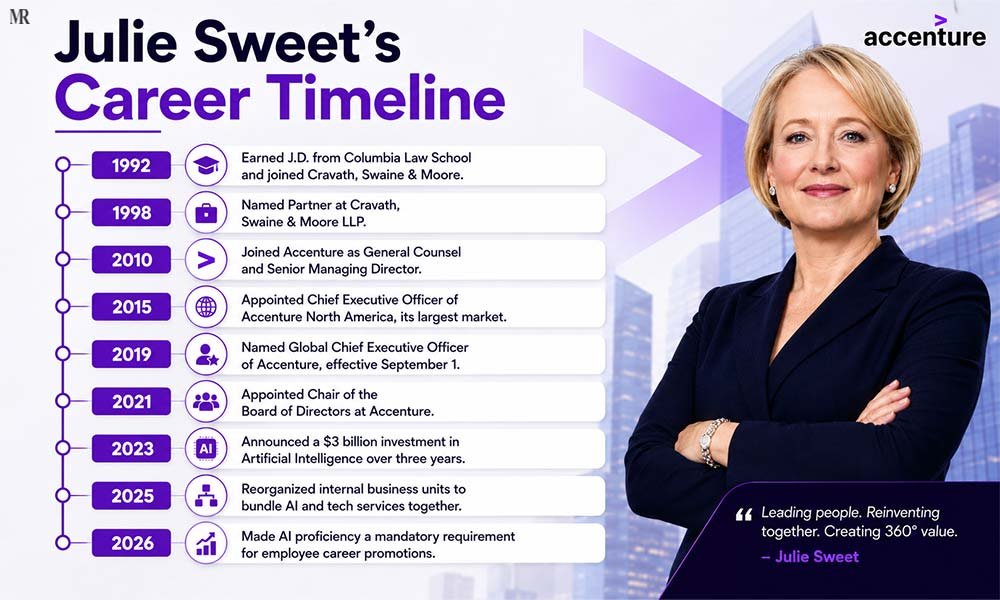
Julie Sweet moved quickly through legal and corporate ranks over three decades. Julie Sweet became Chief Executive Officer of Accenture on September 1, 2019. She previously served as CEO of Accenture’s North America business starting in 2015 and added the role of Chair of the Board of Directors on September 1, 2021.
How Julie Sweet Transformed Accenture
Julie Sweet shifted Accenture from traditional business consulting toward advanced tech services, cloud software, and generative artificial intelligence. She pushed the firm to adapt quickly to changing corporate needs.
1. Leading Accenture’s AI Strategy
Under her guidance, Accenture committed $3 billion to artificial intelligence development. The firm doubled its AI workforce to 80,000 specialists and created dedicated learning pathways for all workers. She shifted the company’s focus from basic testing to deployment of commercial AI models for global enterprise clients. Moreover, in 2026, Accenture formed high-impact industry partnerships, including joining OpenAI’s Frontier Alliances with consulting firms to accelerate enterprise-scale AI agent deployment.
2. Updating the Business Operations
Julie Sweet restructured Accenture’s internal organization to remove operational siloes. In a video message to staff, she outlined a streamlined business model that combines data analytics, cloud services, and functional expertise into unified client teams. This approach helped clients modernize their work systems faster.
3. Leadership During Industry Change
During periods of rapid tech changes, she prioritized responsible technology practices and continuous skills updates. She mandated that Accenture’s top executives complete intensive AI training programs. This step ensured that corporate leaders understood both the risks and the capabilities of emerging tools before advising clients.
Why Julie Sweet Is One of Business’s Most Influential Women
Accenture CEO Julie Sweet earns global recognition because she controls major corporate technology investments and sets industry standards for global enterprise modernization.
1. Breaking Barriers
She is the first woman CEO in Accenture’s history and the first leader of the firm who did not start there immediately after college. Her rise to the top position in a major global technology consultancy paved the way for more female executives in technology services.
2. Consistent Recognition
Julie Sweet’s achievements have earned her rankings across major global media platforms.
| Award / List | Organization | Year(s) |
| Most Powerful Women in Business | Fortune | 2016 – Present |
| World’s 100 Most Powerful Women | Forbes | 2019 – Present |
| TIME 100 Most Influential People | TIME | 2024 |
| Top Global CEO Rankings | Harvard Business Review / Financial Times | Multiple Years |
| Corporate Leadership Award | Various Global Business Associations | 2020 – 2025 |
3. Leadership Philosophy
Julie Sweet’s business philosophy focuses on lifelong learning, clear executive communication, and diversity in the workplace. She believes that continuous training builds strong organizations. She encourages companies to rewrite their operating models rather than adding new tools on top of old work habits.
Julie Sweet’s Leadership Style and Management Philosophy
Julie Sweet practices a direct, transparent management style based on workforce skill building and customer outcomes. She uses data to make decisions while keeping clear lines of communication with employees.
1. Employee-First Approach
She places strong focus on workforce training and career growth. Accenture spends hundreds of millions of dollars each year to re-skill employees in cloud computing, cybersecurity, and data analysis.
2. AI Adoption Across the Workforce
She treats artificial intelligence as an operational necessity rather than a side project. She introduced internal certification programs where employees earn credentials by showing practical AI skills in daily client assignments.
3. Innovation Focus
Her operational strategy centers on client-focused innovation. She shifted Accenture away from basic legal or IT advice toward practical tech delivery, helping clients lower operating costs and build modern software.
4. Customer-Centric Decision-Making
She works directly with Fortune 500 CEOs to solve operational problems. By focusing on measurable business outcomes, her management approach keeps Accenture closely tied to client revenue growth.
5. Diversity and Inclusion
She actively promotes diverse hiring practices across Accenture. Under her management, the firm moved toward equal gender representation across its global workforce and expanded tech job opportunities in underserved communities.
6. Future-Ready Leadership
She plans business growth several years in advance. By identifying cloud computing and AI trends early, she moved Accenture into new service areas before traditional consulting competitors.
Board Memberships and Industry Roles
Julie Sweet holds leadership positions across prominent business groups and global policy organizations.
- World Economic Forum: Serves on the Board of Trustees, discussing global economic trends, job creation, and international technology policy.
- Business Roundtable: Active board member working on policies that affect business growth, workforce education, and international trade.
- Welcome.US: Co-chairs this non-profit initiative to help resettle refugees and connect them with employment opportunities.
- Center for Strategic & International Studies (CSIS): Serves as a trustee, offering guidance on international technology risks and global security.
Latest News About Julie Sweet
In 2026, Julie Sweet introduced strict new workforce standards at Accenture by making AI proficiency a mandatory requirement for employee promotions.
Speaking on the Rapid Response podcast, she stated: “Today, AI at Accenture is how we do work. So if you want to get promoted, you’ve got to do the things that we do in order to operate at Accenture.”
According to official company statements, over 500,000 Accenture employees completed basic AI training courses by early 2026.
At the India AI Impact Summit 2026 in New Delhi, she joined Prime Minister Narendra Modi and other tech leaders to highlight inclusive AI deployment. She noted that Accenture employs over 350,000 staff in India, calling them key contributors to global tech modernization. She also stressed the need for small and medium-sized enterprises to access AI tools to support steady economic growth.
Key Leadership Lessons from Julie Sweet
Readers and business managers can apply several practical lessons from Julie Sweet’s career:
- Embrace Change Early: Adopt new technologies before market forces compel you to react.
- Invest in Skill Building: Technology tools deliver value only when employees possess the skills to operate them effectively.
- Communicate Directly: Use direct messaging, including video updates, to explain major operational changes to employees.
- Link Career Growth to New Tools: Set clear expectations for staff to master modern software to advance within the company.
- Maintain Broad Diversity: Build diverse teams to improve problem-solving and create resilient organizations.
Looking Ahead: The Legacy of Julie Sweet
Accenture CEO Julie Sweet continues to reshape tech consulting through direct leadership, clear strategic investments, and mandatory skill standards. Her personal journey from a corporate lawyer at Cravath to the head of a major global enterprise provides a model for modern business leadership. By tying employee career advancement to technology skills and rebuilding operating models around artificial intelligence, she maintains Accenture’s position as a premier global consulting firm.
Maria Isabel Rodrigues
FAQs
- How did Julie Sweet become CEO of Accenture?
Julie Sweet joined Accenture as General Counsel in 2010 after spending 17 years as a partner at Cravath, Swaine & Moore LLP. She transitioned into business operations by taking charge of Accenture North America in 2015, where she grew revenue in the firm’s largest geographic market. Her strong operational results led the Board of Directors to select her as global CEO in 2019.
- How much does Julie Sweet make at Accenture?
Accenture CEO Julie Sweet receives an annual base salary of $1.55 million. According to official corporate proxy filings, her total annual compensation ranges between $22 million and $31 million, depending on performance incentives, equity grants, and stock options tied to company growth metrics. The estimated Julie Sweet net worth stands at approximately $75 million.
- What are the main points of the Julie Sweet AI strategy?
The Julie Sweet AI strategy focuses on integrating artificial intelligence into all core business services, retraining hundreds of thousands of staff members, and making AI usage a key factor in internal employee promotions.