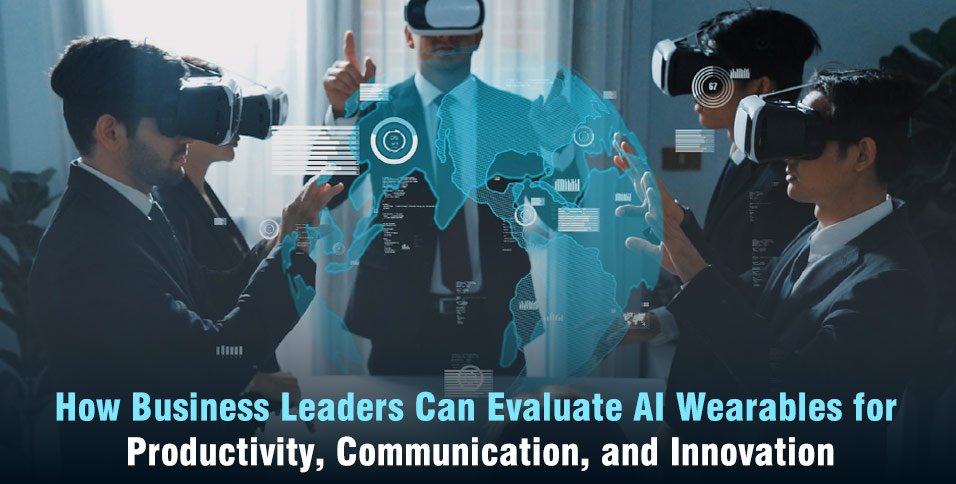
AI wearables are moving from consumer experiments into serious business discussions. Smart glasses, connected headsets, intelligent earbuds, watches, and other wearable devices can now capture information, respond to voice commands, support remote collaboration, and provide guidance during physical tasks.
Their potential is easy to understand. Employees can access information without stopping to open a laptop or phone. Field teams can show remote specialists what they see. New workers can receive instructions while completing a task. Managers can gain a clearer picture of where operational delays occur.
However, the presence of artificial intelligence does not automatically make a wearable valuable. Business leaders need to evaluate whether the technology solves a specific problem, fits existing systems, protects sensitive information, and earns the trust of employees.
The right question is not whether AI wearables are innovative. It is whether they improve the way people work enough to justify the cost and complexity of introducing them.
Begin With the Work, Not the Device
Technology evaluations often begin with a product demonstration. This can be misleading because demonstrations are designed to show the most impressive features under controlled conditions.
A better starting point is the workflow.
Leaders should identify where employees lose time, where communication breaks down, and which tasks require people to repeatedly stop what they are doing. They should also look for situations where workers need information but cannot easily use a phone, tablet, or computer.
A maintenance technician may need equipment instructions while holding tools. A warehouse employee may need to confirm a product location while moving stock. A healthcare worker may need hands free access to a checklist. A field inspector may need to record evidence while wearing protective equipment.
These are clearer business cases than a general goal such as improving productivity through wearable AI.
Once the problem is defined, leaders can determine whether a wearable is the best solution or whether a simpler change to software, training, or process design would achieve the same result.
Evaluate Productivity at the Task Level
Productivity claims should be connected to measurable tasks.
A wearable may save time by allowing employees to retrieve information through voice commands. It may reduce the need to walk back to a workstation, search through documents, or call a supervisor. It may also help workers capture notes and photographs before important details are forgotten.
These benefits can appear small during a single task. Across hundreds of employees and thousands of repeated actions, they may become meaningful.
Leaders should still avoid assuming that faster access always creates better performance. A device can introduce new delays if its voice recognition performs poorly, its battery runs out during a shift, or employees must repeat information in another system later.
Useful productivity measures may include task completion time, error frequency, repeat visits, time spent searching for information, and the number of issues resolved without escalation.
The purpose of a pilot should be to test these outcomes in normal working conditions rather than proving that the technology functions.
Consider How Wearables Change Communication
AI wearables can improve communication when teams are distributed across offices, stores, factories, construction sites, and customer locations.
A first person camera view allows a remote expert to see a problem from the worker’s perspective. This can be more useful than a phone call because the employee does not need to describe every detail verbally. It can also be more practical than holding a smartphone while inspecting equipment or performing a repair.
Voice based notes can help employees document observations while they are still at the site. Translation and transcription features may support communication between colleagues, customers, and partners who speak different languages.
However, communication can become worse when the technology creates too much information. Constant notifications, unclear transcripts, unnecessary recordings, and poorly organized media can increase noise rather than improve collaboration.
The organization needs rules for what should be recorded, where information should be stored, and how important observations move into official systems. A video call that solves a problem is useful. A collection of unlabelled recordings that no one reviews is not.
Separate Consumer Appeal From Business Suitability
Consumer wearables are making smart glasses and voice controlled devices more familiar. Products such as Ray-Ban AI glasses show how cameras, microphones, audio, and AI assistance can be placed inside frames that look closer to ordinary eyewear.
This familiarity may help employees feel more comfortable with wearable technology, but consumer appeal should not determine an enterprise purchase.
Business environments may require stronger durability, longer battery life, protective certification, secure account controls, device management, and compatibility with specialist software. A device that works well for personal photography or navigation may not be suitable for a factory, hospital, warehouse, or construction site.
Leaders should assess the complete operating environment. This includes lighting, noise, connectivity, protective clothing, temperature, dust, moisture, and the length of a normal shift.
Comfort also matters. A wearable that causes pressure, heat, distraction, or fatigue will not deliver value simply because its software is advanced.
Examine Integration Before Buying at Scale
A wearable becomes much more useful when it connects with the systems employees already use.
For example, an inspection image should be attached to the correct asset record. A voice note should enter the relevant work order. A product lookup should use current inventory data. A training instruction should reflect the latest approved process.
Without integration, workers may need to manually transfer information between the wearable and another platform. This creates duplicate work and increases the chance of errors.
Business leaders should ask vendors how the device connects with identity systems, cloud storage, communication tools, customer platforms, inventory software, and operational databases. They should also understand whether integration depends on custom development or standard interfaces.
The organization should consider what happens if it later changes vendors. Data should remain accessible, and essential workflows should not depend on a closed platform that is difficult to replace.
Calculate the Full Cost of Adoption
The purchase price is only one part of the investment.
A wearable program may also require software licences, integration work, mobile connectivity, accessories, replacement units, training, support, and security management. Devices may need to be shared across shifts, cleaned between users, repaired, or replaced more frequently than office computers.
Managers must also account for implementation time. Employees may initially work more slowly while learning the device. Supervisors may need to update processes and review new forms of data. Technology teams may need to manage another group of connected endpoints.
A realistic business case should compare these costs with the value of fewer errors, faster task completion, reduced travel, improved training, or stronger customer service.
Some benefits will be difficult to express in immediate financial terms. Faster access to an expert may prevent a serious mistake. Better documentation may make an audit easier. Hands free instructions may reduce confusion during a complicated task.
These outcomes still need to be defined clearly enough to support a responsible investment decision.
Treat Privacy and Security as Design Requirements
AI wearables can collect information that ordinary workplace tools do not. Cameras may capture employees, customers, confidential documents, computer screens, or private property. Microphones may record conversations that were never intended to leave the room.
Leaders should understand exactly what data is collected, where it is processed, how long it is retained, and who can access it.
The organization should also determine whether AI requests are processed on the device or sent to an external service. Sensitive images and spoken questions should not enter consumer accounts or personal storage systems without approval.
Strong access controls, secure authentication, software updates, encryption, and remote device management are basic requirements. Lost or stolen devices should be removable from company accounts, and stored information should be erasable when necessary.
Bystander privacy deserves equal attention. Employees and customers should be able to tell when recording is taking place. Wearables may need to be prohibited in changing areas, private meetings, healthcare spaces, or locations containing confidential information.
Clear policies protect the organization, but they also protect employees from uncertainty about what the devices are monitoring.
Involve Employees Before the Pilot
Wearable projects can fail when employees feel that the technology has been imposed on them.
A device designed to improve productivity may be interpreted as a surveillance tool if workers do not understand what information management can see. Employees may also notice practical problems that decision makers miss, such as discomfort, unreliable controls, or instructions that appear at unsafe moments.
Leaders should involve the people who will use the devices when selecting use cases and testing products. Their feedback can reveal whether the technology actually supports the work.
Training should explain more than how to operate the device. Employees need to understand when it should be used, when it should be removed, what information may be captured, and how to report errors or security concerns.
Participation also improves acceptance. Workers are more likely to support a system when they can see that it removes frustrating tasks instead of measuring every movement.
Run a Focused Pilot With Clear Measures
An effective pilot should be narrow enough to evaluate properly.
Instead of giving wearables to an entire department, an organization might test one process with a small group. The selected task should occur often enough to produce useful data and have a clear result that can be compared with the existing method.
Leaders should record performance before the pilot begins. Otherwise, it becomes difficult to prove whether the wearable created an improvement.
The evaluation should include productivity, accuracy, reliability, employee experience, security, and customer reaction where relevant. It should also identify problems that would become more serious at a larger scale.
A successful pilot does not mean the device worked during a demonstration. It means employees used it consistently, the workflow improved, and the organization can support the technology responsibly.
Use Wearables to Strengthen Human Capability
The strongest case for AI wearables is not replacing employees. It is giving people better access to information while they are doing the work.
A new employee can receive guidance without waiting for a trainer. A field technician can consult an expert without leaving the site. A manager can receive more accurate information because observations were recorded at the moment they occurred.
These benefits depend on thoughtful implementation. Wearables that create distraction, mistrust, duplicate work, or security problems will quickly lose support.
Business leaders should therefore evaluate AI wearables as part of a wider operating system that includes people, processes, data, and governance. The device is only one component.
Organizations that begin with a genuine problem, test measurable outcomes, and involve employees are more likely to find useful applications. Those that purchase wearables mainly to appear innovative may discover that impressive hardware does not automatically produce meaningful change.
AI wearables can become valuable tools for productivity, communication, and innovation. Their success will depend on whether leaders introduce them with the same discipline they would apply to any important business investment.