Mirror Review
July 1, 2026
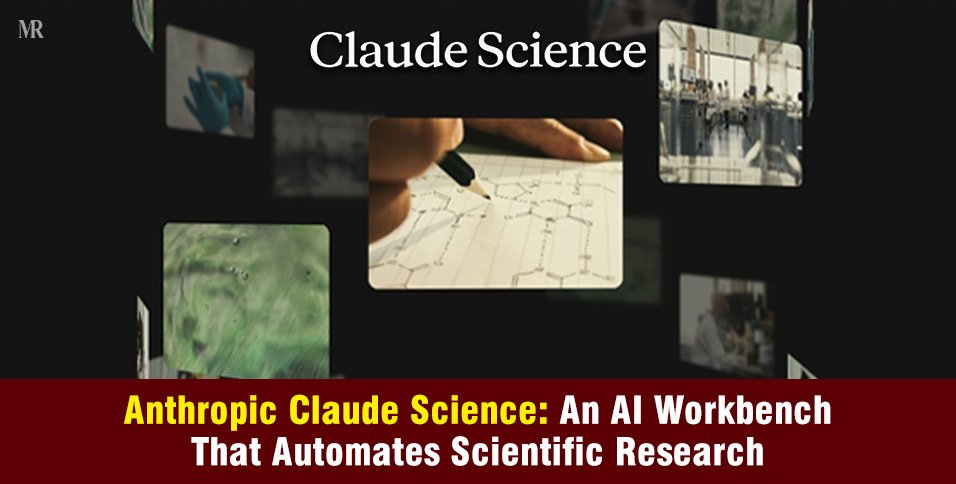
Anthropic launches Claude Science, an innovative AI workbench for scientists designed to automate and accelerate complex scientific research. This specialized application integrates the fragmented tools, databases, and computing resources that researchers use daily into a single, unified environment. By bringing together multi-step analysis, automated computation management, and rigorous built-in fact-checking, the Anthropic Claude Science AI workbench transforms how laboratory and data-driven discoveries are made.
What is the Anthropic Claude Science AI Workbench?
The newly released Claude Science platform is not a brand-new underlying AI model; rather, it is a highly specialized “harness” built around Anthropic’s existing flagship models. The launch further expands the company’s growing portfolio of AI products for enterprise and specialized use cases.
In artificial intelligence, a harness is the structural scaffolding that connects a general-purpose model to external data, code execution capabilities, memory, and validation checks.
While a standard AI model can reason conceptually about biological structures, this AI workbench for scientists can actively fetch data from public repositories, run complex pipelines on high-performance computing (HPC) clusters, render the final 3D outputs, and maintain an immutable log of the entire process.
Core Features and Technical Architecture of Anthropic Claude Science
Claude Science simplifies the traditional research workflow by eliminating the need to constantly switch between separate tools like PubMed, Jupyter Notebooks, R, and terminal clusters.
The architecture relies on three primary pillars:
- Multi-Agent Orchestration: Users interact with a generalist coordinating agent that can spin up specialized sub-agents and access over 60 preconfigured connectors to scientific databases such as UniProt, PDB, and Ensembl.
- Automated Compute Scaling: The system drafts computational plans, handles authentication, and submits large-scale data jobs to external infrastructure, such as a lab’s local HPC cluster via SSH or a cloud-based Modal account, scaling seamlessly from a single GPU to hundreds of GPUs.
- Autonomous Review: A dedicated reviewer agent runs in the background, utilizing actor-critic pairs to inspect data outputs, catch calculation errors, flag incorrect citations, and self-correct code execution on the fly.
Powered by NVIDIA BioNeMo
A major technical highlight of the Anthropic Claude Science platform is its native integration with the NVIDIA BioNeMo Agent Toolkit.
This collaboration injects massive GPU-accelerated computing power directly into the conversational interface, letting agents execute advanced molecular and genomic workflows at unprecedented speeds.
| Tool / Model | Scientific Domain | Core Capability & Performance Boost |
| NVIDIA Parabricks | Genomics | Accelerates genomic analysis from hours to mere minutes. |
| RAPIDS-singlecell | Single-Cell Biology | Compresses a 1.3-million-cell clustering workflow from 52 minutes to 25 seconds. |
| nvMolKit | Cheminformatics | Speeds up similarity searches and conformer generation by up to 3,000x. |
| Boltz-2 & OpenFold3 | Structural Biology | Delivers state-of-the-art biomolecular and protein structure prediction. |
Real-World Impact and Case Studies
Early beta testers across prominent research institutes report dramatic reductions in the time required to complete exhaustive data synthesis and experimental design.
1. Streamlining Long-Form Literature Reviews
Jérôme Lecoq, a neuroscientist at the Allen Institute, used the workbench to construct a multi-agent template containing 20 custom skills. The system read through thousands of papers, extracted core quantitative findings, built a cohesive narrative arc, and generated cross-study figures.
“Before Claude Science, it could take my team as many as two years to write such a review,” Lecoq noted, adding that he now has roughly 10 comprehensive reviews completed with fully verified citations.
2. Accelerating Glioma Research
At the UCSF Brain Tumor Center, Associate Professor Stephen Francis utilized the tool to study the molecular epidemiology of glioma. The system independently discovered a laboratory virus contaminant in bulk RNA-seq data that had stalled the lab’s progress for nearly a year. Francis confirmed that the application accelerated the comprehensive germline
workups, executing complex analyses in roughly one-tenth of the time it previously took.
Shifting From Data Collection to Scientific Judgment
A major advantage highlighted by early adopters is the platform’s ability to maintain a complete history of its workflows.
Every figure, plot, and manuscript created is permanently welded to the precise code, environment variables, and conversation that generated it.
Researchers can modify visual assets using plain natural language, such as asking the AI to remove gridlines or shift an axis to a log scale, and the workbench automatically rewrites its own underlying code.
This complete transparency guarantees absolute reproducibility, allowing external teams to validate or fork an analysis thread at any point without losing context.
By automating the tedious data pipeline engineering that traditionally consumes weeks of lab time, the platform allows human researchers to pivot away from manual data wrangling and focus their energy entirely on scientific judgment, validation, and conceptual novelty.
Availability and the “AI for Science” Initiative
Anthropic has launched the system in a public beta available on macOS and Linux for users on Claude Pro, Max, Team, and Enterprise plans. To encourage academic adoption, Anthropic is offering a discounted Team plan specifically for active scientific labs at universities and non-profit research organizations.
Furthermore, the company announced the AI for Science project initiative, promising up to $30,000 in Anthropic credits for up to 50 select research projects. Modal is supporting this launch by providing an additional $2,000 in compute credits for chosen proposals.
While the initial launch features heavy optimizations for biology and chemistry, the general-purpose engine is designed to expand into field sciences, environmental modeling, and epidemiology as the scientific community develops new connectors.
As these agentic workflows continue to mature, the Anthropic Claude Science platform stands out as a foundational tool that compresses the historical timeline between forming a hypothesis and validating a discovery.
Maria Isabel Rodrigues