Introduction
The industrial material handling landscape has undergone a dramatic transformation over the past decade. What was once entirely dependent on skilled operators and manual coordination has evolved into a sophisticated ecosystem of intelligent machines and automated systems. Modern crane technology represents one of the most significant leaps in industrial productivity, safety, and efficiency.
From the moment an operator presses a button on a wireless remote control to the precise positioning of a load using anti-swing algorithms, every aspect of contemporary crane systems reflects decades of technological innovation. This shift from manual to autonomous operation is reshaping industries worldwide—particularly in ports, manufacturing facilities, and logistics hubs.
The Foundation: Remote Control Technology
How Wireless Remote Controls Changed Crane Operations
Traditional overhead and gantry cranes relied on fixed pendant controls tethered to the operator by cable. This limitation restricted operator visibility and movement, creating safety challenges and operational bottlenecks.
Modern wireless remote control systems have eliminated these constraints entirely. Contemporary remote controls operate on industrial-grade frequencies, offering:
- Extended operational range (typically 100-300+ meters depending on the environment)
- Real-time feedback through LCD displays showing load weight, hook height, and system status
- Ergonomic design reducing operator fatigue during long shifts
- Safety interlocks preventing dangerous operations through redundant safety protocols
- Weather resistance enabling outdoor port and dock operations
The transition to wireless control wasn’t merely about convenience—it fundamentally changed how cranes could be positioned and operated. Operators can now move freely around the work area, maintaining optimal visibility from multiple angles while controlling complex movements with precision.
Safety Integration in Remote Systems
Modern wireless remote controls integrate advanced safety features:
- Two-hand control options requiring simultaneous button presses for certain movements
- Dead-man switch functionality that instantly stops operations if the remote is dropped
- Encrypted communication protocols preventing unauthorized access or signal jamming
- Multi-frequency capability allowing multiple cranes to operate simultaneously without interference
- Low-battery warnings ensuring operators are aware of remote status
Variable Frequency Drives: The Brain Behind Smooth Operations
Understanding VFD Technology in Crane Systems
Variable Frequency Drives (VFDs) represent perhaps the most transformative technology in crane system modernization. These sophisticated power management systems replaced traditional fixed-speed motors with intelligent, electronically controlled drives.
What is a VFD?
A VFD is an electronic control system that adjusts the frequency and voltage supplied to electric motors, allowing precise speed control. In crane applications, this translates to:
- Smooth acceleration and deceleration eliminating the mechanical shock of traditional motors
- Energy efficiency reducing power consumption by 20-50% compared to older systems
- Load-responsive operation automatically adjusting motor speed based on actual load requirements
- Regenerative braking capturing energy during lowering operations
The Operational Impact of VFD Technology
The implementation of VFDs in crane systems has delivered measurable improvements:
Reduced Load Swing: By gradually ramping up motor speed rather than applying full power instantaneously, VFDs minimize the inertial forces that cause loads to swing. This gentle acceleration is particularly crucial when handling delicate or expensive cargo.
Energy Conservation: Modern ports that have upgraded to VFD-equipped cranes report electricity consumption reductions of 30-40% compared to fixed-speed systems, translating to significant operational cost savings over multiple years.
Extended Equipment Lifespan: The gentler mechanical treatment of motors, gearboxes, and structural components reduces wear and extends maintenance intervals, lowering total cost of ownership.
Environmental Benefits: Reduced energy consumption directly correlates with lower carbon emissions, supporting sustainability goals that increasingly matter to port operators and industrial facilities.
VFD Integration with Smart Monitoring
Modern VFDs communicate with centralized control systems, providing:
- Real-time energy consumption data
- Predictive maintenance alerts
- Performance analytics for operational optimization
- Remote diagnostics capabilities
Anti-Swing Technology: The Precision Revolution
The Physics Behind Load Swing
One of the most persistent challenges in crane operations is load swing—the pendulum motion that occurs when a load is accelerated or decelerated. This phenomenon creates several problems:
- Safety risks from swinging loads in congested areas
- Operational inefficiency as operators must wait for swings to stabilize before positioning
- Cargo damage from impacts during uncontrolled swinging
- Structural stress on crane components from dynamic loads
Modern Anti-Swing Solutions
Contemporary crane systems employ multiple technologies to minimize or eliminate load swing:
Active Feedback Systems: Utilizing accelerometers and load cells, these systems continuously measure swing angles and automatically adjust motor speed to counteract pendulum motion. Advanced algorithms predict and prevent swing before it occurs.
Automated Spreader Bar Technology: Specially designed lifting attachments incorporate hydraulic damping that absorbs and dissipates the energy that would otherwise cause swinging.
Path Planning Algorithms: AI-driven systems calculate optimal motion profiles that inherently minimize swing characteristics. Rather than fighting swing after it occurs, these systems prevent it from developing in the first place.
Oscillation Damping Controls: Real-time monitoring of load movement with instantaneous brake applications suppress minor swings before they amplify.
Automation in Port Operations: The Straddle Carrier Revolution
The Critical Role of Straddle Carriers in Modern Ports
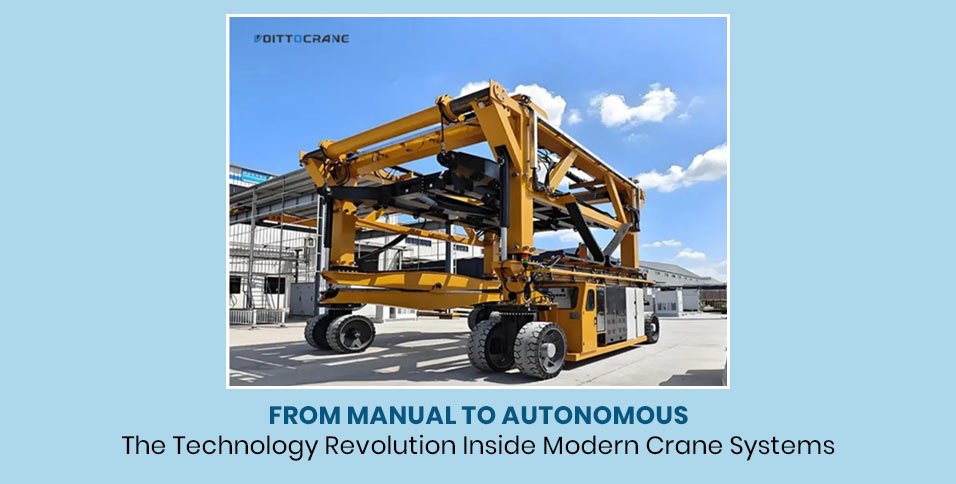
While overhead and gantry cranes handle vertical loading and unloading, the horizontal movement of containers within port facilities demands equally sophisticated automation. This is where straddle carriers—specialized wheeled vehicles designed to lift and transport containers—have become indispensable.
Modern straddle carriers represent the bridge between traditional port operations and fully automated container terminals. These vehicles combine:
- Autonomous navigation systems for precise positioning
- Computer vision for container identification and alignment
- Load detection sensors for safety and operational confirmation
- Wireless communication with port management systems
How Straddle Carriers Enable Port Automation
Container Movement Efficiency: A single straddle carrier can move multiple containers per hour, with automation reducing the time for positioning and load securing. Modern systems achieve positioning accuracy within centimeters.
Workforce Safety: Autonomous and semi-autonomous straddle carrier systems minimize human workers in high-risk areas beneath suspended loads or in congested port zones.
Real-time Inventory Tracking: Integrated with port management software, straddle carriers provide live location data on every container, enabling precise logistics planning.
Integration with Terminal Automation: For port operators implementing automated container terminal systems, modern straddle carriers equipped with variable frequency drives and remote control systems serve as the critical link between automated ship-to-shore cranes and container storage areas.
Operational Scalability: As ports expand or contract operations, automated straddle carriers can be quickly redeployed without requiring additional permanent infrastructure.
High-quality straddle carrier systems specifically engineered for demanding port environments—such as those incorporating VFD technology and advanced anti-swing capabilities—can dramatically improve terminal throughput. Operators seeking to upgrade their port automation infrastructure benefit from selecting straddle carriers designed for integration with modern crane systems and port management software. Solutions like modern straddle carrier technology provide the reliability and automation capabilities required for 24/7 port operations.
Industry Case Studies: Transformation in Action
Large Container Terminals
Major ports in Shanghai, Rotterdam, and Los Angeles have each invested heavily in modernizing crane systems. The results consistently show:
- 25-35% improvement in container handling throughput
- 40-45% reduction in operational energy costs
- Significant safety metric improvements with fewer load-related incidents
- Faster vessel turnaround times reducing overall logistics costs
Manufacturing Environments
Heavy manufacturing facilities that adopted VFD-equipped overhead cranes and anti-swing technology reported:
- 50% reduction in product damage from load swing
- 30% faster material handling cycles
- Improved worker safety with reduced swing-related incidents
- Better ergonomics from wireless remote controls reducing operator strain
The Path Forward: Emerging Technologies
IoT and Predictive Maintenance
The next frontier involves integrating crane systems with Industrial IoT platforms that collect data from thousands of sensor points, enabling:
- Predictive failure analysis
- Optimized maintenance scheduling
- Energy consumption trend analysis
- Fleet-wide performance benchmarking
Artificial Intelligence and Machine Learning
AI systems are beginning to optimize crane operations in real-time:
- Predicting the most efficient movement paths
- Adjusting acceleration profiles to minimize swing in complex scenarios
- Autonomous load identification and handling
- Dynamic workflow optimization in multi-crane facilities
5G Connectivity
Ultra-low latency 5G networks will enable:
- Real-time remote operation from distant locations
- Improved wireless control reliability in congested RF environments
- Integration of unmanned aerial vehicles for inspection
- Enhanced automation capabilities for port-wide systems
Key Takeaways
The transition from manual to autonomous crane systems represents a fundamental shift in industrial operations. Modern technologies including wireless remote controls, variable frequency drives, and anti-swing systems have collectively created equipment that is:
- Safer through reduced manual intervention and intelligent safety systems
- More efficient through optimized power usage and enhanced throughput
- More reliable with extended equipment life and predictive maintenance
- More sustainable via reduced energy consumption and carbon footprint
- More productive enabling higher throughput in the same physical space
For facility managers and port operators, the business case for upgrading to modern crane systems is compelling. The combination of improved safety, operational efficiency, and reduced costs typically delivers return on investment within 3-5 years, with benefits extending throughout the equipment’s operational life.
As industrial operations continue their march toward greater automation, the crane systems serving these facilities must evolve accordingly. The technologies driving this evolution—remote control systems, variable frequency drives, and anti-swing capabilities—are no longer cutting-edge innovations but industry standards. Facilities that have not yet upgraded to these modern systems are likely falling behind in operational efficiency and cost competitiveness.